Extended Realities (VR/AR/MR): Glossar

With every new project that involves XR in some way, designers face the problem that the terminology of this new branch has not yet fully manifested itself. A common vocabulary for these technologies is therefore of utmost importance to keep communication within the team clear and direct. For this reason, we would also like to share our XR compendium with you.

Basics

Augmented Reality

Projection of virtual objects onto the real world in real time. Compatible with modern smartphones or AR headsets like Microsoft Hololens.

Augmented Virtuality

Projection of real objects onto a virtual world. Requires VR-compatible headsets such as HTC Vive or Oculus Rift.

Virtual Reality

Simulation and display of virtual objects in stereoscopic images. Creates spatial effect by recording the user’s eyes separately.

Mixed Reality

Umbrella term for all technologies that are located between the unadulterated, real world and completely virtual reality (e.g. augmented reality or augmented virtuality).

Reality-Virtuality Continuum

The reality-virtuality continuum shows the different stages in the transition from real space to a completely virtual environment.

Reality-Virtuality Continuum

Hardware & Technology

Eye Tracking

Capture and record the eye movements of a personality.

Head Tracking

Head tracking refers to a method of detecting the position, attitude, and movements of the head to provide a display corresponding to the viewing angle or to enable other head-based control. (wikipedia)

HMD — Head-Mounted Display

A head-mounted display is a visual output device worn on the head that displays images generated on a computer on a screen near the eye or projects images directly onto the retina through virtual retina display (e.g., HTC Vive, Oculus Rift, Microsoft Hololens).(wikipedia)

Holophonic Sound

Spatial audio playback method with the aim of creating virtual, acoustic environments. The generated sound can thus serve for spatial orientation in a scenery.

HUD — Head-up Display

Display system in which the user can maintain his head position or viewing direction because the information is projected into the field of view. Known navigation element from the controls of computer games or modern airplanes.

Imaging

Photogrammatic design

A 3D object or environment is created automatically on the basis of a large number of photographs from different perspectives (3d scan) in a 3D program without modeling.

Stereoscopy

Generation of spatial images using two conventional images showing a scene from slightly different viewing angles.

Feedback & User Guidance

Haptical Feedback / Rattle

Haptic feedback of a device, e.g. vibration on a controller.

User Experience and User Interface

Contentlayer / Screen Space

Areas decoupled from the scenery, which can hold additional information.

Diegetic UI

Positioning of the user interface both in the spatial environment and in relation to the context and setting of the application.

Fuse Button

UI elements that trigger a visual countdown when the user has focused on them for a defined time. Replaces direct feedback when the user has no way to trigger an action on a button or hotspot using a controller or physical buttons on the viewer.

Gaze Selection

Selecting UI elements using eye tracking, or head movement.

Hotspot/Hotspot with label

UI element that is linked to an object in the scenery.

Hotspot-Menu

Additional navigation layer in a hotspot.

Hotspot-Area

Sensitive area in which a hotspot is activated.

Hover

Visual/auditory/haptic feedback when the reticle activates a UI element.

Reticle

Corresponds to the mouse pointer in a conventional interface. Controlled either by head movement, gestures or controller.

Spatial UI

Positioning of the user interface in the virtual or real spatial environment (e.g. as a projection on walls).

Interactions

360° Image/Video

Correspond to spherical panoramas. Spherical panoramas or spherical panoramas are panoramic images in which all angles visible from one point of view are reproduced. On such photographs, an image angle of 360° in width and 180° in height is reproduced. (wikipedia)

Immersion

Describes the effect that makes the user of a virtual environment feel real. If the degree of immersion is particularly high, it is also referred to as ‘presence’.

Position Tracking

Detection of the position, attitude and movements of a body in space.

Transporter/Teleport

Hotspot that leads to a change of location within the application.

VR Video

Stereoscopically captured 180° or 360° video that allows the user to look around.

Design

Context Design

Design in relation to the user’s current context (e.g., location, activity, time) to provide more user-friendly results.

Equirectangular

Back translation of a spherical panorama into a two-dimensional image. Equirectangular two-dimensional images represent 180° image angles in the vertical image axis. The image of a virtual sphere surrounding the viewpoint is projected onto a surface.

First-person-design

The principle of not guiding the user as the designer of the application. The user should be free to test the possibilities himself and make decisions independently.

Non-narrative-design

The intentional absence of a story within an application. Instead, the user should be able to develop his own story.

Skeuomorphism

The leaning of visual, auditory, or haptic elements against real objects/processes.

Environment

Field-of-view

The field of view, is the area of a scene that the user can see at any given time.

Pattern Libraries for Extended Realities

All over the world, designers and developers are working on new extended realities applications. In contrast to web or mobile applications, however, there are as yet no established UX patterns that designers can fall back on to make it easier for users to get started or to create recognition value in the sense of the brand. If good examples of user experience and visual design emerge in XR projects (design patterns), it is worth documenting them in a dedicated online library. In this way, future XR projects can be developed much faster.

Benefits of pattern libraries for XR

A pattern library makes it possible to move XR projects forward more quickly because applications do not have to be developed from scratch. Instead, designers and developers can use existing patterns for user experience and visual design or develop new patterns based on them.

The existing patterns also ensure consistent design. This is particularly important in extended realities projects, as applications are developed for very different viewing situations (screen, VR, Hololens) and interaction possibilities (touch, controller, gauze, gesture) within the same brand.

In XR, a brand is allowed to be much more innovative and courageous, in line with user expectations, and to combine familiar elements with something new. The entire corporate design can benefit from these new impulses and adopt new design aspects.

Working on the pattern library also helps to establish a structured design process. The design patterns are processed in a structured manner according to their prioritization and supplemented in a sensible, forward-looking manner.

How To

A company-wide pattern library can only be developed on the basis of real projects that involve real requirements. It is important that the basic conditions of the design work are right: work must be consistently user-centered, in the sense of the brand, and with a constant view of the various requirements. If the conditions are right, a consistent and sustainable pattern library will emerge step by step.

A stable foundation for this is the brand strategy. The Branded Interactions Design process has also proven itself in extended realities projects: design principles for the various design disciplines, such as look & feel and user guidance, are developed in accordance with the brand values. These can be extended to include XR-specific aspects such as environment, force feedback or sound. On this basis, a mood board is developed that shows the cornerstone for the general look & feel.

In einem gemeinsamen Workshop mit dem Product-Team werden die benötigten Patterns für die anstehenden Projekte zusammengetragen und ggfs. zusätzliche Patterns definiert, die in zukünftigen Projekten benötigt werden. Alle Patterns werden in ein Backlog übertragen und priorisiert.

The design team can now work through the design patterns in individual sprints.

Ideally, each new pattern is elaborated directly for the different technologies so that developers and designers can later use them in corresponding projects.

At the end of each sprint, the resulting patterns are entered as a draft in the online pattern library – for example in Frontify – so that the coordination with the product owner can take place directly there. After the coordination, the patterns are finally made available to the other teams.

A pattern library can only function if it is viewed as a flexible and living document that is continuously developed further through input from new projects and feedback from users and designers.

Controls

When developing design patterns, designers should consider the different interaction possibilities and plan and develop patterns with foresight.

Touch Screen

In screen-based augmented reality, the user moves the mobile or tablet device to discover the augmented reality and interacts using touch gestures.

Gaze

Gaze control tracks the position of the headset. A ‘reticle’ – a kind of virtual crosshair – is used to target and select objects.

Gaze and Commit

Gaze and Commit combines gaze controls for selection with the simplicity of gesture controls to interact with virtual objects.

Gesture

Users can see a virtual version of their hands in VR and interact with objects, the environment and navigation elements using gestures.

Controller

Controllers are familiar to most people from the gaming world and allow users to perform complex tasks in VR.

Structure for a Pattern Library

Due to the different technologies, an XR pattern library can become very extensive. A well thought-out structure at an early stage helps designers, developers and product owners to find the right patterns for their project.

In principle, the patterns should be sorted by controls. Within these supercategories, the patterns can be structured like this, for example:

– Usability Essentials
– Design Basics

Design Patterns

General Style and Behaviour
Behaviour of Interactive Elements
Transitions
Reticle
Interacting with the Application
Splash Screen
Loader
Hints
Menu

Interacting with Objects

Selecting Objects
Positioning Objects
Hotspots
Text
Layer

Interacting with the Environment

Scanning for Space
Changing the Environment

Five Learnings on Brands in Extended Realities

As designers, we move into new territory in Extended Realities (XR). Only rarely do we get the chance to design applications for new technologies and face new design challenges. It’s not just about designing for another dimension that brings its own unique paradigms. It is also about designing for an immersive medium that combines significantly more design aspects than screen-based media. Elements such as space and environment, lighting, sound and haptics must work together consistently to convey a unified image in the spirit of the brand.

Full immersion in a virtual world or augmented reality also enhances the effect on the user. In contrast to screen-based applications, which are always viewed with a certain distance, immersion in extended realities causes a more intense experience, which also increases the potential effect of the brand many times over. This makes brand-appropriate design in extended realities all the more important.

But how do designers develop a brand for virtual three-dimensional space? And how do you transform an established brand for these new media? We have compiled the five most important lessons learned from our Extended Realities projects for you.

1. Think Strategically

A stable brand foundation is the starting point for branded design – in all media. The Branded Interaction Design process has also proven itself in Extended Realities projects: For each brand value, we formulate design principles that define the brand’s behavior toward users.

The classic design disciplines such as look & feel, animation, transitions, etc. should be supplemented by special design aspects for extended realities. These include, for example, the look & feel of the environment, the sense of space and lighting, force feedback or sound.

2. Be Bold

In a new medium, a brand is allowed to present itself more boldly. In fact, it has to, because the user expectations associated with extended realities go beyond what has already been seen. A well-known brand in extended realities is expected to surprise and delight. Virtual, augmented and mixed reality offer the right platform for this.

The important thing is that the use case fits the brand and creates essential new value for customers or employees. One should avoid designing an application just to have an XR case. Only then can the application contribute to the positive perception of the brand.

3. Combine the good with the new

The first question that arises with every design is: Which elements do we take over from existing corporate design and which new elements must there be?

Central is of course the logo, which finds its use for example in the splash screen of the application. In our projects we have used a reduced version of the color palette, for example a dark tone as a base for layers etc. and a light blue tone for central design elements. In addition, there are often already interaction elements whose basic look and feel can be transferred to Extended Realities.

For our Extended Realities projects, we have also developed our own effect based on the existing color palette, which is used as animated feedback or transition. In this way, we exploit the potential of Extended Realities and further develop the corporate design in the spirit of the brand.

4. Mind the details

The whole is always more than the sum of its parts. This also applies to Extended Realities applications: The sum of the design aspects makes up the brand experience, and their proper interaction determines whether the whole feels round.

Due to the multitude of design aspects that come together in Extended Realities, it can be easy for the design of individual aspects to lack detail, but ambience and sound, interactions and force feedback, etc. should be coordinated.

In addition, the individual aspects within the application should be designed as coherently as possible. Design patterns must work for different contexts and cases within the application and be thought across media.

5. Design for eyes and ears

“Sound is 50% of the VR experience” writes Casey Fiktum in his book ‘VR UX’. Sound not only plays a central role as feedback on user actions, but can also help to better integrate interface elements into the virtual or real environment (for example by supporting transitions auditorily) or serve as 3D sound for orientation.

Applications for mobile devices or AR headsets must of course work without sound, as users are often in public spaces or talking to other people around them while using them.

Especially in VR, however, sound primarily creates atmosphere and thus has a decisive influence on the brand.

Willkommen im Team: Marcel, Janina, Andrej, Salina, Frank, Lorenza, Nikolai und Susan!

Wir freuen uns sehr, dass unsere neuen, größeren Räumlichkeiten mit vielen neuen Mitarbeitern gefüllt werden. In den letzten Wochen haben wir einiges an kreativer und tatkräftiger Unterstützung in den Bereichen Strategie, Design, UX, Projektmanagement und Office Management dazu bekommen.

Marcel, Janina, Andrej, Salina, Frank, Lorenza, Nikolai und Susan unterstützen uns in unseren Kernaufgaben und bringen zudem neuen Input ins Team: Aus Ihrer Zeit in Digitalagenturen, Start-Ups, als Freelancer und an der D-School bringen Sie unter anderem Erfahrungen in den Bereichen Interface Design, Visual Design, UX Design, Prototyping, Design Thinking, Illustration und User Centered Design mit.

Wir freuen uns auf tolle Projekte mit Euch! Willkommen im Team!


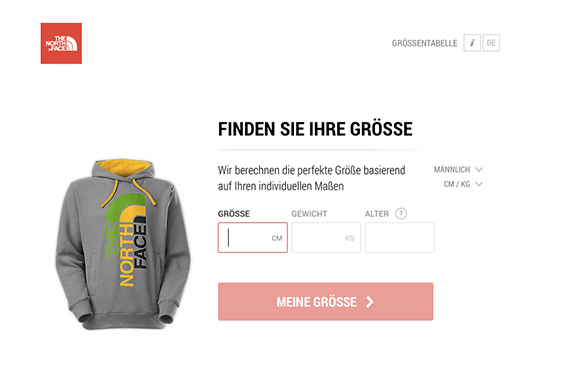
7 Fragen an: Fit Analytics

Fit Analytics ist die lang-erhoffte Lösung für uns Online-Shopper: Das Tool hilft uns online immer die richtige Größe zu finden. Eine spannende Sache, wenn man bedenkt, dass der Online Kleiderkauf in Deutschland etwa 20 % des gesamten Einzelhandelsumsatzes ausmacht.

Das Startup von Sebastian Schulze und Asaf Moses sitzt in Kreuzberg. Wir haben das Team in Person von Steffen Poralla und Sandra Grether getroffen und mit ihnen über ihr Produkt und die neue Marke Fit Analytics gesprochen.

Continue reading “7 Fragen an: Fit Analytics”

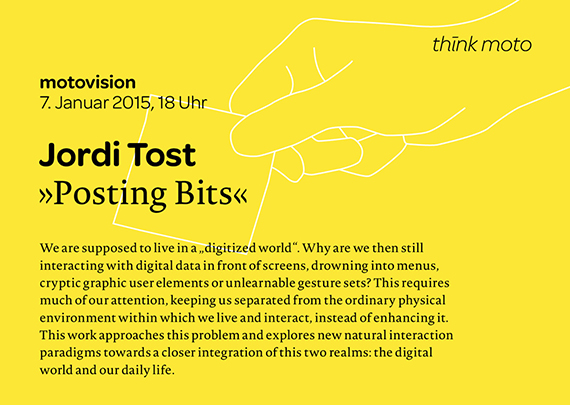
motovision – Posting bits

Die Frage nach zeitgemäßen Interface-Konzepten beschäftigt die Designwelt ständig. »Posting bits« nennt sich die Masterarbeit von Jordi Tost, die nach neuen Interaktionsformen und -medien fragt, die einen natürlicheren Zugang bieten als heutige Devices wie Smartphones und Tablets.

Continue reading “motovision – Posting bits”

Brand Holism – Marken als lebendige Organismen

Vergangenen Donnerstag präsentierte unser Designpraktikant Emanuel Jochum bei unserer Vortragsreihe motovision einige Erkenntnisse aus seiner Arbeit »Dynamic Branding«, in der er sich umfassend mit dem zeitgemäßen Verständnis von Branding beschäftigt hat. Was als Masterprojekt über flexible Designsysteme für Erscheinungsbilder angefangen hat, ist mittlerweile ein unabhängiges Forschungsprojekt mit Fokus auf strategischer Markenentwicklung und Markenführung.

Hier ein kurzer Abriss zum Inhalt:

Unser Lebensumfeld ist außerordentlich dynamisch und digitalisiert. Noch nie waren wir mit anderen Menschen einfacher und schneller vernetzt als heute. Die Entwicklung in Kultur, Technologie und Wirtschaft führt zu neuen Formen, wie wir uns verbinden, wie wir miteinander kommunizieren und wie wir Produkte und Services konsumieren. Was bedeutet diese umfassende Flexibilisierung für eine Marke? Warum darf sich eine Marke nicht gegen Veränderung wehren, sondern muss aktiv etwas dazu beitragen? Wie wird eine Marke zu einem lebendigen Organismus?


Inhaltliche Basis des Projekts sind vor allem Inputs von Menschen, die Marken entwickeln, gestalten, realisieren und betreuen – Kreativdirektoren, Designerinnen, Brand Manager, Content-Strateginnen und Kommunikationsberater. In mehreren Gesprächen wurden und werden Gedanken, Sichtweisen und Auffassungen zum Thema Marke gesammelt and analysiert. Essenz dieser Inputs ist »Brand Holism«, eine Sammlung aus 15 Eigenschaften, die helfen, eine Marke zu einem lebendigen Organismus zu machen. Themen wie Strategie, Authentizität und Konsistenz einer Marke finden ebenso Platz wie Kohärenz, Erweiterbarkeit und Nachhaltigkeit. Das Konzept bietet Denkanstöße und Hilfestellung für alle, die für und mit Marken arbeiten.

KIKK – The state of play

„The state of play“ – unter diesem Motto startete letzte Woche das New Media Festival KIKK in Belgien und schrieb sich damit auf die Fahne, uns die wichtigsten Projekte der Design- und Medienwelt zu präsentieren und uns vor allem zum Spielen zu animieren. Zu sehen gab es eine Reihe namhafter Speaker wie Onformative, Adam Magyar, Zach Lieberman und Casey Neistat vor der beeindruckenden Kulisse eines Theaters aus dem 19. Jahrhundert.

Wir zeigen Euch unsere Favoriten des KIKK-Festivals.

Continue reading “KIKK – The state of play”

Willkommen Emanuel

Unser neuer Praktikant Emanuel kommt für sechs Monate aus dem weiten Österreich zu uns nach Berlin! Wir freuen uns sehr auf seine Unterstützung und die Zusammenarbeit.


Emanuel studierte Medien- und Kommunikationsdesign an der Fachhochschule Vorarlberg, an der Universidad de Monterrey in Mexiko und an der Züricher Hochschule der Künste. Er arbeitete bei den Vorarlberger Agenturen Sägenvier und spitzar als Grafikdesigner für Kunden aus den Bereichen Kultur, Kunst, Technologie, Industrie, Finanzdienstleistungen und Tourismus.

Continue reading “Willkommen Emanuel”

上海超 – Ni hao think moto

Unser Design-Praktikant Mario startete direkt nach seinem Praktikum im Frühjahr in sein Auslandssemester in Shanghai. Seine Eindrücke von China, dem Designstudium an einer internationalen Uni und der lebendigen Designszene vor Ort, teilte er mit uns in seinen E-Mails und beantwortete uns außerdem einige Fragen zu Themen, die uns schon immer am „Design made in China“ interessierten.

Continue reading “上海超 – Ni hao think moto”

We minimize and compensate our CO2 consumption.

Cookie Consent with Real Cookie Banner