+AURA: more immersion for brands

Brands today need more than just good messages. They need charisma—or, as Gen Z would say, aura. With our new +AURA unit, we create just that—immersive experiences that make brands tangible.

Imagine entering a room and immediately feeling the vibe of a brand—hearing its soundscape, seeing its messages in motion, feeling the atmosphere. This is precisely the experience we want to create with +AURA.

Why +AURA?

Digital formats reach their limits when it comes to real experiences. Today, brands don’t just want to be heard or seen – they want to make an impact. In a world full of stimuli, this can only be achieved if we design experiences that engage multiple senses simultaneously and anchor themselves emotionally.

At think moto, we spent years developing brand strategies and UX concepts. But at some point it became clear: We were missing the layer that makes experiences emotionally and sensually tangible. This is how +AURA was born – our new unit for immersive brand worlds.

+AURA combines strategy, design, and multisensory staging: sound, moving images, and space become an orchestrated experience that goes far beyond traditional communication. The goal is to create memorable moments—moments that are not just heard or seen, but felt.

The Team behind +AURA

+AURA is more than a project—it’s a partnership. Together with Peter Hayo and Darius Rafat, who have been working at the intersection of music, pop culture, and brands for decades, we create experiences that reach new audiences and make brands tangible.

Where the journey goes

With +AURA, we want to give brands a new expression: immersion first. We believe that brands are successful when they are not only understood, but also felt. And that’s exactly what we want to enable – at events, showrooms, in digital spaces, or hybrid formats.

+AURA is the next step in the evolution of brand communication: When strategy, creativity, and technology meet the senses, the result is a lasting experience.

Curious? More on: aura.thinkmoto.de

Tone of Voice—How a Brand Sounds and Speaks: A Successful Brand Personality Always Has a Distinctive Tone of Voice

—Den Artikel gibt es hier auch auf Deutsch

Brands are successful if they are recognizable and provide outstanding user experiences at all touch points. Be it website, social media, point of sale, marketing or virtual assistant—only a clearly defined brand personality ensures a consistent and unique encounter between brand and user at all times. This always includes the tone of voice.

The tone of voice defines how we speak and write as a brand. Through the tone of voice, the brand’s personality becomes verbally tangible. So it’s not about what we say or who we talk to—but how.

Since the tone of voice is never separate from the brand, it is essential to first define the brand personality.

Discovery_Workshop
What would the brand be like as a person? One of the questions we ask in the discovery workshop

Uncover the Brand in the Discovery Workshop

If the brand was a person, how would it behave and be perceived by others? This is one of the crucial questions we regularly ask in our discovery workshops. Later, in the define phase, we reflect the insights gained this way by writing a prose text about the brand, assigning it the behavioral attributes contained therein. 

In a next step, we group them into clusters and select the strongest attribute from each. From these key attributes, we derive the brand filters that we use to align look-and-feel, user guidance, and tone of voice. The twelve archetypes serve as further orientation because they have been linked to emotions and characteristics for generations. They are therefore useful when it comes to defining the role of a brand—in the market, towards competitors and, above all, towards customers.

Brand Archetype Card Deck by think moto
Archetype Card Deck by think moto

The Linguistic Dimension

In the discovery workshop, we also have the participants define an initial framework for the tone of voice. Five dimensions serve as guiding principles for determining the respective degree of seriousness, formality, emotionality, approachability, and the level of deference to the brand or product. This framework provides an initial feel for the language style. When developing the brand strategy, we later check whether it is congruent with the brand filters and readjust if necessary.

Taking a Refined Approach

Let’s assume that a brand is primarily empowering, smart, and sophisticated as a person—how would these characteristics express themselves in writing and speaking? We specify this using the brand filters in the language principles.

For example, a sophisticated tone of voice means that we communicate eloquently, with our speech fluid and full of elegance. This way, we emphasize the premium character of the brand, but do so in such a nonchalant way that it never comes across as showy.

We then clarify how these language principles affect sentence structure and word choice in particular and illustrate this with the help of concrete examples. To do this, it is a good idea to run the customer’s existing texts through the defined language filters, rephrase them, and explain how and why something was changed.

Use the Right Tone to Add Persuasive Power to Your Corporate Identity

Linguistic principles and guidelines are an important addition to the CI portal of any brand. Along with the existing visual brand basics, they ensure that the brand acts and communicates according to its personality. 

We all know about the power of words. When used cleverly and coherently, they sharpen the brand and make it both real and accessible.

Learn more about brand personalities and our branding approach in the standard work on digital brand management: “Branded Interactions. Living Brand Experiences for a New Era”.

Pattern Libraries for Extended Realities

All over the world, designers and developers are working on new extended realities applications. In contrast to web or mobile applications, however, there are as yet no established UX patterns that designers can fall back on to make it easier for users to get started or to create recognition value in the sense of the brand. If good examples of user experience and visual design emerge in XR projects (design patterns), it is worth documenting them in a dedicated online library. In this way, future XR projects can be developed much faster.

Benefits of pattern libraries for XR

A pattern library makes it possible to move XR projects forward more quickly because applications do not have to be developed from scratch. Instead, designers and developers can use existing patterns for user experience and visual design or develop new patterns based on them.

The existing patterns also ensure consistent design. This is particularly important in extended realities projects, as applications are developed for very different viewing situations (screen, VR, Hololens) and interaction possibilities (touch, controller, gauze, gesture) within the same brand.

In XR, a brand is allowed to be much more innovative and courageous, in line with user expectations, and to combine familiar elements with something new. The entire corporate design can benefit from these new impulses and adopt new design aspects.

Working on the pattern library also helps to establish a structured design process. The design patterns are processed in a structured manner according to their prioritization and supplemented in a sensible, forward-looking manner.

How To

A company-wide pattern library can only be developed on the basis of real projects that involve real requirements. It is important that the basic conditions of the design work are right: work must be consistently user-centered, in the sense of the brand, and with a constant view of the various requirements. If the conditions are right, a consistent and sustainable pattern library will emerge step by step.

A stable foundation for this is the brand strategy. The Branded Interactions Design process has also proven itself in extended realities projects: design principles for the various design disciplines, such as look & feel and user guidance, are developed in accordance with the brand values. These can be extended to include XR-specific aspects such as environment, force feedback or sound. On this basis, a mood board is developed that shows the cornerstone for the general look & feel.

In einem gemeinsamen Workshop mit dem Product-Team werden die benötigten Patterns für die anstehenden Projekte zusammengetragen und ggfs. zusätzliche Patterns definiert, die in zukünftigen Projekten benötigt werden. Alle Patterns werden in ein Backlog übertragen und priorisiert.

The design team can now work through the design patterns in individual sprints.

Ideally, each new pattern is elaborated directly for the different technologies so that developers and designers can later use them in corresponding projects.

At the end of each sprint, the resulting patterns are entered as a draft in the online pattern library – for example in Frontify – so that the coordination with the product owner can take place directly there. After the coordination, the patterns are finally made available to the other teams.

A pattern library can only function if it is viewed as a flexible and living document that is continuously developed further through input from new projects and feedback from users and designers.

Controls

When developing design patterns, designers should consider the different interaction possibilities and plan and develop patterns with foresight.

Touch Screen

In screen-based augmented reality, the user moves the mobile or tablet device to discover the augmented reality and interacts using touch gestures.

Gaze

Gaze control tracks the position of the headset. A ‘reticle’ – a kind of virtual crosshair – is used to target and select objects.

Gaze and Commit

Gaze and Commit combines gaze controls for selection with the simplicity of gesture controls to interact with virtual objects.

Gesture

Users can see a virtual version of their hands in VR and interact with objects, the environment and navigation elements using gestures.

Controller

Controllers are familiar to most people from the gaming world and allow users to perform complex tasks in VR.

Structure for a Pattern Library

Due to the different technologies, an XR pattern library can become very extensive. A well thought-out structure at an early stage helps designers, developers and product owners to find the right patterns for their project.

In principle, the patterns should be sorted by controls. Within these supercategories, the patterns can be structured like this, for example:

– Usability Essentials
– Design Basics

Design Patterns

General Style and Behaviour
Behaviour of Interactive Elements
Transitions
Reticle
Interacting with the Application
Splash Screen
Loader
Hints
Menu

Interacting with Objects

Selecting Objects
Positioning Objects
Hotspots
Text
Layer

Interacting with the Environment

Scanning for Space
Changing the Environment

think moto goes rural–A Workshop-Experience

The day was here. My first time at think moto’s annual internal Branded Interactions Workshop. The expectations were high: I had already wanted to participate in a similar workshop half a year earlier as part of my studies before joining think moto for a semester. Unfortunately, nothing came of it then, but now the time had finally come.

For two days we were going to leave Berlin. Two days of workshop in the Mecklenburg Lake District with my head between nature and service design.

Friday, morning

Some of the colleagues have taken the workshop several times before, but there always seems to be a new component. It would never be boring, I was told. We pack the cars with plenty of provisions and workshop materials. I pick up conversations of Argentine barbecue and massive chunks of grilled meat. Did I mention that I love barbecue?

We arrive in the early morning. As a country bumpkin from Lower Saxony, I feel right at home in the green lowlands. The birds chirp pleasantly while we unpack, briefly enjoy the sun and set up the workshop.

Friday, noon

After a short snack, things get underway: Marco Spies, strategic partner at think moto and now head of the workshop, explains what the workshop will be about. The twelve participants are divided into three groups and the tasks are distributed. In order to oil our creative gears and gain experience with the Branded Interactions Design process, the task is to develop a new product or service for a specific brand. Of course, the thinking is user-centric, so each group is assigned a specific target group. When the starting signal is given, the three groups spread out across the site. The crackling of a freshly lit fire backdrops an intense brainstorming session.

For a short break, they head to the nearby lake. A colleague has brought fishing equipment and would like to treat us to some fresh catch. While he bobs on the lake with a small boat, the sun shines strongly on the surrounding forest. The scenery is picturesque, Bob Ross could not depict it more peacefully.

Friday, evening

After the short lunch break, the work continues, ideas are considered and discarded. Finally, the groups present their respective current status. Since our main focus is on creative methods, some presentations take on their own forms. Especially the lively role play of a group creates a cheerful atmosphere.

As dusk approaches, it is time to set up dinner. The rumors turned out to be true. Two massive pieces of meat cook on the two grills. In the meantime, vegetable chopping becomes a team-building task. Shish kebabs are created at breakneck speed and the work table would fit just as well in a factory hall of growing industrial nations.

In the late evening, all participants gather around the campfire. We sit relaxed around the fire, faces lit by twitching flames. Stories are told in the warming glow of the fire, while the topics take on an increasingly philosophical nature as time goes on.

Saturday, morning

Saturday morning we awaken gently to the aroma of coffee in the air and the songs of local birds. After a hearty breakfast and a team yoga session, it’s final spurt in the workshop. The groups meet one last time for final set up before it’s time to present the results of the last twenty-four hours.

Although there had already been presentations on interim statuses before, the focus was now for the first time on realizable products and services. All groups surprised with unexpected and very creative approaches.

Saturday, noon

With the official part of the workshop over, it was time to go to the lake once more to relax before most returned to the metropolis of Berlin.

It was the most intensive workshop I had the pleasure to participate in. Besides learning some new methods, I was also able to enjoy deeper insights into the Branded Interactions design process directly from the author. An experience that was definitely worth it.

Fare ye well, I’ll see you soon, forest.

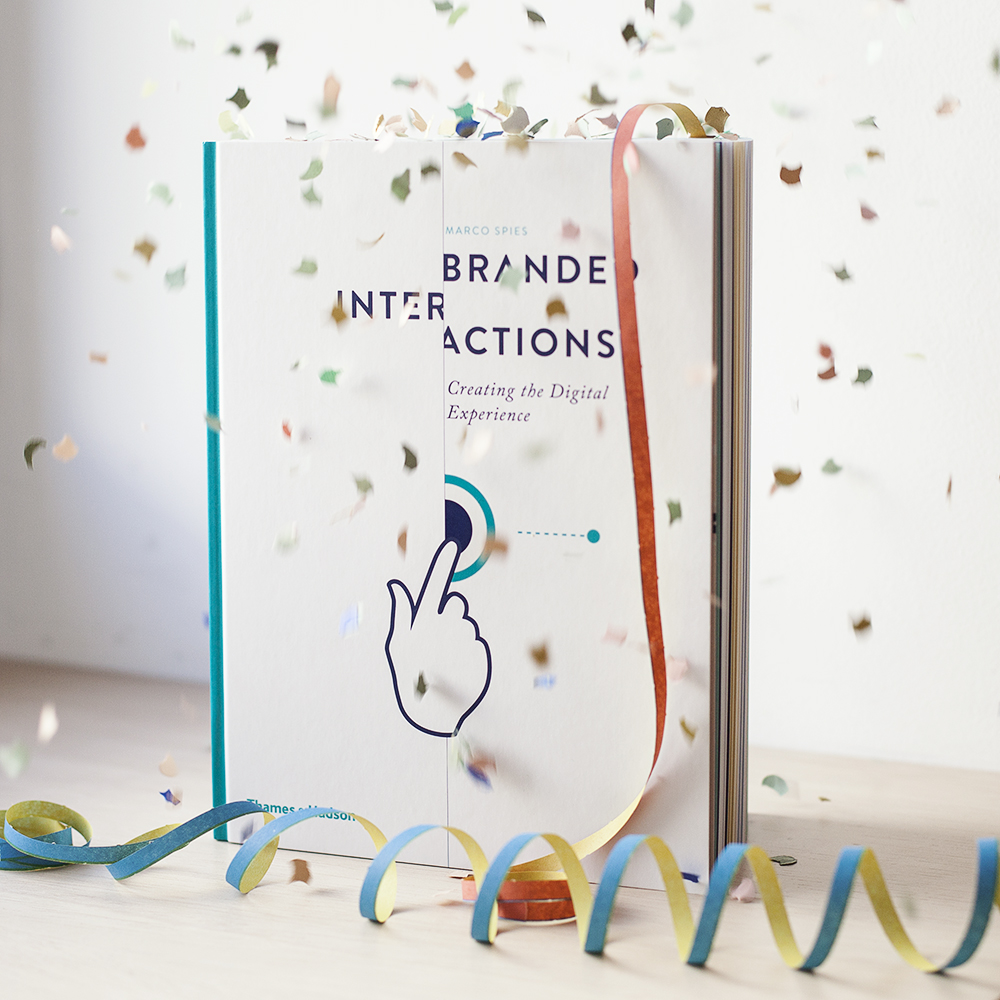
English Version of Branded Interactions Will Be Available Soon

We’re happy to announce that the English version of Branded Interactions will finally be available from the 6th of October.

After publishing two editions of the German version, we have received many inquiries from all over the world asking for an English version of the book. It will be published by Thames&Hudson, a proficient publishing partner with more than 60 years of experience with books in the field of art and education. Continue reading “English Version of Branded Interactions Will Be Available Soon”

Beiträge von Marco Spies in der form und in der PAGE

Und wieder sehr erfreuliche Nachrichten: Ein paar Beiträge von Marco wurden kürzlich in den Design-Fachzeitschriften form und PAGE veröffentlicht! Nachfolgend geben wir einen kleinen Überblick über die Themen.

Continue reading “Beiträge von Marco Spies in der form und in der PAGE”

Beiträge von think moto in »Marke und digitale Medien«

Im Buch »Marke und digitale Medien – Der Wandel des Markenkonzepts im 21. Jahrhundert« haben die beiden Herausgeber Stefanie Dänzler und Thomas Heun zahlreiche Beiträge von Wissenschaftern und Praktikern zur Entwicklung und Führung von Marken im digitalen Zeitalter gesammelt. Marco Spies und Carsten Totz befinden sich ebenfalls unter den Autoren, die ihre Gedanken und Erfahrungen aus der Perspektive verschiedener Disziplinen wie Markenstrategie, Medienkommunikation, Konsumpsychologie, strategischer Planung oder Experience Design in diesem Buch teilen.
Continue reading “Beiträge von think moto in »Marke und digitale Medien«”

Neue Unterstützung kehrt ein!

Wir freuen uns sehr über Dorothée, die uns in den nächsten sechs Monaten als Praktikantin im Bereich Visual und UX Design tatkräftig unter die Arme greift.

Doro studierte Kommunikationsdesign an der HTW Berlin und ist Mit­grün­de­rin/Mitglied bei „sehen und ernten“, einem studentischen Designnetzwerk. Auch in ihrer Freizeit überlegt sie sich am liebsten Lösungen und Konzepte für nachhaltige Produkte. Bei think moto möchte sie sich mehr über Konzeption und UX Design aneignen. Während ihrer Bachelorarbeit ist sie auf das Buch „Branded Interactions“ von Marco Spies gestoßen. Das Buch hat sie so sehr beeindruckt, dass sie bei think moto Erfahrungen sammeln möchte.

Continue reading “Neue Unterstützung kehrt ein!”

“Branded Interactions” in English. Interested anyone?

We need your help, guys. We think about financing an English version of Branded Interactions via Crowdfunding. Although we have a number of requests for an English version from people around the world, it seems like there is no American/English publishing house that has the guts to publish such a complex (and beautiful) book. So we’d like to do it ourselves. Unfortunately, Kickstarter is not available in Germany. So which one would be the appropriate platform? Any ideas, suggestions, advice any one?

What it is: “Branded Interactions – Digitale Markenerlebnisse planen und gestalten” is a handbook for designers who work at the interface between brand and interactive design. Following the typical design process from analysis to distribution, it presents the relevant tools and methods for interactive branding and design and illustrates them with design patterns and examples. Branded Interactions offers sound and practical advice with case studies, expert interviews and checklists throughout the BIxD process. The Book is widely recognized as a leading specialist book on digital branding and design. It has been called “a bible for anyone working in interactive media”. More about the book (in German) at brandedinteractions.com.


Take a closer look at the beautifully crafted book here:
Flipping through the book on vimeo: https://vimeo.com/55593293

Check out our pinterest board: http://www.pinterest.com/thinkmoto/branded-interactions/

IF YOU WOULD LIKE TO READ
THE ENGLISH EDITION OF “BRANDED INTERACTIONS” –
PLEASE SHARE & LIKE THIS BLOG POST!

Interaktionen machen Marken.

… oder wie die Digitalisierung Interaktionen zum Kern der Markenführung macht.

Die Digitalisierung hat das Leben und Verhalten der Menschen zweifelsfrei maßgeblich verändert. Ein verändertes menschliches Verhalten – mag es sich um das Kommunikations-, das Entscheidungs- oder auch das Transaktionsverhalten handeln – hat wiederum Einfluss auf die Art und Weise der Beziehungen zwischen Menschen und Marken. Wie sieht dieser Einfluss der Digitalisierung auf die Markenführung aus? Was ändert sich bzw. hat sich verändert? Welche Herausforderungen ergeben sich daraus für die Markenführung? Wie kann bzw. muss die Markenführung reagieren um diese Herausforderungen zu meistern?

In einem Beitrag im bald erscheinenden Buch Heun, Thomas (Hrsg.). Digital Branding; Springer Verlag gehe ich zusammen mit Florian-Ulrich Werg diesen Fragen nach. Es sind Perspektiven, Hypothesen und Gedankenanstöße – basierend auf unseren langjährigen Erfahrungen als Markenberater und Digitalstrategen in der Praxis. Die zentralen Punkte unseres Artikels haben wir bei think moto als kurze Präsentation zusammengefasst und bei Slideshare bereitgestellt.

Was sind die zentralen Aussagen? Zentrale Parameter der Markenführung verändern sich durch die Digitalisierung:

  • Kaufentscheidungsprozesse werden komplexer und weniger linear.
  • Wertschöpfungsstrukturen werden integrativ und kollaborativ.
  • Markenbeziehungen werden ubiquitär und interaktiv.

Die Digitalisierung stellt die Markenführung vor neue Herausforderungen. Die Potenziale digitaler Kontaktpunkte und Interaktionen werden vergleichsweise schwach zur Markenprofilierung genutzt. Warum?

  • Die Bedeutung digitaler Interaktionen für die Markenwahrnehmung und -profilierung wird eklatant unterschätzt.
  • Die Bedeutung der formalen Konsistenz im Markenauftritt wird klar überschätzt.
  • Das Festhalten an klassischen Organisationsformen der Markenführung führt zu einem anhaltenden Silo-Denken und verhindert eine ganzheitliche und effektive Markenführung.

Zu welchen Schlussfolgerungen, zu welchen Empfehlungen kommen wir? Wie kann man die Markenführung in der Praxis interaktionsorientierter gestalten?

  • ”Signature Interactions” als Ziel der Markenführung definieren: Interaktionen als Signatur einer unverwechselbaren und Identität ausdrückenden ”Unterschrift” einer Marke verstehen, anstreben und gestalten.
  • Das Verständnis davon was eine Marke ist und wie sie heute geführt werden muss unternehmensintern harmonisieren.
  • Die Steuerungsinstrumente der (operativen) Markenführung anpassen. Weniger Markenmodelle und Richtlinien, mehr Kennzahlen, die die Interaktionsqualität erfassen und abbilden.
  • Die Organisation der Markenführung im Sinne eines Brand Experience Managements verändern: Einfluss der Markenführung auf Prozesse, Technologieeinsatz, Datenmanagement, Mitarbeiterverhalten etc. stärken; Ausstattung mit ausreichenden Entscheidungs- und Eskalationsbefugnissen etc.
Cookie Consent with Real Cookie Banner