Pattern Libraries for Extended Realities

All over the world, designers and developers are working on new extended realities applications. In contrast to web or mobile applications, however, there are as yet no established UX patterns that designers can fall back on to make it easier for users to get started or to create recognition value in the sense of the brand. If good examples of user experience and visual design emerge in XR projects (design patterns), it is worth documenting them in a dedicated online library. In this way, future XR projects can be developed much faster.

Benefits of pattern libraries for XR

A pattern library makes it possible to move XR projects forward more quickly because applications do not have to be developed from scratch. Instead, designers and developers can use existing patterns for user experience and visual design or develop new patterns based on them.

The existing patterns also ensure consistent design. This is particularly important in extended realities projects, as applications are developed for very different viewing situations (screen, VR, Hololens) and interaction possibilities (touch, controller, gauze, gesture) within the same brand.

In XR, a brand is allowed to be much more innovative and courageous, in line with user expectations, and to combine familiar elements with something new. The entire corporate design can benefit from these new impulses and adopt new design aspects.

Working on the pattern library also helps to establish a structured design process. The design patterns are processed in a structured manner according to their prioritization and supplemented in a sensible, forward-looking manner.

How To

A company-wide pattern library can only be developed on the basis of real projects that involve real requirements. It is important that the basic conditions of the design work are right: work must be consistently user-centered, in the sense of the brand, and with a constant view of the various requirements. If the conditions are right, a consistent and sustainable pattern library will emerge step by step.

A stable foundation for this is the brand strategy. The Branded Interactions Design process has also proven itself in extended realities projects: design principles for the various design disciplines, such as look & feel and user guidance, are developed in accordance with the brand values. These can be extended to include XR-specific aspects such as environment, force feedback or sound. On this basis, a mood board is developed that shows the cornerstone for the general look & feel.

In einem gemeinsamen Workshop mit dem Product-Team werden die benötigten Patterns für die anstehenden Projekte zusammengetragen und ggfs. zusätzliche Patterns definiert, die in zukünftigen Projekten benötigt werden. Alle Patterns werden in ein Backlog übertragen und priorisiert.

The design team can now work through the design patterns in individual sprints.

Ideally, each new pattern is elaborated directly for the different technologies so that developers and designers can later use them in corresponding projects.

At the end of each sprint, the resulting patterns are entered as a draft in the online pattern library – for example in Frontify – so that the coordination with the product owner can take place directly there. After the coordination, the patterns are finally made available to the other teams.

A pattern library can only function if it is viewed as a flexible and living document that is continuously developed further through input from new projects and feedback from users and designers.

Controls

When developing design patterns, designers should consider the different interaction possibilities and plan and develop patterns with foresight.

Touch Screen

In screen-based augmented reality, the user moves the mobile or tablet device to discover the augmented reality and interacts using touch gestures.

Gaze

Gaze control tracks the position of the headset. A ‘reticle’ – a kind of virtual crosshair – is used to target and select objects.

Gaze and Commit

Gaze and Commit combines gaze controls for selection with the simplicity of gesture controls to interact with virtual objects.

Gesture

Users can see a virtual version of their hands in VR and interact with objects, the environment and navigation elements using gestures.

Controller

Controllers are familiar to most people from the gaming world and allow users to perform complex tasks in VR.

Structure for a Pattern Library

Due to the different technologies, an XR pattern library can become very extensive. A well thought-out structure at an early stage helps designers, developers and product owners to find the right patterns for their project.

In principle, the patterns should be sorted by controls. Within these supercategories, the patterns can be structured like this, for example:

– Usability Essentials
– Design Basics

Design Patterns

General Style and Behaviour
Behaviour of Interactive Elements
Transitions
Reticle
Interacting with the Application
Splash Screen
Loader
Hints
Menu

Interacting with Objects

Selecting Objects
Positioning Objects
Hotspots
Text
Layer

Interacting with the Environment

Scanning for Space
Changing the Environment

Starthilfe für Start-Ups? Branding!

Die Herausforderungen und Aufgaben von Start-Ups sind endlos: das Budget und die Mittel sind knapp, das Zeitfenster für den Launch wird von Tag zu Tag kleiner, bereits gewonnene Investoren wollen bei Laune gehalten und neue Investoren überzeugt werden und schließlich soll das eigentliche Produkt ja auch möglichst bald das Licht der Welt erblicken… Warum sollte man als Start-Up seine Ressourcen dann gerade für Branding einsetzen? Ist es nicht wichtiger alle Ressourcen in die Produktentwicklung zu stecken? Und wenn schon Marketing, dann doch eher um die Bekanntheit zu erhöhen und den Traffic auf die eigene Website zu lenken, oder?

Nein. Branding ist schlicht elementar für Start-Ups und die am meisten unterschätzte Disziplin im Start-Up „Zehnkampf”. Continue reading “Starthilfe für Start-Ups? Branding!”

Katja Wenger in der Jury des Wettbewerbs Gute Gestaltung des DDC

Seit inzwischen 11 Jahren zeichnet die Jury des DDC gute Gestaltung in 8 Kategorien aus. Ziel ist es, die besten Ideen aus den verschiedenen Disziplinen der Designwelt zu entdecken und zu fördern. Beim diesjährigen Wettbewerb Gute Gestaltung ist Katja Wenger, Geschäftsführerin und Partner Design von think moto, Teil der Jury. Der DDC prämiert unter dem Vorsitz von Niko Gültig Arbeiten aus den Bereichen Produkt, Digital Media, Foto/Film, Markenkommunikation, Raum/Architektur, Unternehmenskommunikation, Corporate Design, Geschäftsberichte, Graphic Fine Arts und Zukunft. Katja wird in der interdisziplinären Jury Einreichungen aus dem Bereich Corporate Design sichten.

The GAP Logo Change – discussed by branding people

Erinnert ihr euch noch an die Rolle rückwärts beim Logo-(Re-)Design der US Modemarke GAP? 2010 führte GAP ein neues Logo ein, das zu zahlreichen negativen Reaktionen in social media, u.a. auf der Facebook-Fanseite führte. GAP zog das neue Logo zurück und setzte fortan wieder das altbekannte ein. Das Video habe ich gerade auf Youtube gefunden.

The media have changed and the tactics have changed. There are more ways to interact with the brand all the time. If you aren’t listening to the people and also listenting to your own brand essence you are going to have problems.

Mehr dazu im Design-Tagebuch, im Guardian und bei Spiegel Online.

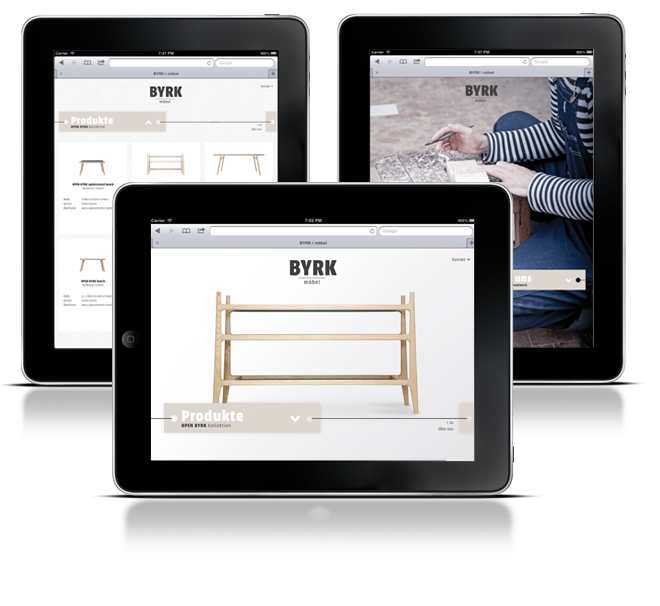
Online Offline Branding für BYRK möbel

Wir freuen uns, pünktlich zur Kölner Möbelmesse ging die Seite von BYRK Möbel online! Wir haben die Jungs von BYRK gestalterisch aber auch unternehmensstrategisch begleitet, d.h. einen Markennamen entwickelt, Markeantribute definiert und über das Corporate Design und die Bildwelt hinaus eine Website entwickelt.

BYRK moebel Website

Schaut mal rein und macht euch ein Bild von der neuen jungen Möbelmarke. Am besten mit eurem iPad, denn dafür ist die Seite optimiert.
Das iPad ist nicht nur in der Zielgruppe verbreitet, sondern unterstützt BYRK aktuell am Messestand in Köln.
Die tollen Bilder sind übrigens von der Fotografin Jasmin Marla Dichant.

www.byrk-moebel.de
www.thinkmoto.de/case-byrk

Das Logo in interaktiven Medien

Das Logo ist das Aushängeschild einer Marke schlechthin. Früher waren die Regeln klar: ein Logo sollte unverwechselbar sein, einfach, unveränderbar und in verschiedenen Größen und Umgebungen funktionieren. Die Aufgabe bestand darin, den Absender eines Produktes, eines Plakates, eines Briefes möglichst eindeutig zu kommunizieren. Für den Werber hieß das dann meist: Make the logo bigger! Continue reading “Das Logo in interaktiven Medien”

We minimize and compensate our CO2 consumption.

Cookie Consent with Real Cookie Banner