Hear It, Feel It, Live It: Event-, Experiential- and Immersive Design in the Age of AI

For a long time, brand management was dominated by the visual. Logo, color, typography – the eye was the lead sense organ of brand communication. Acoustic phenomena were considered ephemeral, hard to control, too subjective to plan strategically.

That’s changing fundamentally right now. With the spread of AI-based voice interfaces, we’re seeing a new appreciation for voice, sound, and presence. At the same time, the purely visual interface is losing ground: graphical surfaces are increasingly being replaced by natural user interfaces – voice interaction, body language, situational behavior. The constant flood of social media is producing a genuine iconographic exhaustion, a digital fatigue confirmed by recent research. Attention is shifting: away from the image, toward voice, posture, a brand’s aura – and toward human encounter in physical space.

We saw what that means in practice with the Audi Club of Progress – an immersive live marketing tour across five major German cities, combined with test drives and a multisensory dinner. Not a trade show booth, not a showroom – but a place where people could encounter the car in a way no campaign alone could have created. For one of the installations, we gave the Audi A6 e-tron its own, AI-developed voice – designed not to sound functional, but human: empathetic, charming, present. One visitor put it this way afterward: “The voice was so pleasant and likeable – I fell for it immediately.” That’s a statement about resonance. About what happens when an experience isn’t designed as a channel, but as an encounter.

Definition: Experiential branding is the deliberate design of brand experiences in physical and hybrid space – through events, pop-ups, installations, and immersive formats. AI is increasingly becoming a design tool within it: personalizing content, adapting space, sound, and interaction to people in real time, and making experiences scalable without making them generic.

Three Layers Where Brands Are Becoming Experienceable

1. Event & Live Experience Design

Brands that want real impact go where people actually are: they run tours, open pop-up spaces, host community events, and invite people into formats you don’t just consume, but live through. The Audi Club of Progress shows how far that can go – from the test drive to the multisensory dinner.

AI changes one thing above all: the ability to shape these experiences differently for individual visitors, instead of running one rigid program for everyone. Content, tone, and even the arc of an evening can now be adapted in real time to audience, context, and mood – without the experience feeling any less personal. If anything, the opposite is true.

2. Spatial & Immersive Design

The second layer concerns the space itself: showrooms, trade show booths, pop-up areas, and installations are increasingly becoming adaptive environments. Projections, generative visuals, lighting and sound systems respond to presence, movement, or visitor numbers, instead of being built once and staying static.

This is where AI becomes a co-designer: it generates and varies visual and acoustic content for the space, adapts atmosphere to time of day or audience, and makes it possible to prototype and iterate an immersive concept far faster than purely manual production would allow. That conviction is exactly why we built think moto +AURA – our unit for audio, voice, and immersion design, which treats body, sound, and presence as strategic brand elements from the outset, rather than as a separate “sound team.”

.

3. Sound & Voice as an Ingredient, Not the Frame

Sound and voice remain important building blocks – but as one layer within a larger, immersive experience, not as a standalone discipline next to it. Static audio logos and jingles are being complemented by dynamic sonic identities that can adapt to context and space, as long as it’s clearly defined what’s allowed to vary and what remains the recognizable constant of the brand.

Why This Is Becoming Strategic, Not Just a Design Choice

The more digital content can be infinitely reproduced through generative AI, the more valuable everything becomes that can’t simply be copied: a place, a moment, a physical encounter that happens exactly once, in exactly this form. Sensory, spatial, and experiential branding will therefore move, over the coming years, from a design nice-to-have to a strategic necessity – precisely because AI is making so much other brand communication scalable and interchangeable.

These experiences aren’t a marketing add-on. They’re proof that brand experience is a structural decision, not a nice-to-have tacked onto the end of a campaign brief.

Bottom Line

A brand that wants to remain distinctive in the age of AI won’t win that advantage in the feed – increasingly, it will win it in physical space: in events, installations, and immersive formats that can’t simply be rebuilt. AI isn’t a replacement for the physical experience here; it’s the tool that makes it more personal, more adaptive, and faster to realize.

If you’d like to develop your own immersive brand experience, think moto +AURA is the right place to start – our unit for audio, voice, and immersion design.

Frequently Asked Questions

What is experiential branding?

Experiential branding is the deliberate design of brand experiences in physical or hybrid space – for example through events, pop-ups, or immersive installations – where people encounter a brand directly instead of merely consuming it.

What role does AI play in event and experiential marketing?

AI personalizes content and pacing in real time, generates and varies visual and acoustic elements for spaces, and makes it possible to develop and test immersive concepts far faster than with purely manual production.

Is immersive brand experience only feasible with a large budget?

No. The underlying logic – designing an experience across multiple senses in a consistent, personal way – applies just as well at a smaller scale, for example in individual pop-up formats or one-off installations.

How is think moto +AURA different from classic event marketing?

+AURA treats body, sound, and presence as strategic brand elements from the very start – including AI-driven personalization and adaptive design – rather than handling sound and spatial staging as a downstream production task.

Marco Spies is founder and managing director of think moto, a Berlin-based design and innovation agency. He is the author of “Branded Interactions” (together with Katja Wenger), the guide to digital brand management, and of “The Spherical Brand”. think moto develops brands for the age of AI — with the credo: Human First, AI-backed.

Is Your Brand AI-Ready? 10 Questions Every CMO Should Be Able to Answer

Most CMOs would readily agree that their brand should be “somehow” AI-ready. Few can say what that actually means in practice. A chatbot on the website, a handful of AI-generated social posts, a ChatGPT integration in customer service – all of that looks like progress. It says very little about whether a brand is genuinely ready for the AI era.

That’s the core problem. Individual AI tools scale one thing above all: output. Whether that output serves the brand or dilutes it across channels and systems is decided elsewhere – by whether there is a clear, machine-readable brand foundation that can actually guide AI systems. Being an AI-ready brand is therefore not a question of which tools you use. It’s a question of governance, data quality, and strategic clarity.

Definition: An AI-ready brand has a clearly defined, machine-readable brand foundation that lets AI systems – from chatbots to content generators – act consistently on the brand’s behalf, instead of leaving that decision to each individual tool.

So how do you check where you stand? The following ten questions are an honest self-assessment, grouped into five areas. Answer most of them clearly and you’re already ahead of the field – stumble on question three or four, and you’ve just found your next priority.

The 10 Questions

Governance & Brand Direction

Governance is where it becomes clear fastest whether a brand is leading AI strategically – or just reacting to it.

1. Do you know how your AI systems are allowed to act on behalf of your brand? 
Without defined boundaries, the model decides by default – not the brand. That’s the core of AI-Powered Brand Governance.

2. Is there a clear brand voice policy for automated systems? 
A tone of voice written into a style guide helps humans. AI systems need it in a structured, retrievable form – which is exactly what a Brand Core Prompt provides.

3. Is there a named owner for AI brand consistency in your organization?
Governance without ownership stays a document. Someone needs the mandate to decide what AI systems may and may not do on the brand’s behalf.

Brand Memory & Data Quality

Even the best governance is worthless if AI systems have no reliable brand knowledge to draw on.

4. Where does your brand knowledge live – and can AI systems actually access it? 
A PDF on the intranet is readable for humans. For language models, it’s effectively invisible. Brand knowledge has to sit where AI systems can actually retrieve it.

5. Are your brand guidelines formatted in a machine-readable way? 
Structured, clearly written guidelines can be turned into a brand memory. Unstructured layout PDFs mostly can’t.

Sourcing & Authenticity

The more content is AI-generated, the more important it becomes to know who is ultimately accountable for it.

6. How do you ensure AI-generated content doesn’t dilute your brand identity? 
Scaled output without brand control also scales inconsistency – often unnoticed, until the damage is visible.

7. Do you have an approval process for AI-generated customer interactions?
The moment AI systems talk directly to customers, they effectively become Branded AI Agents – and should be governed and reviewed accordingly.

Compliance & Transparency

For European brands especially, this is no longer a nice-to-have – it’s increasingly a regulatory requirement.

8. Do you know where your AI brand systems stand on EU/GDPR compliance? 
Data origin, hosting, and model choice are brand decisions today – not just IT topics.

9. Are your customers informed when they’re talking to an AI?
Transparency builds trust – and in many jurisdictions, it’s increasingly a legal requirement too.

Measurability

What isn’t measured can’t be managed – that’s as true for brand leadership in the AI era as for any other discipline.

10. How do you measure whether AI-driven brand interactions strengthen or weaken your brand equity? 
Without metrics, “AI-ready” remains a claim rather than a demonstrable state.

Where Does Your Brand Stand?

Score ten points for every question you can answer clearly, with a concrete example. Score five points for “partially” or “in progress.” Score zero for “no” or “not sure.” That’s a maximum of 100 points.

Below 40 points, AI is largely running unguided inside the brand. Between 40 and 70 points, initial structures exist, but the connecting governance layer is usually still missing. Above 70 points, a brand has moved from simply using AI to actually leading it – and should make that position visible, in trade media or at conferences.

Why These Questions Aren’t Optional

Brands that can’t answer these questions aren’t avoiding the risk – they’re just deferring it. Inconsistent AI interactions, legal grey areas around AI disclosure, and brand damage from uncontrolled AI output are no longer hypothetical scenarios; they’re already observable across many industries.

The common thread through all ten questions is the same: a shared, machine-readable knowledge base from which every AI-driven brand process – content production, customer dialogue, approval – can be consistently governed. Systems like Spherical Brand AI automate exactly this kind of check on an ongoing basis, rather than treating it as a one-off checklist; but for a starting point, an honest run through the ten questions above is enough.

For a deeper definition, further criteria, and practical examples, see our knowledge article on AI-Ready Brand.

Bottom Line

A brand doesn’t become AI-ready by adopting a new tool. It becomes AI-ready once it’s clear who – human or AI – is allowed to make decisions on the brand’s behalf, what those decisions are based on, and how they’re checked. The ten questions above are a first, honest step. The next one is turning the answers into a real governance structure.

The ten questions above are a first AI-readiness check. The next step is making sure this doesn’t stay a static checklist, but becomes an ongoing evaluation: which parts of the brand foundation are machine-readable? Which AI systems actually draw on them? And where is governance still missing?

If you’d like to run this check for your own brand, reach out – or take a look at how we structure exactly this kind of assessment inside Spherical Brand AI.

View Spherical Brand AI

Frequently Asked Questions

What does “AI-ready” mean for a brand?

A brand is AI-ready when its foundations – values, tone of voice, guidelines, but also positioning, value proposition and target audience – are structured and accessible enough for AI systems to act consistently on the brand’s behalf, instead of making their own assumptions.

Is integrating ChatGPT or a chatbot enough to be AI-ready?

No. Integrating individual AI tools increases output, but says nothing about the brand consistency of that output. AI-readiness is a question of governance and data quality, not tool selection.

Who in the organization should own AI-ready branding?

In practice, usually a cross-functional owner spanning brand, marketing, and IT. What matters most is that ownership is explicitly assigned, rather than leaving brand leadership implicitly to the AI systems themselves.

How long does it take to make a brand AI-ready?

An initial assessment can be done quickly – for example, with the ten questions in this article. Building a robust, machine-readable brand foundation, however, depends on the starting point: the quality of existing guidelines, how brand data is structured, which AI systems are already in use, and the desired depth of governance. Systems like Spherical Brand AI can help structure this process and develop it on an ongoing basis.

Marco Spies is founder and managing director of think moto, a Berlin-based design and innovation agency. He is the author of “Branded Interactions” (together with Katja Wenger), the guide to digital brand management, and of “The Spherical Brand”. think moto develops brands for the age of AI — with the credo: Human First, AI-backed.

Why Single AI Tools Don’t Solve the Brand Problem — And What Does

Imagine a mid-sized company that has spent years building its brand. Clear positioning, consistent design, a Brand Voice that reliably works across campaigns and communications. Then AI arrives — and with it the pressure to produce faster, more, cheaper. The company buys a number of AI tools. Implements them. And three months later, every department is producing brand-consistent content — in five different tones of voice, with three different value propositions, and a chatbot that answers customer inquiries as if it belongs to a different company entirely.

The tools work. The brand doesn’t.

This is not an edge case. It is the structural problem behind the AI boom in branding — and it has nothing to do with the quality of any individual tool.

The Market Is Solving the Wrong Problem

The market for branding AI tools is growing fast. DAM systems manage assets. Content AI tools generate copy. Design systems structure visual language. And a growing number of providers are building AI suites that attempt to secure brand consistency through rulebooks and styleguide logic.

Each of these tools solves a real partial problem. None solves the actual problem.

The actual problem is fragmentation. Companies have one tool for analysis, another for content, a third for approvals — and multiple knowledge bases that never truly communicate. Every new tool that solves one problem creates three new inconsistencies. The result: more production, less control.

Why Three Layers Apart Don’t Work

Anyone serious about brand leadership in the age of AI needs three capabilities — and all three simultaneously:

Intelligence — the ability to understand, measure, and strategically develop one’s own brand. Maturity assessments, gap analyses, market comparisons. Where does the brand stand? Where are the blind spots?

Production — the ability to translate brand knowledge into concrete outputs. Copy, visual assets, AI assistants that speak in the name of the brand. But not generically — conditioned by the brand core.

Governance — the ability to actively secure consistency. Not through an archive of already-approved content, but through active review before anything goes out. Design check, compliance review, approval trail.

The market offers these three capabilities as separate solutions. One tool for Intelligence, another for Production, a third for Governance. They are coordinated — but not integrated. And that difference is decisive. Coordinated means: the tools exchange data when forced to. Integrated means: they draw from the same source. The design check knows what the brand’s aesthetic positioning is — because it works from the same knowledge base as the copy writer. The approval trail documents decisions based on the same brand definitions the AI assistant uses.

Tools fail through confusion. Agents fail through action. That is not a semantic distinction — it is the difference between a usability problem and a trust violation. A content tool that produces off-brand copy is a configuration error: you notice, correct, move on. A brand agent that acts off-brand has spoken in the name of the brand, committed to something, represented you — and got it wrong. That is precisely why Governance is not an optional layer in an agentic brand system: it is the discipline that decides what the agent is allowed to do without checking in.

Governance without Intelligence is blind rule enforcement. Production without Governance is uncontrolled scaling. Intelligence without Production remains analysis without impact.

What a Brand Operating System Does Differently

Spherical Brand AI is not the next branding AI suite. It is a brand operating system — a system that structures brand knowledge, makes it machine-readable, and operationalizes it, so that every department, every tool, and every AI application in the organization always draws from the same source.

The core architecture follows a circular logic:
Market and user knowledge flows into the Intelligence Layer → is condensed in Brand Memory into a machine-readable brand core → the Production Layer generates brand-consistent content and AI assistants from it → the Governance Layer reviews, evaluates, and approves → feedback and versioning close the loop back into the brand core.

This is not a workflow. It is a system architecture. And the difference shows precisely where other tools fail: an AI assistant drawing from Brand Memory does not respond generically — it responds the way the brand responds. A design check based on the same knowledge base as the Brand Voice does not evaluate against abstract rules — it evaluates against the concrete brand core.

Why Method Matters More Than Feature Lists

There is another distinction that is rarely discussed in the market: the methodological foundation.

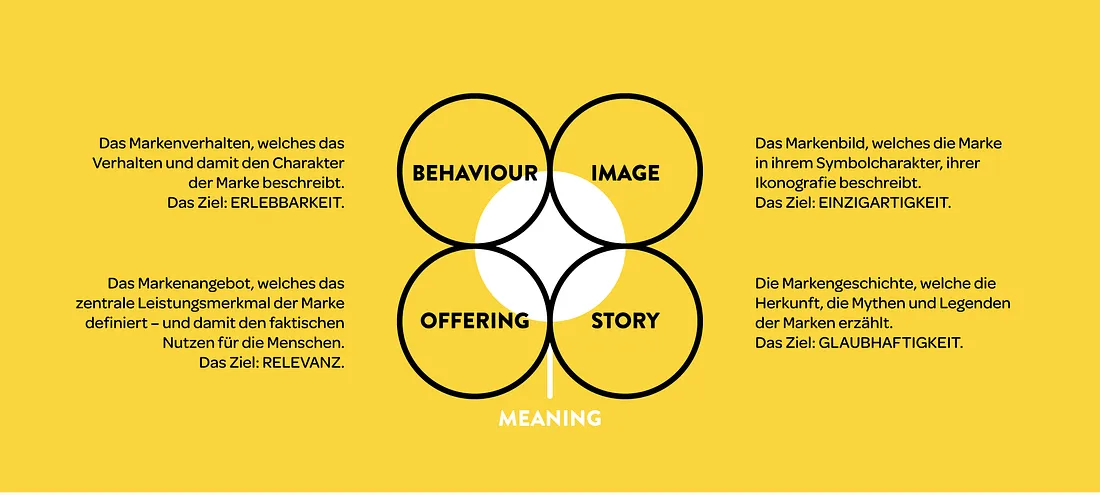
The knowledge base of Spherical Brand AI is not generic. It is built on two proprietary frameworks: the Spherical Brand Framework (9 SPHERICAL dimensions as an evaluation framework) and the Brand BIOS® Model (Behaviour, Image, Offering, Story as a machine-readable structure). This means: the system does not only know what the brand communicates — it knows why it communicates that way, which values underpin it, and how it differs from others.

This is methodological IP. No competitor can replicate it by adjusting a prompt.

And it is the reason why Spherical Brand AI is not a tool you buy and implement. It is a system built on a brand understanding — and one that makes that understanding operationally effective.

11:25Claude hat geantwortet: Two-part comparison infographic.Two-part comparison infographic. Left (01): Fragmented tool landscape — three isolated areas, Intelligence, Production, and Governance, each with their own functions (Audit, Gap Analysis, Market Comparison / Copy, Assets, AI Assistants / Design Check, Compliance Review, Approval Trail), connected by a × symbol — coordinated, but not integrated. Result: more production, less control. Right (02): Integrated brand operating system — the same three layers arranged in a circle around a shared yellow core (Brand Memory as a machine-readable brand core), fed by market and user intelligence, with outputs such as copy, visual assets, and AI assistants, and functions including review, evaluate, and approve. Result: shared knowledge base, active governance, on-brand scaling.

What This Means for Brand Leaders

The question is not whether a branding AI suite makes sense. The question is whether it is built on a shared knowledge base — or whether it becomes another tool in a fragmented system landscape.

A few concrete diagnostic questions for CMOs and brand leaders:

Do all AI-powered outputs — copy, assets, assistants — draw from the same brand definition? Or does every team have its own prompt?

Does the system actively review before something is approved — or does it only manage what has already been approved?

Does the system know what the brand strategically is — or does it only know what it visually looks like?

Can the system benchmark the brand against its market environment — or does it produce in a vacuum?

If any of these questions is answered with “I don’t know” or “no,” the system landscape is fragmented. And fragmentation in the age of AI is not a cosmetic issue — it is a competitive disadvantage.

FAQ: Branding AI Suite — Key Questions

What is a branding AI suite?

A branding AI suite is an AI-powered system supporting brand management and brand communications. The term covers very different product categories — from DAM systems to content AI to agentic brand systems. The decisive question is whether the suite is built on a shared knowledge base or loosely coordinates individual functions.

What distinguishes Spherical Brand AI from other branding AI tools?

Spherical Brand AI connects Intelligence Layer, Production Layer, and Governance Layer from a shared knowledge base. While other tools offer these capabilities as separate solutions, all components of SBAI work from the same machine-readable brand core. The system is integrated, not merely coordinated.

Does Spherical Brand AI require an existing brand strategy?

An existing brand strategy is helpful but not a prerequisite. The Intelligence Layer can analyze and structure a brand’s strategic positioning — as a foundation for all subsequent outputs. Many organizations start with a brand audit and develop the brand core through the process.

Is Spherical Brand AI a SaaS product or an agency service?

Both. Spherical Brand AI can be licensed as a standalone suite — independent of an ongoing agency relationship with think moto. At the same time, think moto offers the strategic guidance that ensures the system is built on a robust brand foundation.

What organizations is Spherical Brand AI designed for?

Spherical Brand AI is designed for mid-sized and large organizations that want to approach brand leadership in the age of AI systematically — with multiple departments producing brand communications, and the need for active governance across all touchpoints.

Is your brand ready for the age of AI?

We analyze whether your current system landscape can secure brand consistency in the age of AI — and identify where the greatest leverage lies.

Discover Spherical Brand AI What Is a Spherical Brand? The Brand Framework for the Age of AI

Marco Spies is founder and managing director of think moto, a Berlin-based design and innovation agency. He is the author of “Branded Interactions” (together with Katja Wenger), the guide to digital brand management, and of “The Spherical Brand”. think moto develops brands for the age of AI — with the credo: Human First, AI-backed.

Beiträge von Marco Spies in der form und in der PAGE

Und wieder sehr erfreuliche Nachrichten: Ein paar Beiträge von Marco wurden kürzlich in den Design-Fachzeitschriften form und PAGE veröffentlicht! Nachfolgend geben wir einen kleinen Überblick über die Themen.

Continue reading “Beiträge von Marco Spies in der form und in der PAGE”

Beiträge von think moto in »Marke und digitale Medien«

Im Buch »Marke und digitale Medien – Der Wandel des Markenkonzepts im 21. Jahrhundert« haben die beiden Herausgeber Stefanie Dänzler und Thomas Heun zahlreiche Beiträge von Wissenschaftern und Praktikern zur Entwicklung und Führung von Marken im digitalen Zeitalter gesammelt. Marco Spies und Carsten Totz befinden sich ebenfalls unter den Autoren, die ihre Gedanken und Erfahrungen aus der Perspektive verschiedener Disziplinen wie Markenstrategie, Medienkommunikation, Konsumpsychologie, strategischer Planung oder Experience Design in diesem Buch teilen.
Continue reading “Beiträge von think moto in »Marke und digitale Medien«”

Brand Holism – Marken als lebendige Organismen

Vergangenen Donnerstag präsentierte unser Designpraktikant Emanuel Jochum bei unserer Vortragsreihe motovision einige Erkenntnisse aus seiner Arbeit »Dynamic Branding«, in der er sich umfassend mit dem zeitgemäßen Verständnis von Branding beschäftigt hat. Was als Masterprojekt über flexible Designsysteme für Erscheinungsbilder angefangen hat, ist mittlerweile ein unabhängiges Forschungsprojekt mit Fokus auf strategischer Markenentwicklung und Markenführung.

Hier ein kurzer Abriss zum Inhalt:

Unser Lebensumfeld ist außerordentlich dynamisch und digitalisiert. Noch nie waren wir mit anderen Menschen einfacher und schneller vernetzt als heute. Die Entwicklung in Kultur, Technologie und Wirtschaft führt zu neuen Formen, wie wir uns verbinden, wie wir miteinander kommunizieren und wie wir Produkte und Services konsumieren. Was bedeutet diese umfassende Flexibilisierung für eine Marke? Warum darf sich eine Marke nicht gegen Veränderung wehren, sondern muss aktiv etwas dazu beitragen? Wie wird eine Marke zu einem lebendigen Organismus?


Inhaltliche Basis des Projekts sind vor allem Inputs von Menschen, die Marken entwickeln, gestalten, realisieren und betreuen – Kreativdirektoren, Designerinnen, Brand Manager, Content-Strateginnen und Kommunikationsberater. In mehreren Gesprächen wurden und werden Gedanken, Sichtweisen und Auffassungen zum Thema Marke gesammelt and analysiert. Essenz dieser Inputs ist »Brand Holism«, eine Sammlung aus 15 Eigenschaften, die helfen, eine Marke zu einem lebendigen Organismus zu machen. Themen wie Strategie, Authentizität und Konsistenz einer Marke finden ebenso Platz wie Kohärenz, Erweiterbarkeit und Nachhaltigkeit. Das Konzept bietet Denkanstöße und Hilfestellung für alle, die für und mit Marken arbeiten.

Interaktionen machen Marken.

… oder wie die Digitalisierung Interaktionen zum Kern der Markenführung macht.

Die Digitalisierung hat das Leben und Verhalten der Menschen zweifelsfrei maßgeblich verändert. Ein verändertes menschliches Verhalten – mag es sich um das Kommunikations-, das Entscheidungs- oder auch das Transaktionsverhalten handeln – hat wiederum Einfluss auf die Art und Weise der Beziehungen zwischen Menschen und Marken. Wie sieht dieser Einfluss der Digitalisierung auf die Markenführung aus? Was ändert sich bzw. hat sich verändert? Welche Herausforderungen ergeben sich daraus für die Markenführung? Wie kann bzw. muss die Markenführung reagieren um diese Herausforderungen zu meistern?

In einem Beitrag im bald erscheinenden Buch Heun, Thomas (Hrsg.). Digital Branding; Springer Verlag gehe ich zusammen mit Florian-Ulrich Werg diesen Fragen nach. Es sind Perspektiven, Hypothesen und Gedankenanstöße – basierend auf unseren langjährigen Erfahrungen als Markenberater und Digitalstrategen in der Praxis. Die zentralen Punkte unseres Artikels haben wir bei think moto als kurze Präsentation zusammengefasst und bei Slideshare bereitgestellt.

Was sind die zentralen Aussagen? Zentrale Parameter der Markenführung verändern sich durch die Digitalisierung:

  • Kaufentscheidungsprozesse werden komplexer und weniger linear.
  • Wertschöpfungsstrukturen werden integrativ und kollaborativ.
  • Markenbeziehungen werden ubiquitär und interaktiv.

Die Digitalisierung stellt die Markenführung vor neue Herausforderungen. Die Potenziale digitaler Kontaktpunkte und Interaktionen werden vergleichsweise schwach zur Markenprofilierung genutzt. Warum?

  • Die Bedeutung digitaler Interaktionen für die Markenwahrnehmung und -profilierung wird eklatant unterschätzt.
  • Die Bedeutung der formalen Konsistenz im Markenauftritt wird klar überschätzt.
  • Das Festhalten an klassischen Organisationsformen der Markenführung führt zu einem anhaltenden Silo-Denken und verhindert eine ganzheitliche und effektive Markenführung.

Zu welchen Schlussfolgerungen, zu welchen Empfehlungen kommen wir? Wie kann man die Markenführung in der Praxis interaktionsorientierter gestalten?

  • ”Signature Interactions” als Ziel der Markenführung definieren: Interaktionen als Signatur einer unverwechselbaren und Identität ausdrückenden ”Unterschrift” einer Marke verstehen, anstreben und gestalten.
  • Das Verständnis davon was eine Marke ist und wie sie heute geführt werden muss unternehmensintern harmonisieren.
  • Die Steuerungsinstrumente der (operativen) Markenführung anpassen. Weniger Markenmodelle und Richtlinien, mehr Kennzahlen, die die Interaktionsqualität erfassen und abbilden.
  • Die Organisation der Markenführung im Sinne eines Brand Experience Managements verändern: Einfluss der Markenführung auf Prozesse, Technologieeinsatz, Datenmanagement, Mitarbeiterverhalten etc. stärken; Ausstattung mit ausreichenden Entscheidungs- und Eskalationsbefugnissen etc.

Die drei Fragen des Branded Interaction Design (BIxD)

In seinem Aufsatz On Theory (GRID, Nr. 1) verweist Guy Bonsiepe auf den Kulturwissenschaftler Edward Said, der in den 80er Jahren dem vorherrschenden werkimmanenten Interpretationsansatz des französischen Strukturalismus einen gesellschaftskritischen Ansatz entgegenstellt. Seine 3 Grundfragen für eine “Politik der Textinterpretation”: “Wer schreibt? Für wen wurde der Text geschrieben? Unter welchen Umständen?”
Bonsiepe formuliert die Fragen für das Design “zu Zwecken der Designinterpretation, -ausbildung und der -praxis” um: “Für wen wird ein Design entwickelt? Unter welchen wirtschaftlichen, sozialen und technischen Bedingungen?” “Vielleicht”, so Bonsiepe, “ließen sich von diesen Fragestellungen her Relevanzkriterien für das Entwerfen […] finden.”

Continue reading “Die drei Fragen des Branded Interaction Design (BIxD)”

Brand BIOS – das think moto Markenmodell.

Neulich las ich im Interview mit Twitter Gründer Jack Dorsey den Satz: “Wir wollen die Welt verändern.” Die Welt zu verändern ist (wieder) das Mantra vieler Start-Ups geworden. Ich bin grundsätzlich nicht abgeneigt gegen eine gesunde Verbindung aus Unternehmergeist und Idealismus, glaube auch, dass nur das eine ohne das andere für Gründer gar nicht funktioniert, aber die Frage die sich mir immer aufdrängt ist: wohingehend wollt ihr die Welt denn verändern? Welche Welt ist die Welt nach Twitter? Die Antwort auf diese Frage bleiben viele Unternehmen schuldig, weil sie sie für sich selbst nicht beantwortet haben. Es ist nichts mehr als die Frage nach einem glaubhaften Markenkern. Es ist für uns die Grundfrage der Marken-Entwicklung. Sie steht am Anfang unseres Markenprozesses.
Continue reading “Brand BIOS – das think moto Markenmodell.”

Cookie Consent with Real Cookie Banner