+AURA: more immersion for brands

Brands today need more than just good messages. They need charisma—or, as Gen Z would say, aura. With our new +AURA unit, we create just that—immersive experiences that make brands tangible.

Imagine entering a room and immediately feeling the vibe of a brand—hearing its soundscape, seeing its messages in motion, feeling the atmosphere. This is precisely the experience we want to create with +AURA.

Why +AURA?

Digital formats reach their limits when it comes to real experiences. Today, brands don’t just want to be heard or seen – they want to make an impact. In a world full of stimuli, this can only be achieved if we design experiences that engage multiple senses simultaneously and anchor themselves emotionally.

At think moto, we spent years developing brand strategies and UX concepts. But at some point it became clear: We were missing the layer that makes experiences emotionally and sensually tangible. This is how +AURA was born – our new unit for immersive brand worlds.

+AURA combines strategy, design, and multisensory staging: sound, moving images, and space become an orchestrated experience that goes far beyond traditional communication. The goal is to create memorable moments—moments that are not just heard or seen, but felt.

The Team behind +AURA

+AURA is more than a project—it’s a partnership. Together with Peter Hayo and Darius Rafat, who have been working at the intersection of music, pop culture, and brands for decades, we create experiences that reach new audiences and make brands tangible.

Where the journey goes

With +AURA, we want to give brands a new expression: immersion first. We believe that brands are successful when they are not only understood, but also felt. And that’s exactly what we want to enable – at events, showrooms, in digital spaces, or hybrid formats.

+AURA is the next step in the evolution of brand communication: When strategy, creativity, and technology meet the senses, the result is a lasting experience.

Curious? More on: aura.thinkmoto.de

Tone of Voice—How a Brand Sounds and Speaks

Brands are successful if they are recognizable and provide outstanding user experiences at all touch points. Be it website, social media, point of sale, marketing or virtual assistant — only a clearly defined brand personality ensures a consistent and unique encounter between brand and user at all times. This always includes the tone of voice. Since the tone of voice is never separate from the brand, it is essential to first define the brand personality.

The tone of voice defines how we speak and write as a brand. Through the tone of voice, the brand’s personality becomes verbally tangible. So it’s not about what we say or who we talk to — but how.

Uncover the Brand in the Discovery Workshop

If the brand was a person, how would it behave and be perceived by others? This is one of the crucial questions we regularly ask in our discovery workshops. Later, in the define phase, we reflect the insights gained this way by writing a prose text about the brand, assigning it the behavioral attributes contained therein.

In a next step, we group them into clusters and select the strongest attribute from each. From these key attributes, we derive the brand filters that we use to align look-and-feel, user guidance, and tone of voice. The twelve archetypes serve as further orientation because they have been linked to emotions and characteristics for generations. They are therefore useful when it comes to defining the role of a brand — in the market, towards competitors and, above all, towards customers.

Three of twelve archetypes that define the role of a brand

The Linguistic Dimension

In the discovery workshop, we also have the participants define an initial framework for the tone of voice. Five dimensions serve as guiding principles for determining the respective degree of seriousness, formality, emotionality, approachability, and the level of deference to the brand or product. This framework provides an initial feel for the language style. When developing the brand strategy, we later check whether it is congruent with the brand filters and readjust if necessary.

Taking a Refined Approach

Let’s assume that a brand is primarily empowering, smart, and sophisticated as a person — how would these characteristics express themselves in writing and speaking? We specify this in the language principles by using the brand filters.

For example, a sophisticated tone of voice means that we communicate eloquently, with our speech fluid and full of elegance. This way, we emphasize the premium character of the brand, but do so in such a nonchalant way that it never comes across as showy.

We then clarify how these language principles affect sentence structure and word choice in particular and illustrate this with the help of concrete examples. To do this, it is a good idea to run the customer’s existing texts through the defined language filters, rephrase them, and explain how and why something was changed.

Use the Right Tone to Add Persuasive Power to Your Corporate Identity

Linguistic principles and guidelines are an important addition to the CI portal of any brand. Along with the existing visual brand basics, they ensure that the brand acts and communicates according to its personality.

We all know about the power of words. When used cleverly and coherently, they sharpen the brand and make it both real and accessible.

Learn more about brand personalities and our branding approach in the standard work on digital brand management “Branded Interactions. Living Brand Experiences for a New Era.”

Visual power seeks identity–Impressions of CXI_19

Brick meets Brand

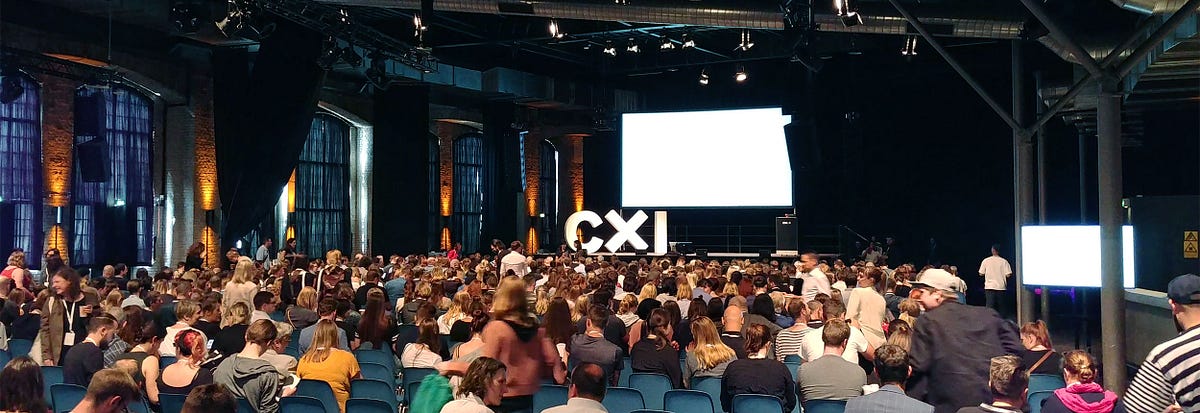
Now in its 11th year, Europe’s largest conference on corporate and brand identity is taking place. The venue for this prestigious event was once again the Bielefeld Lokschuppen, a building from the early 20th century with brick walls and a deeply industrial look.

The CXI is organized by the Fachhochschule Bielefeld, in particular the Faculty of Design. With this educational institution as the organizer, it is therefore hardly surprising that students are primarily represented in the registration and indeed in the audience.

Once again this year, six pairs of speakers and three-person constellations took to the stage to represent agencies and their clients in various brand projects. The aim was to create a unique, comprehensive picture of both parties involved in said projects. After all, otherwise you only get to hear from one side.

FOMO tv | Kurppa Hosk

The CXI_19 kicked off with the conference’s only international speakers. Swedish design agency Kurppa Hosk, represented by Thomas Kurppa, and Stockholm-based gallerist, artist, and jack-of-all-trades Jonas Kleerup shared the highly creative and nostalgic process of finding FOMO tv’s identity.

Kleerup’s idea of a video streaming platform on the topic of FOMO (Fear Of Missing Out) might be difficult to understand in its approach and of questionable relevance apart from the artistic approach, but the intensity and quality of the design left nothing to be desired. With impressive showreels of the brand-in-motion, a style reminiscent of VHS tapes and a flexible logo concept reminiscent of MTV’s myriad of logo variations, Kurppa Hosk overwhelmed the audience with visual power.

Kleerup’s idea of a video streaming platform on the theme of FOMO (Fear Of Missing Out) might be difficult to understand in its approach and of questionable relevance apart from the artistic approach, but the intensity and quality of the design left nothing to be desired. With impressive showreels of brand-in-motion, a style reminiscent of VHS tapes and a flexible logo concept reminiscent of MTV’s myriad of logo variations, Kurppa Hosk overwhelmed the audience with visual power.

To do so, Kurppa Hosk applied her own snowball-like design process to branding, approaching a finished brand gradually but with increasing speed and complexity. An interesting process, but more akin to the waterfall model than agile design, which made one wonder if this approach might be less suitable for more commercial projects due to inflexibility, at least on the outside.

Images published by CXI

Volks­wa­gen | think moto

We had the honor to be on stage with one of our clients again this year as an agency. Between late 2017 and mid-2018, we broke new ground and into new realities with Volkswagen.

To bring Generation X closer to the experience of car dealerships and shiny new cars, Volkswagen developed a series of applications for virtual reality and mixed reality. The basis of the applications was the possibility to bring different car models to the users in a playful and virtual way. The only thing missing was the smell of new cars.

The involvement of think moto started with the dissonance of many interaction patterns within these prototype-like applications. After all, no one had yet addressed the coherence of interactions across different realities. As a rule, there were hardly any applications that had to pass the test of brand conformity in both virtual reality and augmented reality. Our mission, therefore, was to create a unified pattern library to keep existing and future extended reality applications in line with other Volkswagen digital products.

think moto

OSRAM Con­ti­nen­tal | KMS TEAM

When two people move in together, the household goods do not double. This was also the experience of Nadine Schian, Head of Communications, Marketing & Brand at OSRAM Continental. In a tough, three-year struggle, the joint venture between OSRAM and Continental built itself up on the basis of a technological partnership in the field of mobility lighting solutions and faced an important challenge in the process. As the brainchild of two down-to-earth and prestigious corporations, the task of finding its identity was either to follow in the footsteps of its parents or to break completely new ground.

This question was asked even before the actual founding of the joint venture, which for Vera Schnitzlein and the southern German agency KMS Team also meant: How do you build a brand without an existing company behind it? After all, nothing had been fixed yet, let alone signed.

Visually, therefore, basic elements of both brands were used. It was particularly important to find a color scheme for the colors that could stand alone but was derived from the parents.

For OSRAM Continental, however, the advantage of such an early start to finding an identity was above all that the corporation was able to launch on the first day after its official founding with around 1,500 employees on all continents and a fully developed, independent and expressive identity. A flying start for the young joint venture.

Images published by CXI

FC Bay­ern Mün­chen | Inter­brand

How do you tell an absolute Bayern Munich fan that his club’s favorite color is now yellow and green? You don’t. Philipp Mokrohs, the club’s lead brand strategist, and Alexandra Gövert of Interbrand told us about the problems of designing an incredibly emotional brand like the world’s most famous soccer club. In 2017, Gövert and her team were tasked with touching FC Bayern Munich’s identity and bringing it into the 21st century.

For a brand whose core values are all about tradition and heritage, change means putting on kid gloves for design. Major changes would have vehemently fallen victim to the emotions of millions and millions of fans, but at the same time Mokrohs reported a need for change. Evolution instead of revolution, was the motto.

The logo, for example, which hadn’t been touched in decades, was in desperate need of craft help and was first freshened up by Alexandra Gövert’s team. This was followed by the introduction of various key visuals, the gradient in the background, and the cut and contrast of fonts and images. In the end, it became clear that the company also needed its own typeface to ensure a consistent brand presence in the future. This way, Bayern Munich is not only secure on the pitch, but also on the web (and other touchpoints).

Images published by CXI

sip­ga­te | g31

Agile, lean and in sprints to success. That’s actually a good recipe, isn’t it? That’s what the Internet telephony provider sipgate and the small Düsseldorf agency g31 thought when they tackled the rebranding of sipgate. Before they got to that point, however, the two partners had already taken a turn.

When sipgate originally came to g31, the talk was of a brand refresh – not a complete rebranding with a new identity. A project that was to be tackled in the classic waterfall approach. After the guys and gals from g31 around Mats Kubiak and Paul Schoemaker had then locked themselves away for two months and worked out a concept to meet this requirement, it was time to present.

However, the concept presented did not seem quite right for Tim Mois and Tobias Ritterbach from sipgate. Instead, they wanted something completely new. To achieve this, they now relied on two-week sprints, lively exchanges and employee surveys. Thus, week by week, the company’s stale body with its dotcom look grew into a sleek bolide in black and white with colorful facets for the Internet telephony provider’s many different products.

The previously almost independent and not at all visually consistent products and sub-brands were now captured and merged into a whole via patterns, uniform logos and a holistic identity system.

Images published by CXI

DHL | Strich­punkt

After DHL had already completed a tough and elaborate redesign of the brand a few years ago, there was no question of allowing the logo, the colors or even the key visuals to be touched, brought on board Strichpunkt to give the yellow logistics brand new vigor.

Thick tomes of style guides, separate online portals for digital and print media, and a plethora of different layouts and touchpoints from airplane wrappings to advertising posters in the DHL branch, each with its own set of rules, had slowed down the logistics giant and now threatened to be unnecessary ballast for an agile future for DHL.

Strichpunkt recognized this quite correctly and worked to consolidate the visual components of the brand. A UI toolkit for developers now helps keep new digital products consistent across different devices and shortens development time enormously. The two heavily text-heavy and opaque Brand Portals became one with lots of images, examples and help. The font selection, which previously consisted of over a dozen typefaces, was replaced by the new house font “Delivery”.

But probably the most impressive result from Strichpunkt was the creation of a layout generator, via which every DHL employee can easily create brand-compliant digital and print publications and products thanks to templates and guidelines. Just fill in the text fields, select images from the online library and you have a print-ready PDF in the highest quality and conforming to the brand from the choice of colors to the spacing.

Strichpunkt made all these changes under the concept of simplification. There should be flexible and universal principles and elements of design that can be applied across all touchpoints. And this has definitely been achieved. Good job, Strichpunkt!

Image Courtesy of DHL

Reduce and Recycle

The presence of flexible identities and living brands was to be expected at CXI_19 and did not disappoint. A simplicity of rules, reusable patterns and visuals, and a break with the separation between digital and print are leading principles of brand building and development in today’s world and in the foreseeable future.

The days of 200-page brand manuals and pixel-perfect media guidelines are numbered. Today’s brands can adapt, grow and survive. The brand is dead, long live the brand.

Five Learnings on Brands in Extended Realities

As designers, we move into new territory in Extended Realities (XR). Only rarely do we get the chance to design applications for new technologies and face new design challenges. It’s not just about designing for another dimension that brings its own unique paradigms. It is also about designing for an immersive medium that combines significantly more design aspects than screen-based media. Elements such as space and environment, lighting, sound and haptics must work together consistently to convey a unified image in the spirit of the brand.

Full immersion in a virtual world or augmented reality also enhances the effect on the user. In contrast to screen-based applications, which are always viewed with a certain distance, immersion in extended realities causes a more intense experience, which also increases the potential effect of the brand many times over. This makes brand-appropriate design in extended realities all the more important.

But how do designers develop a brand for virtual three-dimensional space? And how do you transform an established brand for these new media? We have compiled the five most important lessons learned from our Extended Realities projects for you.

1. Think Strategically

A stable brand foundation is the starting point for branded design – in all media. The Branded Interaction Design process has also proven itself in Extended Realities projects: For each brand value, we formulate design principles that define the brand’s behavior toward users.

The classic design disciplines such as look & feel, animation, transitions, etc. should be supplemented by special design aspects for extended realities. These include, for example, the look & feel of the environment, the sense of space and lighting, force feedback or sound.

2. Be Bold

In a new medium, a brand is allowed to present itself more boldly. In fact, it has to, because the user expectations associated with extended realities go beyond what has already been seen. A well-known brand in extended realities is expected to surprise and delight. Virtual, augmented and mixed reality offer the right platform for this.

The important thing is that the use case fits the brand and creates essential new value for customers or employees. One should avoid designing an application just to have an XR case. Only then can the application contribute to the positive perception of the brand.

3. Combine the good with the new

The first question that arises with every design is: Which elements do we take over from existing corporate design and which new elements must there be?

Central is of course the logo, which finds its use for example in the splash screen of the application. In our projects we have used a reduced version of the color palette, for example a dark tone as a base for layers etc. and a light blue tone for central design elements. In addition, there are often already interaction elements whose basic look and feel can be transferred to Extended Realities.

For our Extended Realities projects, we have also developed our own effect based on the existing color palette, which is used as animated feedback or transition. In this way, we exploit the potential of Extended Realities and further develop the corporate design in the spirit of the brand.

4. Mind the details

The whole is always more than the sum of its parts. This also applies to Extended Realities applications: The sum of the design aspects makes up the brand experience, and their proper interaction determines whether the whole feels round.

Due to the multitude of design aspects that come together in Extended Realities, it can be easy for the design of individual aspects to lack detail, but ambience and sound, interactions and force feedback, etc. should be coordinated.

In addition, the individual aspects within the application should be designed as coherently as possible. Design patterns must work for different contexts and cases within the application and be thought across media.

5. Design for eyes and ears

“Sound is 50% of the VR experience” writes Casey Fiktum in his book ‘VR UX’. Sound not only plays a central role as feedback on user actions, but can also help to better integrate interface elements into the virtual or real environment (for example by supporting transitions auditorily) or serve as 3D sound for orientation.

Applications for mobile devices or AR headsets must of course work without sound, as users are often in public spaces or talking to other people around them while using them.

Especially in VR, however, sound primarily creates atmosphere and thus has a decisive influence on the brand.

We minimize and compensate our CO2 consumption.

Cookie Consent with Real Cookie Banner