Human First. AI-backed.

Why Brands Are Becoming Human Again. The last few years belonged to technology. The years ahead belong to people — precisely because technology has become so powerful.

With Human First. AI-backed., we articulate our stance for a future in which AI does not replace humans, but amplifies them. It does not dominate — it empowers.

Human First stands for responsibility. And for radical creativity.

Brands must reconnect with emotion, learn to listen again, and create real meaning.
It’s about empathy, user-centered thinking, and the courage to make clear decisions. Intuition. Imagination. Judgment. These remain fundamentally human.

AI-backed means we design differently — and we advise differently.

We have rethought every step of our workflow: research, strategy, naming, brand voice, design, prototyping. AI changes speed and quality. We have rethought every step of our workflow: research, strategy, naming, brand voice, design, and prototyping. AI changes speed — and it changes quality.

Brands today are built within integrated, intelligent design systems. Strategies become sharper. Brand experiences more adaptive. Agentic AI solutions open up entirely new dimensions of brand leadership.

One thing is becoming unmistakably clear: it’s not the size of a team that matters, but the seniority of the minds behind it. AI amplifies what already exists. It does not replace responsibility.

That’s why we invest in experience, depth, and creative excellence — supported by purpose-built intelligent systems. This is how brands become not just more consistent, but more alive. The future of brand leadership is not about choosing between human creativity and technology. It lies in their interplay.

Human First. AI-backed.

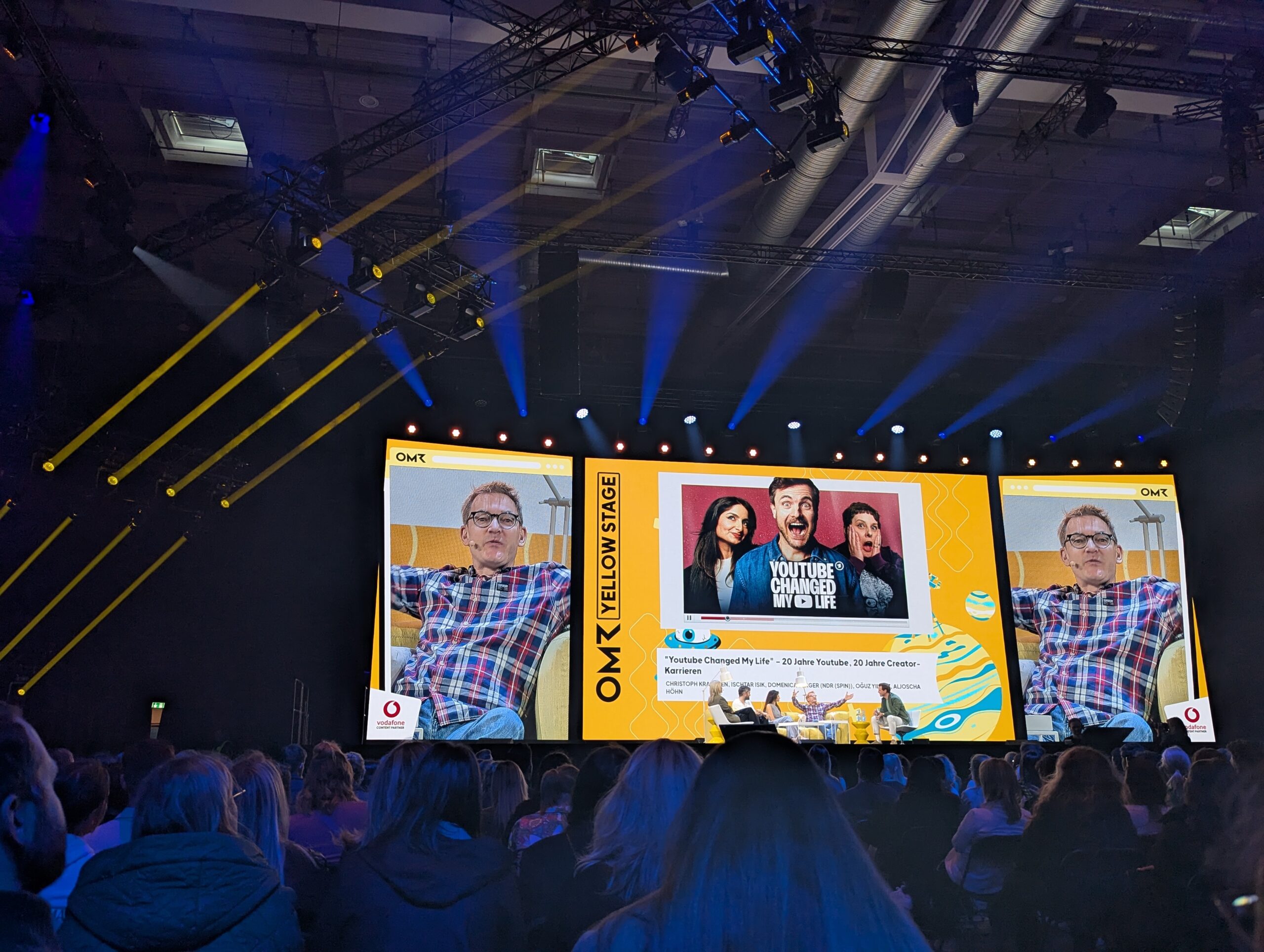
My OMR takeaway: “Do you speak Animal?”

Many people are currently asking me what impressions I took away from #OMR. Of course, one highlight was the wonderful visit with our partners at Frontify (many thanks again to Anneke Matsis in that context).

And elsewhere on the exhibition grounds? It was crowded, it was loud, and somehow the sword of Damocles—Gen AI—seemed to be hanging over everyone’s heads. Especially in online marketing, the changes over the next 12 months will likely be radical.

This year again, Philipp Klöckner delivered a true tour de force with his format “Beyond the AI hype,” driving the packed audience breathlessly through his roughly 170 (yes, really!) slides. Very well-founded. Very detailed. With glimmers of hope—such as the outlook that open source will eventually prevail even in the field of AI. But also with the already familiar shockers for the industry (farewell asset production, farewell code production, bye bye to the production of pretty much everything that has been and still is value-creating).

In the end, Philipp had to pay tribute to his tightly packed schedule—time was running out, Steven Gätjen stepped from the wings into the spotlight—only 2 minutes left for 20 slides. But those were packed with substance! Curtain up for the “Science” section:

“By 2030, the number of vegetarians will double. Worldwide.”

Thanks to AI, we are already capable (see also: documentary “Talking Pigs”) of decoding the “language” of animals. In the future, this may raise a fundamental question: Do we really want to continue with the industrial processing of living beings that we can understand linguistically—beings who, through that understanding, gain a personality?

I discussed this question with a friend last week. She’s active in the animal rights movement and was rather pessimistic about the above idea: “People already turn a blind eye to the horrors in factory farms. And no one gets in there anyway. The video of a pig begging for help and going viral—it’s not going to happen.”

But what if it does happen? What if it becomes a task for all the marketing experts at #OMR to craft exactly this kind of campaign—and to spread the question far and wide:

“Do you speak Animal?”

Recap of our Business Breakfast with Frontify

We look back with satisfaction and motivation on our first exclusive Business Breakfast, which we organized together with our partner Frontify. In a relaxed atmosphere, six experts – Anne Brüning, Holger Zeh, Tina Mushak, Matti Wachholz-Hausmann, Antonia Paul and German Schulz – discussed the topic of brand management and talked about their experiences and challenges in this area. We have summarized the highlights for you to read in this article.

Marco Spies and Katja Wenger opened with a fascinating presentation on “Spherical Brands”, an innovative approach to developing sustainable brand strategies. You can read more about this at thesphericalbrand.com.

In the panel discussion that followed, our six experts spoke on a variety of topics, such as the role of the brand manager as friend and helper, rebranding experiences, challenges in brand management and the use of creativity and agility.

What everyone agreed on: Brand management should never be perceived as the brand police, but more as a helper, coach, advisor or supporter.

Tina from BASF reported on how she manages to communicate the brand to around 100,000 employees with just a small team of brand managers. The so-called “brand champions” play a central role here, communicating the brands and their guidelines to the respective teams and being available to answer questions. Using messaging channels such as Facebook groups, the team offers a solution for sharing updates and responding to questions and concerns.

Holger from Deutsche Welle spoke about the importance of being responsive and adaptable, especially when it comes to news, social media and fake news. For Holger and his team, Frontify Publisher is the ideal tool to make processes simpler, more efficient and more trustworthy.

The ability to react quickly is also very important for German from VfL Wolfsburg, and not just on the pitch. Trust and loyalty are very important in soccer, and fans in particular expect their favorite club to have a high recognition value.

Anne from the Bundesdruckerei reported on how they have created a brand family of seven different brands, in which each one has its own identity and yet a family affiliation can be recognized among them.

Matti from Cornelsen talked about how important it is for his design team to ensure a high return on investment through brand management and long-term strategies, above all to ensure the company’s performance.

Antonia from Frontify emphasized the advantages of giving the responsible team a face and assigning clear roles in the brand management team. These roles can also be mirrored accordingly in a brand management portal such as Frontify and thus create a framework in which everyone can live out their creative potential.

The topic of creativity vs. control was discussed at length. Some ensure the creativity of their employees through best practices and clear communication, others emphasize that creativity sometimes needs to be controlled rather than encouraged in order to maintain brand consistency. Matti from Cornelsen is more concerned with creating a “tone of voice as a recipe”. According to Tina, it’s important not to dismiss employees’ ideas out of hand, but to appreciate that they are thinking while you communicate how and why an idea might need some tweaking.

We would like to thank all the panelists and participants who took part in the discussion. Also many thanks to our partners at Frontify for making this event possible!

Not enough info just yet? Stay up to date with our newsletter and sign up here.

Why Content Designers and AI Could Actually Be a Dream Team

If you’re a content designer, UX writer, or hold any other role in the field of the ever-evolving world of digital content creation, the prospect of integrating artificial intelligence (AI) into your work process is both exciting and daunting.

Large language models (LLMs), in particular, are passionately debated for how they will not only transform our work but completely disrupt it. The possibilities for editing and generating text are diverse and evolve rapidly. Yet, in the future of content design, human creativity, and AI efficiency are not competitors but rather dynamic teammates. Here are three reasons why content designers should seriously consider pairing up with AI.

1. AI is efficient and effective

AI can significantly improve the efficiency and effectiveness of content design. But only if content creators understand how AI works. The better they understand the functionality and capabilities of the system, the better they will generate useful prompts that transform their ideas in real-time. Also, AI systems are outstanding at mining vast quantities of data and identifying patterns. This can save time or open up completely new perspectives. The once-dreaded blank page can lose its intimidation. Knowing these AI capabilities and how to use them paves the way for a more efficient and effective content-creation process.

2. Humans can decide the focus

AI can free content designers to concentrate on what humans do best: shaping ideas, strategizing, and solving problems with empathy and purpose.

While AI can manage the routine tasks of data analysis, pattern recognition, and interpreting insights, it’s humans who lead the way. It’s humans who provide the perfect briefing for the artificial teammate, ensuring it creates content that is not only accurate but also relevant and ethical. It’s perfectly clear: Crafting a well-thought-out strategy is essential to nourish the AI with precisely tailored prompts and get it reflect on the ideas you’ve been thinking about. This thoughtful application of AI could help generate more targeted and personalized content, resulting in better user engagement. The more focused the thinking of humans, the more valuable the result of the AI.

3. Writing skills become a new benchmark

While AI can create mostly generic content, it still can’t replicate the exceptional writing skills that humans possess–at least not without inhuman efforts to engineer prompts.AI lacks the ability to fully comprehend nuances of language, emotion, and culture that are often essential for compelling content.

AI fails to adapt content to user and business needs. This is where content designers shine, by giving communication a fresh touch that makes it exceptional, if not surprising!

So … what’s next?

To wrap it up: AI’s role is not to replace content designers, but rather to augment their capabilities. For me, it offers a way to automate repetitive tasks so I can focus on strategic thinking, problem-solving, leadership, and maintaining exceptional writing quality. When designing conversational experiences for our customers, my role has shifted. I no longer point out the many constraints within the conversation that the chatbot used to have, but instead, give constraints to the AI to keep the conversation on track and aligned with user and business needs.

It’s incredibly fun and challenging at the same time to put yourself not only in the shoes of the user but also in the shoes of AI. As this process is just emerging, it is up to us content designers to use this service wisely and thus shape the future of our profession.

Why Digital Products Need UX Writing More Than Ever

We all know those attractive people who immediately capture our attention. They appear almost too perfect — until they begin to speak. Suddenly, they become dull and uninspiring, making us wish we’d never started the conversation. Or perhaps, they’re excellent conversationalists, but something about them is disconcerting, leaving us feeling uneasy and eager to escape.

Imagine digital products as good-looking people. While it’s the looks that make us engage with them in the first place, in the long run it’s about how these products interact with us. 

If they are uninspiring and complicated to use, we will turn them down forever. However, if they are simple and helpful, we will stick around. And if they empower and delight us? Well, that’s when we’re truly hooked. 

UX Writing and Unique User Experiences are Inseparable Twins

But how do you get your users hooked? Actually, you need to create the perfect interplay of stunning visual design, smooth navigation, and compelling UX writing. UX writing is all about helping users complete a task and providing copy that meets their needs. 

That’s why a UX writer must also be a design thinker and an integral part of the product team, iterating and testing the product.

Think of design and copy as interwoven elements that are mutually dependent. Ideally, the text will emphasize what is shown, making the visuals and navigation even more powerful.

However, if the words don’t mesh seamlessly, that could be an indication that you need to revise the design first.

Understanding Comes Before Writing

That said, UX writing is more than polished words that sound good. UX writing is more than verbal bling, bling. Instead, UX writers need to put themselves in their users’ shoes. Before they write, they need to understand what’s on their users’ minds. What they want to accomplish. What might be holding them back. It’s all about empathy. 

A good UX writer anticipates users’ needs and takes away their fears. A good UX writer is their loyal, verbal companion whose presence is useful and fun.

A good UX writer prevents stumbling, hesitating, or guessing. Instead, they show what to expect by being clear. They provide just the right information at the right time. It’s both simple, difficult, and — beautiful.

UX Writing is Addictive

When done right, UX writing is a multi-sided addiction. Between UX writers and their users. Between users and the product. Between UX writers and language. Yes, UX writing is indeed highly addictive. Because you want to make users happy. You want to come up with the best possible way to explain something. You want to share your passion for language. No matter if it’s a button, an entry screen, or a logout page. Because just as much as you care for your users you care for words, and you know how powerful they are.

You know how the wrong words can ruin it all, whereas the right words can do magic.

For More Wow in Your Products

While it’s true that UX writing principles can help other team members write decent UX copy over time, why would you entrust writing to someone who isn’t used to it or isn’t passionate about it? You wouldn’t turn to a UX writer for nifty visualizations, would you? 

There’s a reason UX writers chose their profession. Because they take the utmost care with words. Because they’re well-versed in the nuances of language. After all, words have been their dearest friends for as long as they can think. And that will pay off. Because their words will flow in the user experience as smooth as silk or as edgy as a pouting teenager if required. 

Users feel when everything is exactly where it should be and makes them think Wow and Oh and Love it! Aren’t we all looking for more wow in our lives? In an app? On a website? So let’s start listening. And get the right words out there.

Our CCO Katja Wenger on why you should attend design conferences


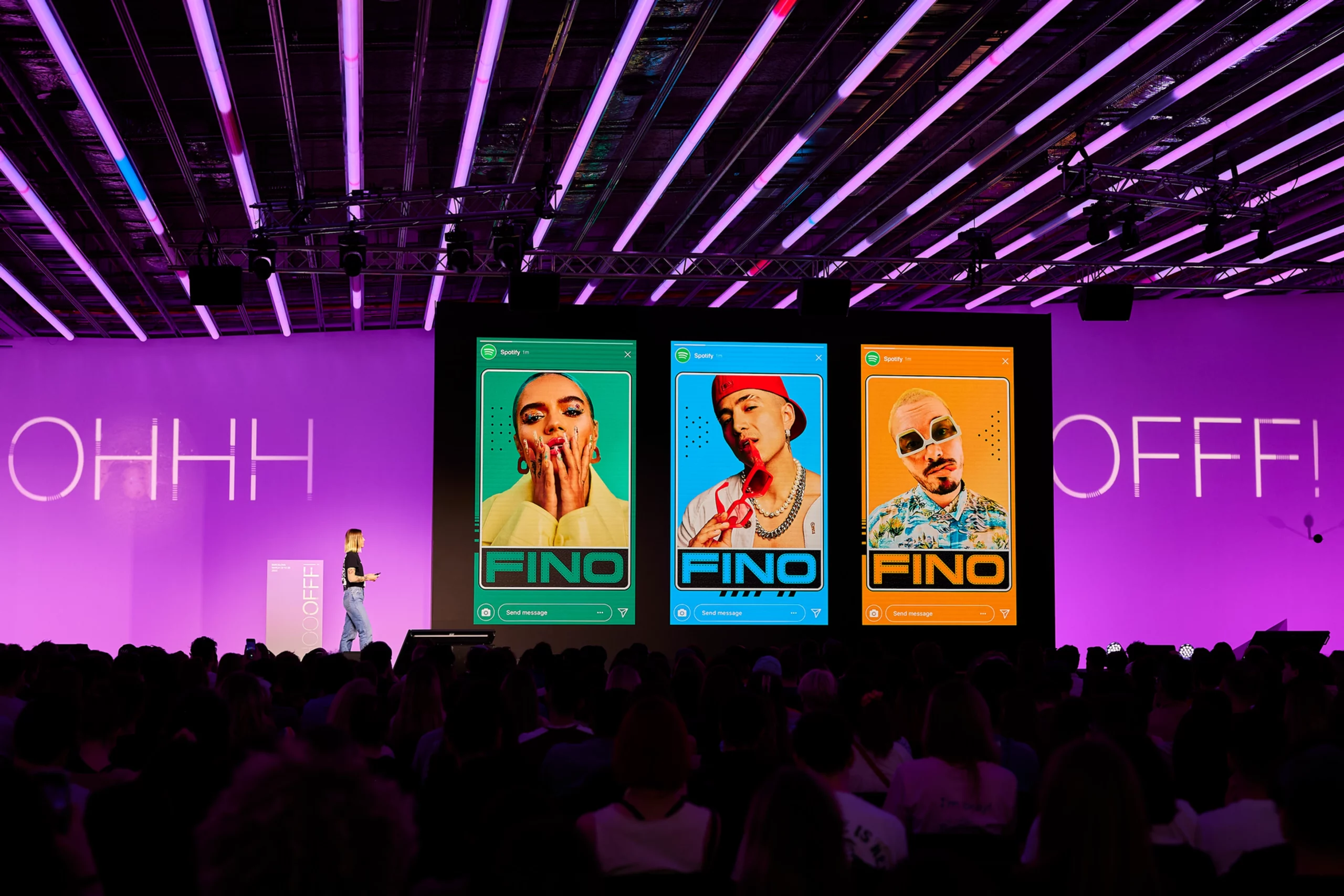
In early May we spoke with Katja Wenger about her experience at this year’s OFFF conference which took place from March 23-25 in Barcelonas Disseny Hub. We learned how she came to attend the event relatively spontaneously and what topics and speakers inspired her the most. We also talked about the importance of courage in design, the agency’s interest in showing presence at conferences, and what she thinks makes a successful conference. Join us as we gain insights and perspectives from this exciting conversation.

Hi Katja, you attended the OFFF conference in March in Barcelona… How did you come to participate?

I had participated the OFFF several times in the past, but with the pandemic everything came to a halt. In 2022 we went to the Forward Festival in Berlin in September and to the Paradigms Brand Experience Summit in Barcelona. For the latter, we were invited by our partner Frontify, who organized the conference for the first time. It was a great experience itself. 

Can you tell us about interesting topics and speakers at the OFFF?

OFFF offers a wide range of international speakers who are incredibly fascinating. There are big names like David Carson, who inspired me very early in my career, as well as smaller or lesser-known talents like the illustrator and artist Kelly Anna

It provides lots of input from various design disciplines, including motion design, 3D, interaction design, animation, and illustration. That’s what makes OFFF and conferences like the Forward Festival so appealing — you get to see different things that inspire you to explore new paths and be creatively productive again.

However, what stuck with me the most was the importance of being courageous in design.


What inspired or intrigued you the most at the conference?

Ultimately, the past six months have witnessed the birth of a new generation of AI, especially in conjunction with visual design. At the conference, we saw the cool possibilities that AI offers for visual designers. However, what stuck with me the most was the importance of being courageous in design. Being courageous means breaking out of the  traditional ideals of beauty and daring to do new things. The concept of beauty, as I learned and saw it many years ago, is evolving into something different. For example, there was a presentation by It’s Nice That, a website or blog that showcased design trends at OFFF. 

Some examples made me cringe because they looked terrible. It seems there’s a trend towards such “trashy” aesthetics. Of course, we can’t always be so daring when working with established brands. But it’s important to break new ground and encourage clients to incorporate some zeitgeist into their brand. Ideally, we have created a brand design framework that makes this possible. As an agency, we are perceived as trendsetters and are asked to provide insights into where the industry is heading.

So, it’s important for the agency to have a presence at such conferences?

It’s not only in my personal interest to attend these conferences. It’s also important for all the designers and also creative technologists who work at think moto. We give them the opportunity to participate in conferences as well. That’s very important for me. It’s not productive if only I, as the CCO, attend. We can’t effectively share the knowledge we’ve gained, and everyone has their own interests and feelings about different presentations. Everyone takes away something valuable. 

I recommend everyone to take part in conferences because they move you forward and allow you to step out of your own bubble and be inspired. There is something very special about listening to a lecture, reading between the lines and hearing the personal stories of the speakers. It’s especially inspiring for young designers, because they learn about a designer’s career, the effort they put into their work, and how chance led them to where they are now.

As an agency, we also actively participate in conferences ourselves. Sometimes it’s about a specific topic. With Branded Interactions, for example, we have been approached several times and have given several presentations at conferences. We’ve been to the CXI, the largest brand conference in Germany, twice so far, once together with a startup client and once with Volkswagen on the topic of Extended Realities

Most recently, we presented our Spherical Brand approach at a CX conference in Oslo, a new concept for brand management in the post-growth economy.  

I believe it is an opportunity for us to reach out and attract talented people. Being able to showcase our work and agency at these conferences provides an excellent chance to get visibility within the design community


What, in your opinion, makes a good conference or contributes to its success?

Of course, the speakers are key, but it’s not just that. The choice of location is also important. Sure, OFFF in Barcelona is super cool and huge, but last year I had the chance to attend Paradigms, which was the very first conference organized by Frontify. That conference impressed me the most. It’s hard to put into words. It was an amazing conference, especially considering the location, organization, food, evening events, and the international speakers they managed to bring together for such a small conference. It was just mind-blowing! If anyone ever gets the chance to attend, it’s absolutely fantastic! It focused on corporate design, brand management, and brand leadership. Frontify, being a company in that space, had the right tools for it.

Thank you Katja!

What ChatGPT and LLMs Mean for How We Build Conversational Interfaces for the Future

Firstly, what are LLMs and ChatGPT? This is not an article about what LLMs (or large language models) and ChatGPT are. If you have been living under a rock and are unfamiliar with these names and terminology then this article written by ChatGPT explaining itself should be a good starting point.

We have been receiving questions from – and participated in many discussions with – our customers and peers about this exciting new tech and wanted to clarify our stance on where we see the opportunities and weaknesses at the current stage, as well as looking forward to a potential hybridized future. The biggest talking point has been the need for conversation design in an increasingly automated and generative world.

From our perspective as experts on conversational interfaces and conversation design we see predominantly two paths that this technology and trend will continue to develop on: the path of consumer-facing applications and the path of the technology as a tool and force multiplier. Neither of which will be eliminating the need for humans behind the wheel, steering the technology, anytime soon.

Hopping on the LLM bandwagon

Broadly speaking, this technology and its implications are spreading at breakneck speed. Many platforms are currently aiming at capitalizing on this goldrush-like state. You may have heard of Microsoft implementing ChatGPT in Bing and Google looking at fusing their proprietary equivalent LaMDa with their own search engine. These search engines follow a trend that companies such as SoundHound have been pursuing for a while, responding to users not in lists of search results, but in concrete answers in the form of natural language.

Other examples of quick wins in this brand new space are bot platforms such as Voiceflow and Cognigy.AI. Here the same purpose of applying LLMs to dynamically generate the system responses or predictable training data for intent training is being used heavily. Some platforms, like Cognigy.AI, are also considering going a step further and looking into the empowerment of conversation designers by allowing the creation of flows and elements through natural language prompts, speeding up the process of setting up new conversations greatly and thus contributing to rapid prototyping capabilities of these low-code platforms. Will these features collate into conversations that are production-ready, about to be rolled out to millions of users, out-of-the-box? Of course not. But they provide a good first framework to expand upon.

Trust in the system and the tech is dwindling

Widely broadcasted anecdotes of tech journalists and influencers, as well as hear-say from colleagues and friends have recently lead to a lot of skepticism when it comes to the current state of the technology. Articles quoting the unsettling feeling, individual erroneous responses and behavioral patterns reinforce negative connotations when it comes to LLMs in todays world. This obviously has a huge negative impact on consumer-facing applications.

Finding an appropriate place for LLMs should not be difficult

Focusing on this new technology as a force multiplies and enablement tool, is therefore the more stable path from our perspective. At least while the technology matures and new, more refreshing experiences for consumer-facing applications improve the publics perception in the mid-term.

On a more immediate and applied note, ChatGPT and LLMs are a great vehicle for innovation and a popular driver for change, but they are tools and will not replace human experts in conversation design. It is a good gap-filler and repetitive tasks but it will not provide the confidence and accuracy of dialogues designed by humans for a while.

The conversation designer is still the agent of change for this new tech

Our workflows in the future could consist of conversation designers laying down the structure of a dialogue, such as the starting point, the goal of the conversation and some checkpoints along the way, with the generative AI or LLM filling the gaps.

In an ideal world we would provide the AI with a purpose and a personality, but no actual dialogue would need to be written by humans. The conversation designer would be focused entirely on the strategic purpose of the interface and the decision on a vector of the personality and tone of voice of the bot.

Paul Krizsan, Director Conversational AI

So while remaining up to date with the current developments of this exciting new technology is vital, we do not share the current ubiquitous sentiment that users are ready for unfettered access to potentially image-harming experiences without having some of the kinks of current LLMs ironed out over the course of 2023.

Are you interested in talking about conversational interfaces, LLMs and how to design for conversations? Talk to us!

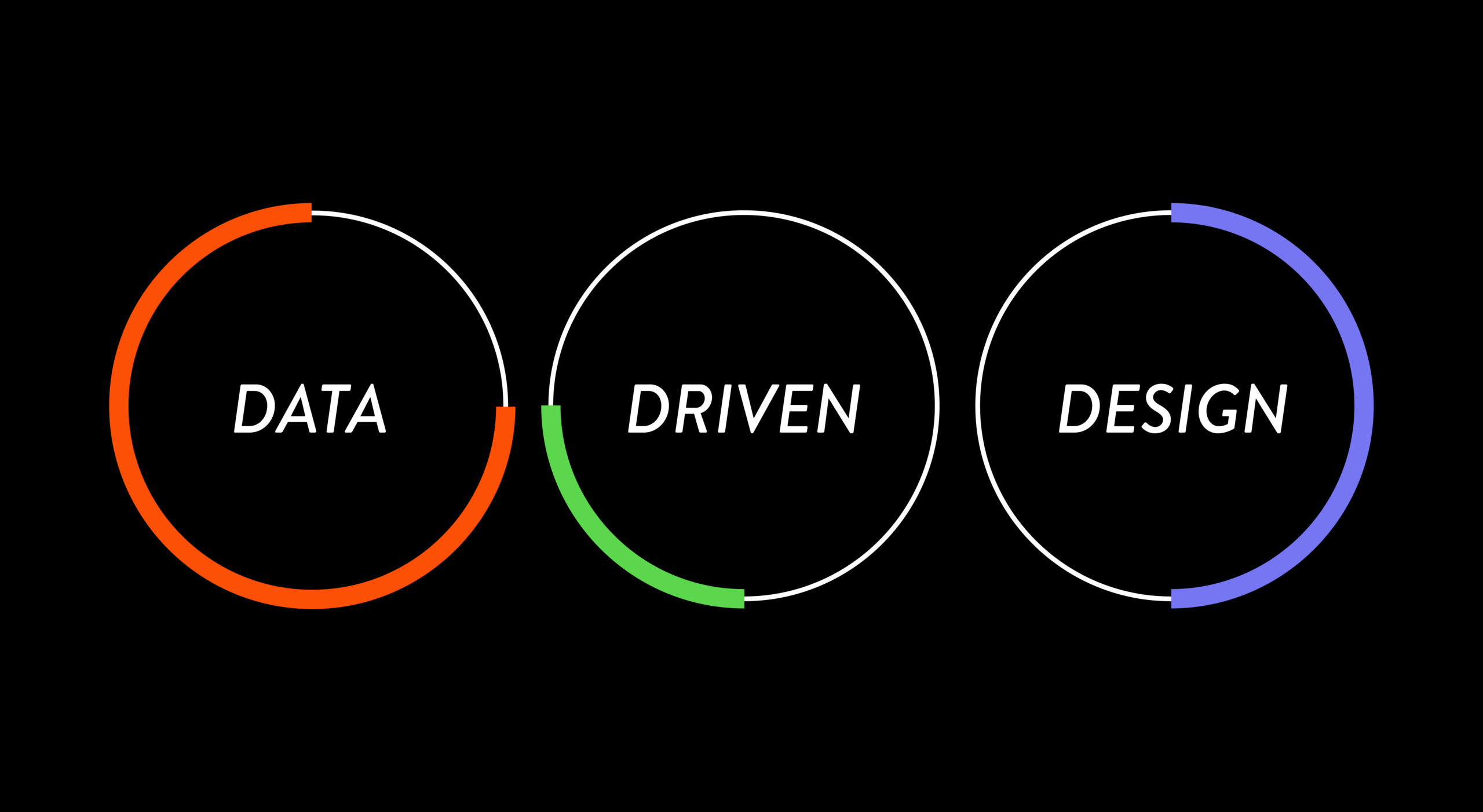
Data-Driven Design–Designing with Data in a User-Centric Way

We talked to Marie Bossecker, Senior Experience Strategist at think moto, about Data-driven Design. She has many years of experience in combining data, strategy and design in such a way that they form the basis for development processes for digital products and services. We asked Marie what data-driven design actually is, how data-based design and creativity are connected, and how innovation gains quality through user data.

Data-driven design is radically user-centric and derives from design thinking. The first step, even before the strategy and design process begins, is an extensive collection of real user data that reflects the current behavior of the user group. Together with further data collection during the process, they form the basis for the development of new approaches in strategy and design.

“Data-driven design means making design decisions based on prior research and data analysis.”

The term data encompasses both the results from qualitative research, such as interviews, and quantitative research, such as surveys or tracking data.

What is the Data-driven Design process?

As with many design approaches, there is no clear process template. The steps presented here are a framework that can be used as is or modified slightly. As a structural basis, the 5 steps of Design Thinking serve: Empathize, Define, Ideate, Design and Test.

1. Data collection & analysis

Data can be collected using various methods, e.g., qualitative user interviews or quantitative data collection. Tools that anonymously query or record user behavior, such as in-page surveys, heat and click maps, or eye tracking, can be used for this purpose.

Data analysis is the task of the strategists. They interpret the data and filter out the problematic interfaces. Many modern tools for data analysis can help to identify conspicuous features and hierarchies that promote or negatively influence the performance of a website.

2. Definition

The task now is to react to the findings and assumptions made. This phase is accompanied by extensive research and, if necessary, user tests to re-examine the assumptions. There are many inclinations in the market that can affect user behavior. For example, the pandemic. User behavior has changed extremely as a result. These external influences and trends are highlighted and analyzed in the definition phase.

“Does a better conversion rate mean we’ve had success, or are there perhaps other movements in the market or in the target group that are influencing this result?”

3. Strategy

In this stage of research, a strategy/concept is developed based on the previous steps, which addresses the identified problems and includes possible solutions. As a rule, several approaches are developed here, which must prove themselves in the course of the further process or are just discarded.

4. Design & Implement

Based on the strategy, conceptual and design measures result, which are implemented by the designers. These are then implemented in the existing website. But the job is not done after that.

5. Test

After implementation, a test phase is carried out again to check how successful a measure was. The data obtained can then be used in turn to draw lessons and develop a revised strategy. This cycle is also known as “customer journey optimization”.

What role do strategists play in the data-driven design process, and how do they differentiate themselves from data analysts?

In quantitative methods, data analysts are primarily responsible for enabling data collection, i.e., creating an interface between the platform and the analysis tool, storing the data, and making it available to strategists in accessible dashboards. Interfaces, such as Google Analytics, hotjar or VWO, make the collection and transmission of data possible in the first place. In order to better evaluate the generated data, it is translated into dashboards and presented in an understandable way using data visualization. The strategists gain access to the data and can now evaluate it. Their task is to analyze and interpret the collected data, define measures, accompanied by extensive research, and then develop a strategy.

In qualitative methods of data collection, for example interviews or focus groups, strategists can be involved from the beginning. They develop the study, define aims and set the framework. After data collection, they then also evaluate the data.

What is the added value from combining strategy and data analysis in the design process?

With the flood of digital offerings, those who know their users best and create the best experience for them will prevail. The short attention span of users has made it all the more important to present relevant content in the most accessible way possible. The better the experience is tailored to the user and their needs, the longer their stay and the higher the likelihood of a “conversion,” such as a purchase or download.

It is almost impossible for designers today to include all the needs of potential user groups in design decisions. Some use the website very frequently, others only drop by occasionally. There are digitally affine personalities and those who need more assistance. That’s why it’s important for designers to draw on previous, data-based research. These show the current, real-world behavior of active user groups.

“You can’t know as a designer what your users really do or need without prior, data-based research. That’s where the clear difference lies between having some opinion and having some knowledge.”

Where does our Branded Interactions design process link to the Data-driven Design approach?

Data analysis can be well integrated in all phases of the branded interactions design process. It depends on the project and the industry of the customer how intensively the analysis of user data can be applied. Data collection is particularly helpful on websites with high traffic, where many users come together, such as in a large e-commerce store. Chatbots and their interfaces also provide a good basis for increasing performance through data in the long term. Qualitative data collection, on the other hand, can also support pure branding projects and MVBs and help to better understand the user group from the beginning through interviews and other research methods.

“Especially in the first two phases, Discovery and Define, data-driven strategy can be linked to the Branded Interactions design process. In Phase 5, Distribute, likewise, as the goal then is to evolve what has been implemented.”

Doesn’t creative freedom get lost if you always refer to data?

Real user data should not be a restriction on design freedom, but should serve as a support in the development of new design approaches. The data shows designers which approaches are already working well and which are not working at all. This allows them to focus on the essential pain points and create solutions where they are really needed. There are no limits to creativity itself.

Continuous analysis of user behavior helps us to optimize what we already have and adapt it to users in the best possible way. In order to develop new, innovative approaches, you have to keep questioning your previous knowledge to see what might work even better. Innovative design approaches can also be improved again and again through user testing and research.

What challenges do trends and technologies from the fields of tracking and data analysis bring for the combination of data and design?

In addition to external factors, such as pandemics, climate change or sustainability, current trends play a decisive role in how we behave online. For example, video content currently works much better than static content, as platforms like TikTok or Instagram guide. The need to be treated as an individual also has an impact on what we demand from our online experiences.

 “When it’s my birthday, I expect a fat voucher from the brand I’ve already left hundreds of euros with.”

The line between personalizing content and manipulating buyers can be very thin. Every click and every text written reveals more about what we like and even how we feel right now. In parallel to the real personality, we also have a virtual one, which analytics tools build from our behavior, our data, and then feed us the content that best suits us.

“I believe that in the future, the line between manipulation and personalization will become narrower. The question is, after all, where do we draw the line? What is exploitation, what is convenience? As designers, we have a supporting responsibility to position ourselves.”

Want to learn more about the design process at think moto? You can read all about it in the book Branded Interactions by our founders. Also check out our project portfolio on thinkmoto.com to learn more about our work.

Adobe 99U Conference: What I took back to the office

Welcome to the creative future

The time has come — I (Isabel Hillenbrand) am on the way to my first design conference in New York. Having secured an Airbnb apartment conveniently close to the venue that is the Lincoln Center, the way to the conference is luckily not much of a challenge.
So, despite jet lag, I make it to the opening on time and even have time to grab a coffee and some fruits in the bustling Alice Tully Hall lobby. Much-needed energy for a long and exciting day to come.

This year’s overarching topic is ‘The Creative Future’, relating to our hope for what’s next: a world in which every creative is empowered and equipped to enforce values like empathy, curiosity and purpose.

The conference experience has already started a couple of weeks before the actual event when all participants received a neat pin that picked up the topic and increased the anticipation even more— stating ‘I have seen the future’.
It is a tribute to a souvenir from the 1939–1940 New York World’s Fair where visitors exiting the ‘Futurama’ pavillion could proudly claim ‘I have seen the future’.

So here I am, sitting in the packed Starr Theater at Alice Tully Hall —
a concert venue at Broadway and West 65th Street in Midtown Manhattan that is part of the larger Lincoln Center. Together with 1,000 fellow designers, marketers, engineers, educators and artists among others, I am ready to explore two days of leadership, design, collaboration, productivity and more. All talks will be original, none has been given before.

“There are events around the world where creatives like you are told about technologies coming to take your jobs. This isn’t one of them.”

Will Allen, VP Community Products at Adobe
Alice Tully Hall lobby — photo by Ryan Muir for 99U

How to make the future bright

Below I share my takeaways of the following two days of keynotes, master classes and workshops that are everything from being entertaining to thought-provoking and inspiring.

Day 1

The first speaker of this year’s 99U is Dr. Vivienne Ming, who co-founded Socos Labs, an independent think tank that explores the future of human potential and the influence of AI on it. Alongside an insight into her latest brainchilds like a technological brain support to stimulate human thinking, she underlines the role of human creativity in the context of the increasing possibilities in the field of AI: In this day and age, it is even more important to be brave enough to truly explore new shores and share one’s unique vision as this will remain an essential advantage of the human being for the foreseeable future. She appeals strongly to our courage — to put it above the fear of losing our jobs if we want to achieve real change.

“Artificial intelligence is fundamentally a tool and you’re the artists. It is a huge mistake to think AI will solve our problems. But taking creative people that know how to explore the unknown and have the courage to do what they think is right, that is fundamentally what creativity is about.”

Dr. Vivienne Ming, Co-Founder & Executive Chair at Socos Labs

The key message of the next speaker, Zach Lieberman, the co-founder of the School for Poetic Computation that teaches students how to use code as a medium for poetry and art, is to constantly look for opportunities in which we can learn and grow — and help others do the same.

“The key to creativity is finding a way to listen to yourself.”

Zach Lieberman, Co-founder of School for Poetic Computation
Audience during Lieberman’s talk — photo by Ryan Muir for 99U

Zach Lieberman is followed by Kyle T. Webster, a Design Evangelist at Adobe. He makes a point stressing how we entertain our minds from morning to night with ever more screen time although boredom is a blessing and a key driver of creativity — a means to unlock the place where creative ideas come from. “We are so bad in being bored. We have to allow ourselves the time and space for boredom. What if we perceive boredom as a blank canvas for our mind?” are some of his central statements.

“We can’t control our subconscious, but we can create the circumstances where our subconscious comes into play.”

Kyle T. Webster, Design Evangelist at Adobe
Kyle T. Webster on the main stage — photo by Ryan Muir for 99U

Next, IDEO’s Tim Brown is interviewed by Courtney E. Martin about various design topics. In his opinion, it is the best time in history to be a designer.

Similar to Dr. Ming before, Brown also addresses the necessary creative confidence to go into the unknown as well as the necessity in our times to master the design of evolving products when iteration and a constant management of ecosystems comes into play. You can’t just design products and are done, ready to move on to the next project — there is no finite moment anymore. Speaking about ecosystems, he makes the comparison with natural ecosystems like rainforests that are diverse, complex and ever evolving.

In addition, he talks about that design is a team sport as well as politics. More ideas fail in organizations than from market rejection so that getting a great idea through the maze is equally important as coming up with the idea in the first place. In this respect, he mentions that mastery in design largely means mastering people and organizations. You have to design for the organization that is the vehicle, for example by creating real experiences as soon as possible instead of bland PowerPoint slides.

Towards the end of the interview, Brown speaks about the necessary ethics of design work – at the same time warning that if you only care about not creating any sort of harm for anyone, you will never create something new. “The thing about new ideas is that they’re like a fragile new species. They have to live for awhile before they flourish. If they get killed before that, they don’t have a chance to flourish,” he says. Instead, we need a system or agreement to make sure we don’t do intentional harm.

“That confidence to leap into the unknown is a form of mastery.”

Tim Brown, CEO & President of IDEO

Kat HolmesDirector UX Design at Google and Founder of Mismatch.design, takes the opportunity to speak about inclusive design and how it can be a catalyst for design as it opens up your thinking. “What if there is no average, no normal?” she asks. She tells us to always ask what is missing in one’s design and what changes for all users when moving from a human to a digital experience for example. “Disability is no health condition but a mismatch — a mismatched interaction between the features of a person’s body and the features of the environment they live in,” Holmes says. “Don’t expect people to match your design. It should be the other way around.”

“What if there was no such thing as normal? How would we proceed in our design?”

Kat Holmes, Director UX Design at Google & Founder of Mismatch.design
Kat Holmes on the main stage —  photo by Ryan Muir for 99U

In the following talk, Joel Beckerman, Founder, Composer and Producer at Man Made Music, makes us aware that a lot of designers simply forget about sound although it is the experience dimension to which users respond most quickly. “If you’re afraid of a horror movie, don’t close your eyes, close your ears,” he tells us. Therefore Beckerman encourages us to practice better storytelling by using music and sounds and also to keep in mind the reaction you want to create with an experience in a given environment. Can you imagine the beeping sounds in hospitals to promote health and well-being?

“When the sound doesn’t match the visuals, your brain believes your ears first.”

Joel Beckerman, Founder, Composer & Producer at Man Made Music

In the afternoon, I attend a high-energy workshop run by Disney’s former Head of Innovation & Creativity, Duncan Wardle.

Following the title ‘Blue Sky Thinking: Where Revolutionary Ideas Come From’, Wardle speaks about how to spark creativity and come up with new ideas as well as how to share them with your team and the client in a sucessful way.

He shares the story behind the Disney MagicBand — a plastic bracelet in use at Walt Disney World Resort that provides a way for the system to connect data to guests. “At the start of its development, the central question was ‘How can we avoid standing in lines?’ and not ‘How can we raise profit by 3%?’” Wardle says. “Start by embedding new solutions deeply in and financial success will follow.”

Speaking about ideation, Wardle encourages us to get into a subconscious state, something that usually doesn’t happen in the office, to encourage playfulness and to regularly break out of our daily habits. Doing things differently every time allows us to access a fresh mind for creative ideas.

Another approach to thinking beyond the usual patterns is the involvement of naive experts — to have an outsider in the room in the form of a person from a different country or industry, who asks the ‘stupid’ questions and brings in new possibilities for solutions. Similarly, he recommends to list all the rules of a challenge and challenge them by asking ‘What if these rules didn’t apply? What would our possibilities be?’.

In an attempt to create an open, positive space for sharing new ideas,
Wardle reminds us of preferring the phrasing ‘Yes, and …’ over the use of
‘No, because …‘ to transfer a concept from ‘my/your idea’ to a group idea and also to grow infant ideas that are still very rough and by no means fully fleshed out yet.

When a new idea is born, Wardle always captures it in a few full sentences right away to avoid not remembering important details the next day.

Presenting the results to clients, he is a big fan of creating an environment with no barriers such as a table as well as of putting the presentation up on all four walls and taking the client for a walk around the room — turning the presentation into a conversation.

Photo by Duncan Wardle
Visual workshop recording — drawing by Lisa Rothstein

The subsequent master class is entitled ‘Gathering and Presenting Design Research’ and is hosted by Paige Bennett, a Design Researcher at Dropbox.

She shares ways to communicate your research results to turn the larger team into advocates of our findings. “Your findings must be able to live on without you as their guardian,” she says. Exhibit pop ups in central office locations, collaterals like fun stickers with key results as well as an informal ‘brown bag’ Q&A session over lunch or a coffee are all proven formats to get attention and buy-in from people outside of the core research team.

In addition, Bennett suggests to share intentions and results early and continuously during the process, using formats like a ‘What to expect and not to expect’ summary, dispatches from the field, theme progression insights as well as a highlight reel in the end.

Day 2

My second day starts with a master class on ‘Designing Tomorrow, Better’ with Brian CollinsHe is the founder of COLLINS that was named as one of the companies transforming the future of brand building by Forbes.

Collins states that “Companies are no longer in competition with each other. They’re in competition with the future itself.” However, we shouldn’t be fighting against the future and all the change it brings, but create a chosen future with maximum love. “The opposite of courage is not cowardice but conformity,” he says.

In this context, he speaks about recent work of his company that attempts to actively shape the future with meaning — engaging Spotify listeners, building a LEED-certified gas station for BP that educates about environmental impact and conservation or a radically new lip balm shape for the skin care brand EOS.

When it comes to execution, Collins mentions the importance of team collaboration as well as courage in visual design that is of particular significance in today’s times in which design finds its way into all processes. ”Create bold design systems that open up possibilities instead of closing them down,” he tells us.

Alice Tully Hall lobby — photo by Ryan Muir for 99U

The following workshop on ‘Presenting Bold Ideas’ is held by Irene Pereyra from Anton & Irene (Anton is sick that day).

Irene shows us how to prepare for and thrive in any presentation and distills her recommendations down to ten commandments:Be comfortable in your body (Relaxation excercises help!)Be comfortable with silence (Smile!)Be strategic about when you present (Not before or after lunch!)Work on your confidence (55% of what is remembered is body language!)Get rid of filler words (Choose silence instead!)Structure your content like an hourglass (Presenting is storytelling!)Learn not to rely on visual aids (Be ready to present without any slide!)Practice, practice practice (Practice!)Invite feedback from your team (Do they disconnect at ay point?)Smile, and learn to enjoy being the center of attention (You rock!)

Opening slide of the ‘Presenting Bold Ideas’ workshop by @antonandirene

In the afternoon, Giorgia Lupi, Information Designer and Partner at Pentagramshows us how to make data more consumable and meaningful by the use of design. She is looking forward to a time when data-driven design is replaced by design-driven data. The examples of her work for the ‘Data Wall’ at the Starbucks Reserve Roastery in Milan and for ‘Bruises’ — a project on the impact the illness of a child has on its family — illustrate how data vizualisation has the power to evoke empathy and also personal relevance, especially when music is added for an extra effect. “There is a world of unexplored, small, and intimate data that we never see,” she tells us.

“Our world is random and messy. Collecting data does not make it more perfect or more controllable.”

–Giorgia Lupi, Information Designer & Partner at Pentagram

Next, Anna Pickard from Slack talks about what it means to make your brand human — a goal most brands strive for today. Her key message is to make people feel seen and not to underestimate the value that a heartfelt error message or a “You’re doing great!” tweet might have. “It’s not about pretending to be human; it’s about finding the moments when you can connect with people,” she says. You have to show a two-way empathy, meeting the people where they are, and also bring the people behind the product to the fore. In addition, she tells us to put the voice of the brand in everyone’s hand instead of having a strict guide. In the end, it’s all about being clear, concise and human.

“Words have never mattered more. A single word can elevate something or it can change your perception. Even if it’s just your own perception.”

Anna Pickard, Head of Brand Communications at Slack
Anna Pickard on the main stage — photo by Ryan Muir for 99U

Eventually, Michael Ventura, Founder and CEO of the brand strategy and design practice Sub Rosa, highlights the importance of a holistic empathy throughout teams to make them better at their job. He tells us that empathy goes beyond being nice or compassionate but that it brings versatility to the process, knowing when to ask and when to listen, and that it should be accompanied by the will to really find out new truths. “It’s going to slow things down before it speeds things up,” he says. However, it will show positive results in the form of less rework, more sales as well as happier customers in the long run.

“Empathy requires attention and commitment. Be brave, because this isn’t something everybody’s willing to do. But if you are willing to do it, you will see change.”

 Michael Ventura, Founder & CEO, Sub Rosa

Summary

Looking back on two days full of inspiration, there are several themes and thoughts that were repeatedly addressed or that I particularly remember for other reasons:

Look into the future with a positive state of mind that curiously involves today’s technological developments instead of fighting them and use your capacities that machines can’t imitate so quickly — your unique creative vision as well as the creation of authentic, human relations with consumers.Show versatile empathy and find out about the whole self of consumers by practicing deep listening and observation in a trustful setting, meeting them where they are and being open to really discover something new.Use the power of your team and create an open, positive and supportive atmosphere where people stimulate each other’s thinking and build on the ideas of other team members to come up with the best results possible.Bring out unique ideas by allowing yourself undisturbed time to let your thoughts wander and break out of routines regularly, be bold enough to share your ideas with the world and think of ways that make it easiest for other people to fully understand them.

More than ever, creativity today demands courage. Let’s be brave and make the creative future bright by taking control of our tomorrow!

Want to design the future with us?

think moto is a digital design consultancy based in Berlin, Germany.
You are planning an innovation project? Let us know!

Visual power seeks identity–Impressions of CXI_19

Brick meets Brand

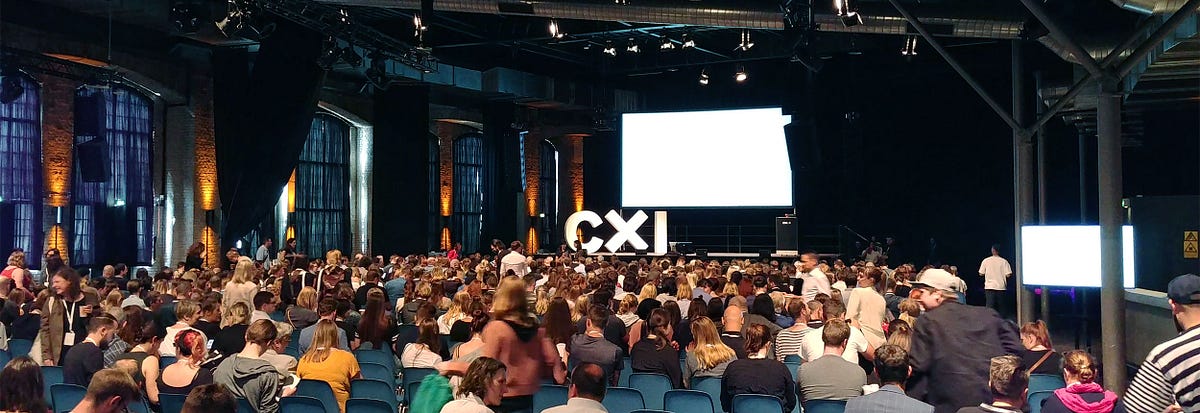
Now in its 11th year, Europe’s largest conference on corporate and brand identity is taking place. The venue for this prestigious event was once again the Bielefeld Lokschuppen, a building from the early 20th century with brick walls and a deeply industrial look.

The CXI is organized by the Fachhochschule Bielefeld, in particular the Faculty of Design. With this educational institution as the organizer, it is therefore hardly surprising that students are primarily represented in the registration and indeed in the audience.

Once again this year, six pairs of speakers and three-person constellations took to the stage to represent agencies and their clients in various brand projects. The aim was to create a unique, comprehensive picture of both parties involved in said projects. After all, otherwise you only get to hear from one side.

FOMO tv | Kurppa Hosk

The CXI_19 kicked off with the conference’s only international speakers. Swedish design agency Kurppa Hosk, represented by Thomas Kurppa, and Stockholm-based gallerist, artist, and jack-of-all-trades Jonas Kleerup shared the highly creative and nostalgic process of finding FOMO tv’s identity.

Kleerup’s idea of a video streaming platform on the topic of FOMO (Fear Of Missing Out) might be difficult to understand in its approach and of questionable relevance apart from the artistic approach, but the intensity and quality of the design left nothing to be desired. With impressive showreels of the brand-in-motion, a style reminiscent of VHS tapes and a flexible logo concept reminiscent of MTV’s myriad of logo variations, Kurppa Hosk overwhelmed the audience with visual power.

Kleerup’s idea of a video streaming platform on the theme of FOMO (Fear Of Missing Out) might be difficult to understand in its approach and of questionable relevance apart from the artistic approach, but the intensity and quality of the design left nothing to be desired. With impressive showreels of brand-in-motion, a style reminiscent of VHS tapes and a flexible logo concept reminiscent of MTV’s myriad of logo variations, Kurppa Hosk overwhelmed the audience with visual power.

To do so, Kurppa Hosk applied her own snowball-like design process to branding, approaching a finished brand gradually but with increasing speed and complexity. An interesting process, but more akin to the waterfall model than agile design, which made one wonder if this approach might be less suitable for more commercial projects due to inflexibility, at least on the outside.

Images published by CXI

Volks­wa­gen | think moto

We had the honor to be on stage with one of our clients again this year as an agency. Between late 2017 and mid-2018, we broke new ground and into new realities with Volkswagen.

To bring Generation X closer to the experience of car dealerships and shiny new cars, Volkswagen developed a series of applications for virtual reality and mixed reality. The basis of the applications was the possibility to bring different car models to the users in a playful and virtual way. The only thing missing was the smell of new cars.

The involvement of think moto started with the dissonance of many interaction patterns within these prototype-like applications. After all, no one had yet addressed the coherence of interactions across different realities. As a rule, there were hardly any applications that had to pass the test of brand conformity in both virtual reality and augmented reality. Our mission, therefore, was to create a unified pattern library to keep existing and future extended reality applications in line with other Volkswagen digital products.

think moto

OSRAM Con­ti­nen­tal | KMS TEAM

When two people move in together, the household goods do not double. This was also the experience of Nadine Schian, Head of Communications, Marketing & Brand at OSRAM Continental. In a tough, three-year struggle, the joint venture between OSRAM and Continental built itself up on the basis of a technological partnership in the field of mobility lighting solutions and faced an important challenge in the process. As the brainchild of two down-to-earth and prestigious corporations, the task of finding its identity was either to follow in the footsteps of its parents or to break completely new ground.

This question was asked even before the actual founding of the joint venture, which for Vera Schnitzlein and the southern German agency KMS Team also meant: How do you build a brand without an existing company behind it? After all, nothing had been fixed yet, let alone signed.

Visually, therefore, basic elements of both brands were used. It was particularly important to find a color scheme for the colors that could stand alone but was derived from the parents.

For OSRAM Continental, however, the advantage of such an early start to finding an identity was above all that the corporation was able to launch on the first day after its official founding with around 1,500 employees on all continents and a fully developed, independent and expressive identity. A flying start for the young joint venture.

Images published by CXI

FC Bay­ern Mün­chen | Inter­brand

How do you tell an absolute Bayern Munich fan that his club’s favorite color is now yellow and green? You don’t. Philipp Mokrohs, the club’s lead brand strategist, and Alexandra Gövert of Interbrand told us about the problems of designing an incredibly emotional brand like the world’s most famous soccer club. In 2017, Gövert and her team were tasked with touching FC Bayern Munich’s identity and bringing it into the 21st century.

For a brand whose core values are all about tradition and heritage, change means putting on kid gloves for design. Major changes would have vehemently fallen victim to the emotions of millions and millions of fans, but at the same time Mokrohs reported a need for change. Evolution instead of revolution, was the motto.

The logo, for example, which hadn’t been touched in decades, was in desperate need of craft help and was first freshened up by Alexandra Gövert’s team. This was followed by the introduction of various key visuals, the gradient in the background, and the cut and contrast of fonts and images. In the end, it became clear that the company also needed its own typeface to ensure a consistent brand presence in the future. This way, Bayern Munich is not only secure on the pitch, but also on the web (and other touchpoints).

Images published by CXI

sip­ga­te | g31

Agile, lean and in sprints to success. That’s actually a good recipe, isn’t it? That’s what the Internet telephony provider sipgate and the small Düsseldorf agency g31 thought when they tackled the rebranding of sipgate. Before they got to that point, however, the two partners had already taken a turn.

When sipgate originally came to g31, the talk was of a brand refresh – not a complete rebranding with a new identity. A project that was to be tackled in the classic waterfall approach. After the guys and gals from g31 around Mats Kubiak and Paul Schoemaker had then locked themselves away for two months and worked out a concept to meet this requirement, it was time to present.

However, the concept presented did not seem quite right for Tim Mois and Tobias Ritterbach from sipgate. Instead, they wanted something completely new. To achieve this, they now relied on two-week sprints, lively exchanges and employee surveys. Thus, week by week, the company’s stale body with its dotcom look grew into a sleek bolide in black and white with colorful facets for the Internet telephony provider’s many different products.

The previously almost independent and not at all visually consistent products and sub-brands were now captured and merged into a whole via patterns, uniform logos and a holistic identity system.

Images published by CXI

DHL | Strich­punkt

After DHL had already completed a tough and elaborate redesign of the brand a few years ago, there was no question of allowing the logo, the colors or even the key visuals to be touched, brought on board Strichpunkt to give the yellow logistics brand new vigor.

Thick tomes of style guides, separate online portals for digital and print media, and a plethora of different layouts and touchpoints from airplane wrappings to advertising posters in the DHL branch, each with its own set of rules, had slowed down the logistics giant and now threatened to be unnecessary ballast for an agile future for DHL.

Strichpunkt recognized this quite correctly and worked to consolidate the visual components of the brand. A UI toolkit for developers now helps keep new digital products consistent across different devices and shortens development time enormously. The two heavily text-heavy and opaque Brand Portals became one with lots of images, examples and help. The font selection, which previously consisted of over a dozen typefaces, was replaced by the new house font “Delivery”.

But probably the most impressive result from Strichpunkt was the creation of a layout generator, via which every DHL employee can easily create brand-compliant digital and print publications and products thanks to templates and guidelines. Just fill in the text fields, select images from the online library and you have a print-ready PDF in the highest quality and conforming to the brand from the choice of colors to the spacing.

Strichpunkt made all these changes under the concept of simplification. There should be flexible and universal principles and elements of design that can be applied across all touchpoints. And this has definitely been achieved. Good job, Strichpunkt!

Image Courtesy of DHL

Reduce and Recycle

The presence of flexible identities and living brands was to be expected at CXI_19 and did not disappoint. A simplicity of rules, reusable patterns and visuals, and a break with the separation between digital and print are leading principles of brand building and development in today’s world and in the foreseeable future.

The days of 200-page brand manuals and pixel-perfect media guidelines are numbered. Today’s brands can adapt, grow and survive. The brand is dead, long live the brand.

We minimize and compensate our CO2 consumption.

Cookie Consent with Real Cookie Banner