Reflections on the world’s first Conversation Design Conference UNPARSED

The debut of the Unparsed Conference this year was a testament to the dynamic evolution of the field of Conversation Design. With the advent of AI-driven language models, the landscape has transformed dramatically, raising intriguing questions about the nature of our profession and its relationship with the capabilities of Large Language Models (LLMs).

Evolution of Conversation Design: From Decision Trees to Neural Networks

The conference prominently highlighted the journey of Conversation Design, tracing it from its humble beginnings in decision trees to its current manifestation in intricate neural networks. This evolution demonstrated the remarkable progress our profession has made and set the tone for exploring new avenues and frontiers in conversation design. The most compelling questions were: What constitutes conversation design today? How do our human skills differ from the skills of LLMs? How will Conversation Experts work in the future? What will be their value-add?

This question also drives us at think moto. We see a big shift from crafting conversations to engineering prompts. We are curious to explore all possibilities to develop prompt architectures that can perform any conversation with any specific content.

A Glimpse of the Possibilities of the Future

UNPARSED discussed innovative prototypes, from AI-generated word games to chatbots that can engage in complex philosophical debates. The 20-minute lectures encouraged thinking about AI companions that could truly engage in conversations and raised the exciting prospect of conversational interactions that go beyond mere assistance. Our key takeaway here: When designing these assistants, it is no longer the variations of possible user questions that are the training data, it is the content itself. The better the content provided to the LLMs, the better, more authentic, and more appropriate the answers.

Ethical Considerations

Panel discussions addressed the ethical dimensions of conversational design, reflecting the increasing intertwining of AI and human interaction. The debate over whether AI discloses in advance what sources are used or how trustworthy a statement is being made is deep and mature. There is a consensus that, on the one hand, human education is crucial, and on the other hand, a responsible approach to the use of technology.

Conversation Design as an Art

The heart of conversational design lies not in mere lines of code or algorithms, but in the art of designing meaningful interactions. The user is always at the center. The conference reinforced that technology should adapt to human behavior, reaffirming that conversation design is an art that requires a deep understanding of human nuances and psychology. At think moto, we believe that the process of conversation design is changing, but the result should be useful, helpful, and enriching, as always. This still requires good research, strategy, and an appropriate approach for each use case.

The UNPARSED 2023 conference was an exciting journey that broadened horizons and demonstrated the potential of conversational design. The diverse inputs from the lectures once again demonstrated the importance of lively debate – whether human, artificial, or a fascinating mix of both – continues to shape the way we interact and communicate.

And what influence we as conversation designers should have on what’s technically possible. Because those who use the technology should question it. 

We are excited to see how the field of conversation design will continue to evolve and are looking forward to UNPARSED 2024.

Our CCO Katja Wenger on why you should attend design conferences


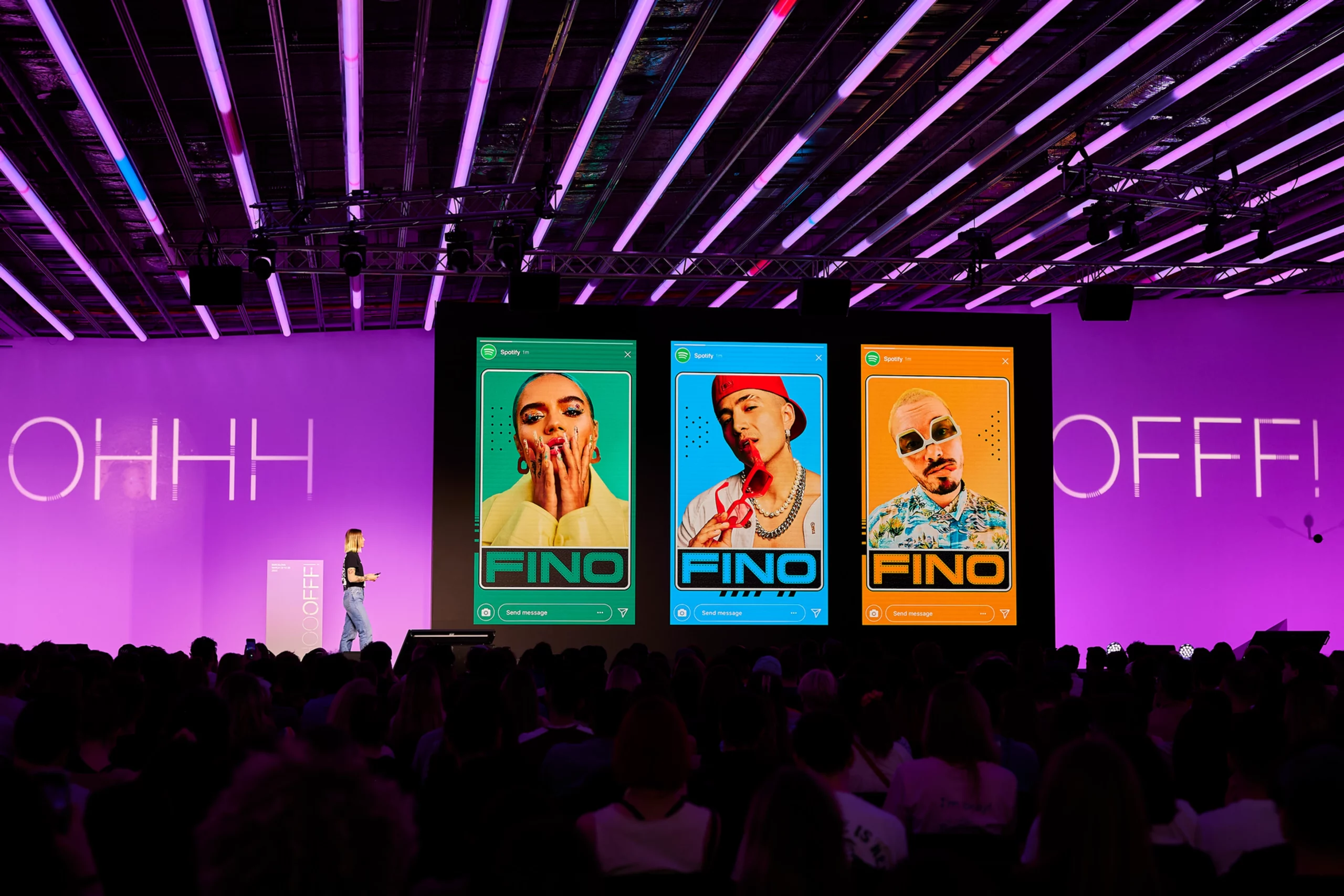
In early May we spoke with Katja Wenger about her experience at this year’s OFFF conference which took place from March 23-25 in Barcelonas Disseny Hub. We learned how she came to attend the event relatively spontaneously and what topics and speakers inspired her the most. We also talked about the importance of courage in design, the agency’s interest in showing presence at conferences, and what she thinks makes a successful conference. Join us as we gain insights and perspectives from this exciting conversation.

Hi Katja, you attended the OFFF conference in March in Barcelona… How did you come to participate?

I had participated the OFFF several times in the past, but with the pandemic everything came to a halt. In 2022 we went to the Forward Festival in Berlin in September and to the Paradigms Brand Experience Summit in Barcelona. For the latter, we were invited by our partner Frontify, who organized the conference for the first time. It was a great experience itself. 

Can you tell us about interesting topics and speakers at the OFFF?

OFFF offers a wide range of international speakers who are incredibly fascinating. There are big names like David Carson, who inspired me very early in my career, as well as smaller or lesser-known talents like the illustrator and artist Kelly Anna

It provides lots of input from various design disciplines, including motion design, 3D, interaction design, animation, and illustration. That’s what makes OFFF and conferences like the Forward Festival so appealing — you get to see different things that inspire you to explore new paths and be creatively productive again.

However, what stuck with me the most was the importance of being courageous in design.


What inspired or intrigued you the most at the conference?

Ultimately, the past six months have witnessed the birth of a new generation of AI, especially in conjunction with visual design. At the conference, we saw the cool possibilities that AI offers for visual designers. However, what stuck with me the most was the importance of being courageous in design. Being courageous means breaking out of the  traditional ideals of beauty and daring to do new things. The concept of beauty, as I learned and saw it many years ago, is evolving into something different. For example, there was a presentation by It’s Nice That, a website or blog that showcased design trends at OFFF. 

Some examples made me cringe because they looked terrible. It seems there’s a trend towards such “trashy” aesthetics. Of course, we can’t always be so daring when working with established brands. But it’s important to break new ground and encourage clients to incorporate some zeitgeist into their brand. Ideally, we have created a brand design framework that makes this possible. As an agency, we are perceived as trendsetters and are asked to provide insights into where the industry is heading.

So, it’s important for the agency to have a presence at such conferences?

It’s not only in my personal interest to attend these conferences. It’s also important for all the designers and also creative technologists who work at think moto. We give them the opportunity to participate in conferences as well. That’s very important for me. It’s not productive if only I, as the CCO, attend. We can’t effectively share the knowledge we’ve gained, and everyone has their own interests and feelings about different presentations. Everyone takes away something valuable. 

I recommend everyone to take part in conferences because they move you forward and allow you to step out of your own bubble and be inspired. There is something very special about listening to a lecture, reading between the lines and hearing the personal stories of the speakers. It’s especially inspiring for young designers, because they learn about a designer’s career, the effort they put into their work, and how chance led them to where they are now.

As an agency, we also actively participate in conferences ourselves. Sometimes it’s about a specific topic. With Branded Interactions, for example, we have been approached several times and have given several presentations at conferences. We’ve been to the CXI, the largest brand conference in Germany, twice so far, once together with a startup client and once with Volkswagen on the topic of Extended Realities

Most recently, we presented our Spherical Brand approach at a CX conference in Oslo, a new concept for brand management in the post-growth economy.  

I believe it is an opportunity for us to reach out and attract talented people. Being able to showcase our work and agency at these conferences provides an excellent chance to get visibility within the design community


What, in your opinion, makes a good conference or contributes to its success?

Of course, the speakers are key, but it’s not just that. The choice of location is also important. Sure, OFFF in Barcelona is super cool and huge, but last year I had the chance to attend Paradigms, which was the very first conference organized by Frontify. That conference impressed me the most. It’s hard to put into words. It was an amazing conference, especially considering the location, organization, food, evening events, and the international speakers they managed to bring together for such a small conference. It was just mind-blowing! If anyone ever gets the chance to attend, it’s absolutely fantastic! It focused on corporate design, brand management, and brand leadership. Frontify, being a company in that space, had the right tools for it.

Thank you Katja!

Offf Festival 2016 – Recap

Let’s feed the future!
Wir gehen langsam auf die Mitte des Jahres zu und der Hunger nach frischem Input wird immer größer. Da trifft es sich gut, dass das Offf Festival dieses Jahr wieder seine Türen für Kreative aus aller Welt öffnete und unter dem Motto »Let’s feed the future!« zur Tafel bat. Die Besucher erwartete ein All-you-can-eat-Buffet der Inspiration vom Feinsten, welches sich über 3 Tage erstreckte und für jeden Geschmack etwas zu bieten hatte. Neben Geschmacksgaranten wie Paula Scher, Ideo und Timothy Goodman gab es auch viele Speaker, deren Namen man vielleicht noch nicht kannte, deren Arbeiten man aber schon desöfteren über den Weg gelaufen ist. Continue reading “Offf Festival 2016 – Recap”

re:publica TEN — recap

Zum zehntem Mal öffnete die re:publica dieses Jahr Anfang Mai ihre Türen. Über 8000 Besucher kamen und im Programm fanden sich mehr als 770 Sprecher auf 17 Bühnen. Die rpTEN hatte dieses Jahr das einfache wie griffige Motto TEN-NET, und so fand sich eine große Auswahl an Themen, von Virtual Reality, über Industrie 4.0 und Hass im Internet bis hin zu Snapchat-Kursen. In der von Spiegelflächen geschmückten Halle in der Station, in Berlin Kreuzberg, sammelten sich außerdem neben den obligatorischen Sponsorenständen auch Meet-Up Spaces für kleine und große Startups, Workshops oder beispielsweise ein Podcastbereich. Eingestreut in das Programm aus Talks und Panels waren auch Kunstaktionen wie das Portal im Frachcontainer von shared studios.

Continue reading “re:publica TEN — recap”

Von Netzkultur bis Raumfahrt — Das war die re:publica 2015

Es ist wieder Mai und das heißt mittlerweile zum neunten Mal: re:publica! Unter dem Motto „Finding Europe“ luden die Organisatoren rund 450 Vortragende und über 6000 Gäste in die Station in Berlin Kreuzberg. Dabei ging es neben dem Thema Netzpolitik, um Netzkultur, Geflüchtete und deren Leben in Deutschland, Technologie und sogar Raumfahrt. Auf mehr als 11 Bühnen wurde größtenteils parallel ein umfangreiches Programm geboten.

Continue reading “Von Netzkultur bis Raumfahrt — Das war die re:publica 2015”

KIKK – The state of play

„The state of play“ – unter diesem Motto startete letzte Woche das New Media Festival KIKK in Belgien und schrieb sich damit auf die Fahne, uns die wichtigsten Projekte der Design- und Medienwelt zu präsentieren und uns vor allem zum Spielen zu animieren. Zu sehen gab es eine Reihe namhafter Speaker wie Onformative, Adam Magyar, Zach Lieberman und Casey Neistat vor der beeindruckenden Kulisse eines Theaters aus dem 19. Jahrhundert.

Wir zeigen Euch unsere Favoriten des KIKK-Festivals.

Continue reading “KIKK – The state of play”

We minimize and compensate our CO2 consumption.

Cookie Consent with Real Cookie Banner