An insight into the cosmos of voice assistants

In a world full of voice assistants, the choice is notoriously difficult. What are the strengths and weaknesses of the individual assistants and which ones are compatible with me? We have addressed these questions and created an overview of the most popular and competent voice assistants.

A brief overview

Google Assistant

Company: Google
Complexity: Android, iOS
Languages: 8
Topics: Travel, commute, search engine
Hotword: “Ok Google, Hey Google”
Features: Smart home integration, Android auto integration

Alexa

Company: Amazon
Complexity: Android, iOS
Languages: 4
Topics: Shopping, Entertainment
Hotword: “Alexa” (customizable)
Features: Smart Home integration, direct shopping on Amazon

Siri

Company: Apple
Complexity: iOS
Languages: 20+
Topics: Planning, productivity, every day life
Hotword: “Hey Siri”
Features: Apple CarPlay integration

Cortana

Company: Microsoft
Complexity: Android, iOS, Windows
Languages: 12
Topics: Planning, search engine
Hotword: “Hey Cortana”
Features: Integration to Alexa hardware

Our prediction for the future: Sprachassistenten und wohin führen uns diese mysteriösen Stimmen eigentlich?

Bixby

Company: Samsung
Complexity: Android
Languages: 2
Topics: Planning, Shopping
Hotword: “Hi Bixby” (customizable)
Features: Smartphone control, virtual shopping

Hound

Company: Soundhound
Complexity: Android, iOS
Languages: Englisch
Topics: Planning, search engine
Hotword: “Ok Hound”
Features: super fast, excellent at complex requests

Nomi

Company: Nio
Complexity: Car-Integration
Languages: Chinese
Topics: Vehicle management, daily companion
Hotword: unknown
Features: Very emotional through visualization, extension of the car

Personality and Voice

While features alone make up a small part of a good voice assistant, the personality of the virtual assistant is probably the most important part. The personality determines how committed we are to listening to the voice and how the hierarchy between human and machine is.

If the assistant is more humane, shows emotion and has as realistic a voice as possible, we tend to listen better and fulfill our wishes and requests through conversation. If the voice is tinny and clearly machine-like, we deal with the technology differently.

Our positioning of the personalities of the listed voice assistants (inspired of magenta.as)

The hierarchy between the user and the voice assistant can vary depending on personality: An always obeying, machine-sounding assistant is quickly regarded and treated as a will-less subordinate of the user, while a human-like personality tends to make us regard the assistant as an equal.

Due to the relevance of the personality, various voice assistants therefore also rely on visual supports, the so-called embodiment. Thereby, the voice assistant manifests itself not only in audible, but also in visual form, whether it is

We design and develop your voice assistant!

 think moto develops brand-adequate conversational user interfaces for voice assistants and chatbots and also deals with questions of visualization and embodiment of voice assistants.

Dream vs. reality–A Beginner’s Guide to User Interfaces in XR

Five years after the arrival of VR technologies in our technology-centric society, extended realities are still a red-hot topic. The possibilities still seem limitless.

As an experienced digital brand agency, we are always expanding our in-house realities and can assure you that it is far from too late to jump in. Therefore, we would like to share with you some learnings as orientation, inspiration and good practices. Here are our golden rules for designing user interfaces for XR applications.

Learn from conventional media

As a pioneer in an extremely young and at least equally unexplored terrain, one naturally likes to rely on the familiar and one’s own experience from less immersive and more conventional media.

In Dead Space 3, the glowing spine indexes the damage taken, while the weapon displays the remaining ammo via hologram. Image source: dreamdawn.com

Game design is the ideal source of inspiration, as three-dimensional user interfaces have been explored there for decades. Since the days of the first consoles, game designers have been looking for ways to embed their user interfaces into the setting and narrative of their creations to maximize immersion.

While this is not true for all games, role-playing games in particular are based on the principle of immersing the user as much as possible in the virtual world.

Star Citizen not only presents the UI in a believable way, but also makes it visible to other players. Image source: vrnerds.de

Unbelievable interfaces create a disturbing dissonance here, which can quickly lead to the loss of the player’s attention. A central aspect that must also be avoided in XR applications in order to achieve the greatest possible immersion for the user.

Dirt Rally offers only authentic speedometer and cockpit displays for orientation. Image source: uploadvr.com

The solution is the diegetic UI, i.e. a user interface that exploits the spatiality of the application as well as the narrative and the setting in order to provide the user with credible information. This can be, for example, the clock on the protagonist’s arm, to which attention must be paid at regular intervals so as not to miss important events, or the dashboard in the cockpit of a vehicle, which can be used to read off speeds and other parameters.

More about UI in video games in this artikel of Anthony Stonehouse.

Choose the right interface concept

Probably the most important aspect for all design in XR is to always be aware of the aim and nature of the project. For example, a minimalist AR companion for concertgoers does not need to be absolutely immersive. Authenticity may not be the primary focus in such meta-interfaces. In this example, Diegetic UI is not superior to a regular, static interface, but only complicates the user experience unnecessarily.

Overall, user interfaces can be divided into three categories. Static UI, places information as a static overlay over the user’s field of view (this method is most popular with AR apps). In comparison, Spatial UI uses the three-dimensional environment to position the interface, such as a floating menu that curves around the user. Finally, there is Diegetic UI, based on which one does not break with the narrative of the application and the authenticity of the setting, and renders user-relevant information through believable shapes (a working clock on the wall, the display of a virtual smartphone, etc.). Before starting any project, it is therefore particularly relevant to weigh the pros and cons of the different platforms, as well as the different UI methods, and find the most effective solution for this project.

Design cross-platform and in patterns

The biggest challenge of Extended Realities – and also the biggest difference to conventional media – is the diversity of interaction design. The various disciplines could not be more different: While one application is controlled via motion tracking through gestures and hand movements, the next uses exclusively controllers and buttons, whereas another works only via gaze control.

This rich fauna of interaction possibilities requires strong design patterns and pattern libraries, especially for projects across multiple XR platforms, so that the user journey and user experience remain as consistent and user-friendly as possible.

Guide the user – gently and cautiously

Good UI: Clean, crisp and comprehensive. Image source: aixlab.com.

In the same vein, interface density is something to consider. Popups and crowded interfaces are already confusing on two-dimensional media and cause some headaches, but in XR – especially when you are positioned in the middle of the UI – chaotic and crowded UI has a claustrophobic effect.

Therefore, it is recommended to keep your distance first, let the user approach the virtual environment, and only then interact.

Final Thoughts

In any sense, one should not be put off by XR and its associated complexity. As a trailblazer, new aspects are explored every day and the opportunity to pioneer new niches is hardly so close in any other field. Thanks to open source software such as Unity and Blender, the entry threshold is extremely low and even laymen can build prototypes within a very short time. Go explore!

Usability – Zwischen Gewohnheit und Identität

Im Schwerpunktthema der aktuellen Ausgabe beleuchtet der Designreport das Thema Usability: Was bedeutet dieses „Versprechen der Einfachheit“ für die zahlreichen Bereiche unseres Lebens in denen der Fortschritt die physische und digitalen Welt aktuell verschmilzt? Diese und andere Entwicklungen stellen neue Anforderungen an die Usability von Automobilität, Wohnen und Gesundheit. Auch der Designprozess muss sich neuen Herausforderungen stellen: Gestalter sind mehr denn je gefordert, den Nutzer als Partner auf Augenhöhe zu begreifen, der es Ihnen ermöglicht, ihre Perspektive einzunehmen.

Marco’s Beitrag in Designreport „Zwischen Gewohnheit und Identität“ geht auf die Rolle von Usability für die Markenführung ein. Für die Gestaltung wirklich erfolgreicher Markenprodukte ist die Gebrauchstauglichkeit digitaler und physischer Produkte unabdingbar und Bestandteil des ganzheitlichen Nutzererlebnisses. Darüber hinaus fordert sie eine Usability, die aus der Marke heraus entwickelt wird und Interaktionsmuster, die markenprägend wirken. Eine Marke, die Nutzerlebnisse mit „Joy-Of-Use“ bietet, wird dauerhaft in Erinnerung bleiben. Continue reading “Usability – Zwischen Gewohnheit und Identität”

Interaktionen machen Marken.

… oder wie die Digitalisierung Interaktionen zum Kern der Markenführung macht.

Die Digitalisierung hat das Leben und Verhalten der Menschen zweifelsfrei maßgeblich verändert. Ein verändertes menschliches Verhalten – mag es sich um das Kommunikations-, das Entscheidungs- oder auch das Transaktionsverhalten handeln – hat wiederum Einfluss auf die Art und Weise der Beziehungen zwischen Menschen und Marken. Wie sieht dieser Einfluss der Digitalisierung auf die Markenführung aus? Was ändert sich bzw. hat sich verändert? Welche Herausforderungen ergeben sich daraus für die Markenführung? Wie kann bzw. muss die Markenführung reagieren um diese Herausforderungen zu meistern?

In einem Beitrag im bald erscheinenden Buch Heun, Thomas (Hrsg.). Digital Branding; Springer Verlag gehe ich zusammen mit Florian-Ulrich Werg diesen Fragen nach. Es sind Perspektiven, Hypothesen und Gedankenanstöße – basierend auf unseren langjährigen Erfahrungen als Markenberater und Digitalstrategen in der Praxis. Die zentralen Punkte unseres Artikels haben wir bei think moto als kurze Präsentation zusammengefasst und bei Slideshare bereitgestellt.

Was sind die zentralen Aussagen? Zentrale Parameter der Markenführung verändern sich durch die Digitalisierung:

  • Kaufentscheidungsprozesse werden komplexer und weniger linear.
  • Wertschöpfungsstrukturen werden integrativ und kollaborativ.
  • Markenbeziehungen werden ubiquitär und interaktiv.

Die Digitalisierung stellt die Markenführung vor neue Herausforderungen. Die Potenziale digitaler Kontaktpunkte und Interaktionen werden vergleichsweise schwach zur Markenprofilierung genutzt. Warum?

  • Die Bedeutung digitaler Interaktionen für die Markenwahrnehmung und -profilierung wird eklatant unterschätzt.
  • Die Bedeutung der formalen Konsistenz im Markenauftritt wird klar überschätzt.
  • Das Festhalten an klassischen Organisationsformen der Markenführung führt zu einem anhaltenden Silo-Denken und verhindert eine ganzheitliche und effektive Markenführung.

Zu welchen Schlussfolgerungen, zu welchen Empfehlungen kommen wir? Wie kann man die Markenführung in der Praxis interaktionsorientierter gestalten?

  • ”Signature Interactions” als Ziel der Markenführung definieren: Interaktionen als Signatur einer unverwechselbaren und Identität ausdrückenden ”Unterschrift” einer Marke verstehen, anstreben und gestalten.
  • Das Verständnis davon was eine Marke ist und wie sie heute geführt werden muss unternehmensintern harmonisieren.
  • Die Steuerungsinstrumente der (operativen) Markenführung anpassen. Weniger Markenmodelle und Richtlinien, mehr Kennzahlen, die die Interaktionsqualität erfassen und abbilden.
  • Die Organisation der Markenführung im Sinne eines Brand Experience Managements verändern: Einfluss der Markenführung auf Prozesse, Technologieeinsatz, Datenmanagement, Mitarbeiterverhalten etc. stärken; Ausstattung mit ausreichenden Entscheidungs- und Eskalationsbefugnissen etc.

Die smarte Art der Markenkommunikation: sayHEY Messenger für simyo

Kürzlich launchte simyo seinen Messaging Service sayHEY, bei dessen Entwicklung besonderes Augenmerk auf Komfort und sichere Verschlüsselung gelegt wurde. Dadurch trifft der neue Service den Nerv der Zeit: Komfortables Messaging über alle Geräte und an alle Kontakte bei garantierter Datensicherheit.

Gemeinsam mit simyo haben wir einen Dienst entwickelt, der – als Teil des simyo Marken-Ökosystems – das Selbstverständnis der Mobilfunkmarke erfahrbar macht: Menschen die wesentlichen Innovationen der mobilen Kommunikation einfach, komfortabel und sicher zugänglich zu machen.

Der Verzicht auf ein starkes simyo-Branding kommuniziert dabei nicht nur die Offenheit des Dienstes für alle Nutzer (auch Nicht-Kunden), sondern zeigt auch die Souveränität von simyo die eigene Marke bewusst zurückzunehmen. Wir unterstützten simyo bei der Entwicklung dieses innovativen Messaging-Dienstes von den markenstrategischen Grundlagen, über die Entwicklung des Markennamens und des visuellen Erscheinungsbildes, über die Grundparameter der User Experience, die Landingpage, bis zu Kommunikationskonzepten und verschiedenen Kommunikationsmitteln.

Für sayHEY kam uns zugute, dass wir 2012 bereits die Neupositionierung von simyo entwickelt und vielfältige Anwendungen gestaltet hatten. Dadurch konnten wir für sayHEY eine Marke entwickeln, die die Grundwerte von simyo transportiert – also immer auf Augenhöhe kommuniziert und näher an den Menschen ist – und diese trotzdem aus ihrer eigenen Sicht interpretiert. sayHEY ist gleichermaßen nur ein Teil von simyo, und auch viel mehr.

Brand new forms mit Typeform

Web-Standards haben sich in den letzten Jahren, dank der Verwendung von HTML5 und CSS3 bei modernen (und mobilen) Browsern, sehr schnell entwickelt. Trotzdem sind Formulare immer noch ein schwarzes Loch: ihre Anpassung an ein Corporate Design kann wegen Crossbrowsing sehr aufwändig und problematisch sein. Auch wenn man dies schafft, Online-Formulare können sehr langweilig sein, besonders wenn man eine Umfrage oder ein Fragebogen ausfüllen muss.

Seit ungefähr 3 Jahren wird in meiner Heimatstadt Barcelona Typeform, ein neues Web-Tool für schicke interaktive Formulare, entwickelt. Und das Beste ist, es funktioniert auf allen Geräten. Verschiedene Beispiele sind im folgenden Video zu sehen:
Continue reading “Brand new forms mit Typeform”

Fell in love with chain reactions

Im Automobilforum Unter den Linden residiert regelmäßig die ARS Elektronica mit ihrer Exportausstellung. Die vielzähligen interaktiven Exponate und Filme zeigen aktuell was “Impuls und Bewegung” alles sein kann. Diese Gelegenheit sollte man noch bis zum 16.09. wahrnehmen und sich beeindrucken und inspirieren lassen. Zum Beispiel von Ryota Kuwakubo: Seine Installation The Tenth Sentiment besteht aus Bewegung, Licht und Schatten. Mittels Alltagsgegenständen, deren Schatten sich an den Wänden abzeichnen, nimmt er den Betrachter mit auf eine Fahrt durch poetische Landschaften, Industrieanlagen und Stadtfluchten. Continue reading “Fell in love with chain reactions”

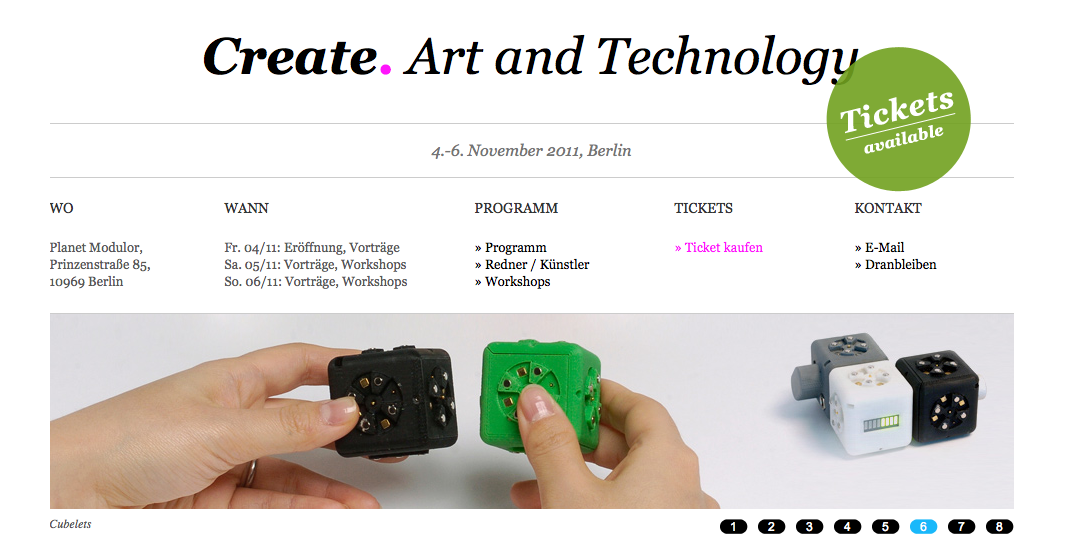
Create Art And Technology: 4. bis 6. November 2011

Vom 4. bis 6. November findet Berlin eine Konferenz für Elektronikfrickler jeder Couleur statt, die wir gerne als Sponsor unterstützen. Das ganze wird maßgeblich von Anton von Tinkersoup organisiert, was uns schon alleine Grund ist, dabei zu sein. Hier der Ankündigungstext… Continue reading “Create Art And Technology: 4. bis 6. November 2011”

We minimize and compensate our CO2 consumption.

Cookie Consent with Real Cookie Banner