Hear It, Feel It, Live It: Event-, Experiential- and Immersive Design in the Age of AI

For a long time, brand management was dominated by the visual. Logo, color, typography – the eye was the lead sense organ of brand communication. Acoustic phenomena were considered ephemeral, hard to control, too subjective to plan strategically.

That’s changing fundamentally right now. With the spread of AI-based voice interfaces, we’re seeing a new appreciation for voice, sound, and presence. At the same time, the purely visual interface is losing ground: graphical surfaces are increasingly being replaced by natural user interfaces – voice interaction, body language, situational behavior. The constant flood of social media is producing a genuine iconographic exhaustion, a digital fatigue confirmed by recent research. Attention is shifting: away from the image, toward voice, posture, a brand’s aura – and toward human encounter in physical space.

We saw what that means in practice with the Audi Club of Progress – an immersive live marketing tour across five major German cities, combined with test drives and a multisensory dinner. Not a trade show booth, not a showroom – but a place where people could encounter the car in a way no campaign alone could have created. For one of the installations, we gave the Audi A6 e-tron its own, AI-developed voice – designed not to sound functional, but human: empathetic, charming, present. One visitor put it this way afterward: “The voice was so pleasant and likeable – I fell for it immediately.” That’s a statement about resonance. About what happens when an experience isn’t designed as a channel, but as an encounter.

Definition: Experiential branding is the deliberate design of brand experiences in physical and hybrid space – through events, pop-ups, installations, and immersive formats. AI is increasingly becoming a design tool within it: personalizing content, adapting space, sound, and interaction to people in real time, and making experiences scalable without making them generic.

Three Layers Where Brands Are Becoming Experienceable

1. Event & Live Experience Design

Brands that want real impact go where people actually are: they run tours, open pop-up spaces, host community events, and invite people into formats you don’t just consume, but live through. The Audi Club of Progress shows how far that can go – from the test drive to the multisensory dinner.

AI changes one thing above all: the ability to shape these experiences differently for individual visitors, instead of running one rigid program for everyone. Content, tone, and even the arc of an evening can now be adapted in real time to audience, context, and mood – without the experience feeling any less personal. If anything, the opposite is true.

2. Spatial & Immersive Design

The second layer concerns the space itself: showrooms, trade show booths, pop-up areas, and installations are increasingly becoming adaptive environments. Projections, generative visuals, lighting and sound systems respond to presence, movement, or visitor numbers, instead of being built once and staying static.

This is where AI becomes a co-designer: it generates and varies visual and acoustic content for the space, adapts atmosphere to time of day or audience, and makes it possible to prototype and iterate an immersive concept far faster than purely manual production would allow. That conviction is exactly why we built think moto +AURA – our unit for audio, voice, and immersion design, which treats body, sound, and presence as strategic brand elements from the outset, rather than as a separate “sound team.”

.

3. Sound & Voice as an Ingredient, Not the Frame

Sound and voice remain important building blocks – but as one layer within a larger, immersive experience, not as a standalone discipline next to it. Static audio logos and jingles are being complemented by dynamic sonic identities that can adapt to context and space, as long as it’s clearly defined what’s allowed to vary and what remains the recognizable constant of the brand.

Why This Is Becoming Strategic, Not Just a Design Choice

The more digital content can be infinitely reproduced through generative AI, the more valuable everything becomes that can’t simply be copied: a place, a moment, a physical encounter that happens exactly once, in exactly this form. Sensory, spatial, and experiential branding will therefore move, over the coming years, from a design nice-to-have to a strategic necessity – precisely because AI is making so much other brand communication scalable and interchangeable.

These experiences aren’t a marketing add-on. They’re proof that brand experience is a structural decision, not a nice-to-have tacked onto the end of a campaign brief.

Bottom Line

A brand that wants to remain distinctive in the age of AI won’t win that advantage in the feed – increasingly, it will win it in physical space: in events, installations, and immersive formats that can’t simply be rebuilt. AI isn’t a replacement for the physical experience here; it’s the tool that makes it more personal, more adaptive, and faster to realize.

If you’d like to develop your own immersive brand experience, think moto +AURA is the right place to start – our unit for audio, voice, and immersion design.

Frequently Asked Questions

What is experiential branding?

Experiential branding is the deliberate design of brand experiences in physical or hybrid space – for example through events, pop-ups, or immersive installations – where people encounter a brand directly instead of merely consuming it.

What role does AI play in event and experiential marketing?

AI personalizes content and pacing in real time, generates and varies visual and acoustic elements for spaces, and makes it possible to develop and test immersive concepts far faster than with purely manual production.

Is immersive brand experience only feasible with a large budget?

No. The underlying logic – designing an experience across multiple senses in a consistent, personal way – applies just as well at a smaller scale, for example in individual pop-up formats or one-off installations.

How is think moto +AURA different from classic event marketing?

+AURA treats body, sound, and presence as strategic brand elements from the very start – including AI-driven personalization and adaptive design – rather than handling sound and spatial staging as a downstream production task.

Marco Spies is founder and managing director of think moto, a Berlin-based design and innovation agency. He is the author of “Branded Interactions” (together with Katja Wenger), the guide to digital brand management, and of “The Spherical Brand”. think moto develops brands for the age of AI — with the credo: Human First, AI-backed.

Is Your Brand AI-Ready? 10 Questions Every CMO Should Be Able to Answer

Most CMOs would readily agree that their brand should be “somehow” AI-ready. Few can say what that actually means in practice. A chatbot on the website, a handful of AI-generated social posts, a ChatGPT integration in customer service – all of that looks like progress. It says very little about whether a brand is genuinely ready for the AI era.

That’s the core problem. Individual AI tools scale one thing above all: output. Whether that output serves the brand or dilutes it across channels and systems is decided elsewhere – by whether there is a clear, machine-readable brand foundation that can actually guide AI systems. Being an AI-ready brand is therefore not a question of which tools you use. It’s a question of governance, data quality, and strategic clarity.

Definition: An AI-ready brand has a clearly defined, machine-readable brand foundation that lets AI systems – from chatbots to content generators – act consistently on the brand’s behalf, instead of leaving that decision to each individual tool.

So how do you check where you stand? The following ten questions are an honest self-assessment, grouped into five areas. Answer most of them clearly and you’re already ahead of the field – stumble on question three or four, and you’ve just found your next priority.

The 10 Questions

Governance & Brand Direction

Governance is where it becomes clear fastest whether a brand is leading AI strategically – or just reacting to it.

1. Do you know how your AI systems are allowed to act on behalf of your brand? 
Without defined boundaries, the model decides by default – not the brand. That’s the core of AI-Powered Brand Governance.

2. Is there a clear brand voice policy for automated systems? 
A tone of voice written into a style guide helps humans. AI systems need it in a structured, retrievable form – which is exactly what a Brand Core Prompt provides.

3. Is there a named owner for AI brand consistency in your organization?
Governance without ownership stays a document. Someone needs the mandate to decide what AI systems may and may not do on the brand’s behalf.

Brand Memory & Data Quality

Even the best governance is worthless if AI systems have no reliable brand knowledge to draw on.

4. Where does your brand knowledge live – and can AI systems actually access it? 
A PDF on the intranet is readable for humans. For language models, it’s effectively invisible. Brand knowledge has to sit where AI systems can actually retrieve it.

5. Are your brand guidelines formatted in a machine-readable way? 
Structured, clearly written guidelines can be turned into a brand memory. Unstructured layout PDFs mostly can’t.

Sourcing & Authenticity

The more content is AI-generated, the more important it becomes to know who is ultimately accountable for it.

6. How do you ensure AI-generated content doesn’t dilute your brand identity? 
Scaled output without brand control also scales inconsistency – often unnoticed, until the damage is visible.

7. Do you have an approval process for AI-generated customer interactions?
The moment AI systems talk directly to customers, they effectively become Branded AI Agents – and should be governed and reviewed accordingly.

Compliance & Transparency

For European brands especially, this is no longer a nice-to-have – it’s increasingly a regulatory requirement.

8. Do you know where your AI brand systems stand on EU/GDPR compliance? 
Data origin, hosting, and model choice are brand decisions today – not just IT topics.

9. Are your customers informed when they’re talking to an AI?
Transparency builds trust – and in many jurisdictions, it’s increasingly a legal requirement too.

Measurability

What isn’t measured can’t be managed – that’s as true for brand leadership in the AI era as for any other discipline.

10. How do you measure whether AI-driven brand interactions strengthen or weaken your brand equity? 
Without metrics, “AI-ready” remains a claim rather than a demonstrable state.

Where Does Your Brand Stand?

Score ten points for every question you can answer clearly, with a concrete example. Score five points for “partially” or “in progress.” Score zero for “no” or “not sure.” That’s a maximum of 100 points.

Below 40 points, AI is largely running unguided inside the brand. Between 40 and 70 points, initial structures exist, but the connecting governance layer is usually still missing. Above 70 points, a brand has moved from simply using AI to actually leading it – and should make that position visible, in trade media or at conferences.

Why These Questions Aren’t Optional

Brands that can’t answer these questions aren’t avoiding the risk – they’re just deferring it. Inconsistent AI interactions, legal grey areas around AI disclosure, and brand damage from uncontrolled AI output are no longer hypothetical scenarios; they’re already observable across many industries.

The common thread through all ten questions is the same: a shared, machine-readable knowledge base from which every AI-driven brand process – content production, customer dialogue, approval – can be consistently governed. Systems like Spherical Brand AI automate exactly this kind of check on an ongoing basis, rather than treating it as a one-off checklist; but for a starting point, an honest run through the ten questions above is enough.

For a deeper definition, further criteria, and practical examples, see our knowledge article on AI-Ready Brand.

Bottom Line

A brand doesn’t become AI-ready by adopting a new tool. It becomes AI-ready once it’s clear who – human or AI – is allowed to make decisions on the brand’s behalf, what those decisions are based on, and how they’re checked. The ten questions above are a first, honest step. The next one is turning the answers into a real governance structure.

The ten questions above are a first AI-readiness check. The next step is making sure this doesn’t stay a static checklist, but becomes an ongoing evaluation: which parts of the brand foundation are machine-readable? Which AI systems actually draw on them? And where is governance still missing?

If you’d like to run this check for your own brand, reach out – or take a look at how we structure exactly this kind of assessment inside Spherical Brand AI.

View Spherical Brand AI

Frequently Asked Questions

What does “AI-ready” mean for a brand?

A brand is AI-ready when its foundations – values, tone of voice, guidelines, but also positioning, value proposition and target audience – are structured and accessible enough for AI systems to act consistently on the brand’s behalf, instead of making their own assumptions.

Is integrating ChatGPT or a chatbot enough to be AI-ready?

No. Integrating individual AI tools increases output, but says nothing about the brand consistency of that output. AI-readiness is a question of governance and data quality, not tool selection.

Who in the organization should own AI-ready branding?

In practice, usually a cross-functional owner spanning brand, marketing, and IT. What matters most is that ownership is explicitly assigned, rather than leaving brand leadership implicitly to the AI systems themselves.

How long does it take to make a brand AI-ready?

An initial assessment can be done quickly – for example, with the ten questions in this article. Building a robust, machine-readable brand foundation, however, depends on the starting point: the quality of existing guidelines, how brand data is structured, which AI systems are already in use, and the desired depth of governance. Systems like Spherical Brand AI can help structure this process and develop it on an ongoing basis.

Marco Spies is founder and managing director of think moto, a Berlin-based design and innovation agency. He is the author of “Branded Interactions” (together with Katja Wenger), the guide to digital brand management, and of “The Spherical Brand”. think moto develops brands for the age of AI — with the credo: Human First, AI-backed.

Why Single AI Tools Don’t Solve the Brand Problem — And What Does

Imagine a mid-sized company that has spent years building its brand. Clear positioning, consistent design, a Brand Voice that reliably works across campaigns and communications. Then AI arrives — and with it the pressure to produce faster, more, cheaper. The company buys a number of AI tools. Implements them. And three months later, every department is producing brand-consistent content — in five different tones of voice, with three different value propositions, and a chatbot that answers customer inquiries as if it belongs to a different company entirely.

The tools work. The brand doesn’t.

This is not an edge case. It is the structural problem behind the AI boom in branding — and it has nothing to do with the quality of any individual tool.

The Market Is Solving the Wrong Problem

The market for branding AI tools is growing fast. DAM systems manage assets. Content AI tools generate copy. Design systems structure visual language. And a growing number of providers are building AI suites that attempt to secure brand consistency through rulebooks and styleguide logic.

Each of these tools solves a real partial problem. None solves the actual problem.

The actual problem is fragmentation. Companies have one tool for analysis, another for content, a third for approvals — and multiple knowledge bases that never truly communicate. Every new tool that solves one problem creates three new inconsistencies. The result: more production, less control.

Why Three Layers Apart Don’t Work

Anyone serious about brand leadership in the age of AI needs three capabilities — and all three simultaneously:

Intelligence — the ability to understand, measure, and strategically develop one’s own brand. Maturity assessments, gap analyses, market comparisons. Where does the brand stand? Where are the blind spots?

Production — the ability to translate brand knowledge into concrete outputs. Copy, visual assets, AI assistants that speak in the name of the brand. But not generically — conditioned by the brand core.

Governance — the ability to actively secure consistency. Not through an archive of already-approved content, but through active review before anything goes out. Design check, compliance review, approval trail.

The market offers these three capabilities as separate solutions. One tool for Intelligence, another for Production, a third for Governance. They are coordinated — but not integrated. And that difference is decisive. Coordinated means: the tools exchange data when forced to. Integrated means: they draw from the same source. The design check knows what the brand’s aesthetic positioning is — because it works from the same knowledge base as the copy writer. The approval trail documents decisions based on the same brand definitions the AI assistant uses.

Tools fail through confusion. Agents fail through action. That is not a semantic distinction — it is the difference between a usability problem and a trust violation. A content tool that produces off-brand copy is a configuration error: you notice, correct, move on. A brand agent that acts off-brand has spoken in the name of the brand, committed to something, represented you — and got it wrong. That is precisely why Governance is not an optional layer in an agentic brand system: it is the discipline that decides what the agent is allowed to do without checking in.

Governance without Intelligence is blind rule enforcement. Production without Governance is uncontrolled scaling. Intelligence without Production remains analysis without impact.

What a Brand Operating System Does Differently

Spherical Brand AI is not the next branding AI suite. It is a brand operating system — a system that structures brand knowledge, makes it machine-readable, and operationalizes it, so that every department, every tool, and every AI application in the organization always draws from the same source.

The core architecture follows a circular logic:
Market and user knowledge flows into the Intelligence Layer → is condensed in Brand Memory into a machine-readable brand core → the Production Layer generates brand-consistent content and AI assistants from it → the Governance Layer reviews, evaluates, and approves → feedback and versioning close the loop back into the brand core.

This is not a workflow. It is a system architecture. And the difference shows precisely where other tools fail: an AI assistant drawing from Brand Memory does not respond generically — it responds the way the brand responds. A design check based on the same knowledge base as the Brand Voice does not evaluate against abstract rules — it evaluates against the concrete brand core.

Why Method Matters More Than Feature Lists

There is another distinction that is rarely discussed in the market: the methodological foundation.

The knowledge base of Spherical Brand AI is not generic. It is built on two proprietary frameworks: the Spherical Brand Framework (9 SPHERICAL dimensions as an evaluation framework) and the Brand BIOS® Model (Behaviour, Image, Offering, Story as a machine-readable structure). This means: the system does not only know what the brand communicates — it knows why it communicates that way, which values underpin it, and how it differs from others.

This is methodological IP. No competitor can replicate it by adjusting a prompt.

And it is the reason why Spherical Brand AI is not a tool you buy and implement. It is a system built on a brand understanding — and one that makes that understanding operationally effective.

11:25Claude hat geantwortet: Two-part comparison infographic.Two-part comparison infographic. Left (01): Fragmented tool landscape — three isolated areas, Intelligence, Production, and Governance, each with their own functions (Audit, Gap Analysis, Market Comparison / Copy, Assets, AI Assistants / Design Check, Compliance Review, Approval Trail), connected by a × symbol — coordinated, but not integrated. Result: more production, less control. Right (02): Integrated brand operating system — the same three layers arranged in a circle around a shared yellow core (Brand Memory as a machine-readable brand core), fed by market and user intelligence, with outputs such as copy, visual assets, and AI assistants, and functions including review, evaluate, and approve. Result: shared knowledge base, active governance, on-brand scaling.

What This Means for Brand Leaders

The question is not whether a branding AI suite makes sense. The question is whether it is built on a shared knowledge base — or whether it becomes another tool in a fragmented system landscape.

A few concrete diagnostic questions for CMOs and brand leaders:

Do all AI-powered outputs — copy, assets, assistants — draw from the same brand definition? Or does every team have its own prompt?

Does the system actively review before something is approved — or does it only manage what has already been approved?

Does the system know what the brand strategically is — or does it only know what it visually looks like?

Can the system benchmark the brand against its market environment — or does it produce in a vacuum?

If any of these questions is answered with “I don’t know” or “no,” the system landscape is fragmented. And fragmentation in the age of AI is not a cosmetic issue — it is a competitive disadvantage.

FAQ: Branding AI Suite — Key Questions

What is a branding AI suite?

A branding AI suite is an AI-powered system supporting brand management and brand communications. The term covers very different product categories — from DAM systems to content AI to agentic brand systems. The decisive question is whether the suite is built on a shared knowledge base or loosely coordinates individual functions.

What distinguishes Spherical Brand AI from other branding AI tools?

Spherical Brand AI connects Intelligence Layer, Production Layer, and Governance Layer from a shared knowledge base. While other tools offer these capabilities as separate solutions, all components of SBAI work from the same machine-readable brand core. The system is integrated, not merely coordinated.

Does Spherical Brand AI require an existing brand strategy?

An existing brand strategy is helpful but not a prerequisite. The Intelligence Layer can analyze and structure a brand’s strategic positioning — as a foundation for all subsequent outputs. Many organizations start with a brand audit and develop the brand core through the process.

Is Spherical Brand AI a SaaS product or an agency service?

Both. Spherical Brand AI can be licensed as a standalone suite — independent of an ongoing agency relationship with think moto. At the same time, think moto offers the strategic guidance that ensures the system is built on a robust brand foundation.

What organizations is Spherical Brand AI designed for?

Spherical Brand AI is designed for mid-sized and large organizations that want to approach brand leadership in the age of AI systematically — with multiple departments producing brand communications, and the need for active governance across all touchpoints.

Is your brand ready for the age of AI?

We analyze whether your current system landscape can secure brand consistency in the age of AI — and identify where the greatest leverage lies.

Discover Spherical Brand AI What Is a Spherical Brand? The Brand Framework for the Age of AI

Marco Spies is founder and managing director of think moto, a Berlin-based design and innovation agency. He is the author of “Branded Interactions” (together with Katja Wenger), the guide to digital brand management, and of “The Spherical Brand”. think moto develops brands for the age of AI — with the credo: Human First, AI-backed.

What Is a Spherical Brand? The Brand Framework for the Age of AI

Brands today are under pressure from multiple directions at once. Climate change and social responsibility demand clear positions. Generative AI is transforming how brands communicate, how they are discovered, and how they interact with people. Cultural coordinates are shifting faster than any strategy can adapt. Classical brand models — including our own Brand BIOS® — are no longer sufficient to lead a brand through this complexity.

The Spherical Brand Framework is our response. It is not a brand model in the classical sense, and not a methodology. It is a concept for brand leadership in a time of profound global challenges — and equally profound opportunity.

From a Flat Disc to a Floating Sphere

For a long time, brand leadership was a linear business. A brand defines its core, communicates outward, grows. The company stood at the center; the consumer was the focus. With digitalization, the center shifted: brands began orbiting their users and customers. Purpose, brand personality, and design principles became the foundation — including our Brand BIOS®, which shaped that era.

But that thinking has reached its limit.

In a world where unconstrained growth can no longer be the highest goal, where technology is no longer neutral, and where cultural reference points are in flux, we need a new image of what a brand is. Not the flat disc with a clear center, but the floating sphere: a brand that is aware of the gravitational pull of employees and customers, partners and competitors, society, politics, and the environment — and remains effective within that field of forces.

The Spherical Brand Framework describes how that works.

Nine Spheres, One System

The Spherical Brand Framework defines nine fields of action in which brands must operate today. Each letter of the word SPHERICAL stands for one of these spheres. They are equal — none more important than another — but they condition each other. Three groups belong more closely together:

Why a brand exists:  Sustainable, Purposeful, Responsible
How a brand becomes culturally relevant:  Humane, Conversational, Archetypical
How a brand functions as a system:  Evolving, Intelligent, Living

The nine spheres emerged from the analysis of recurring tensions in modern brand leadership. They cover the ecological, social, cultural, technological, and organizational dimensions of a brand completely. Together, they form a full picture of the forces acting on brands today — forces that no earlier model addressed in this combination.

No single sphere is sufficient on its own. Their effect emerges in combination.

Diagram of the Spherical Brand Framework showing nine interconnected spheres—Sustainable, Purposeful, Humane, Evolving, Responsible, Intelligent, Conversational, Archetypical, and Living—arranged around a central sphere with orbital paths illustrating their relationships.

The Nine Spheres in Detail

1. Sustainable — Think Long-Term, Act Responsibly

Spherical Brands understand sustainability not as a communications task but as a strategic principle. That means resource-efficient design, circular economy thinking, fair supply chains — and the willingness to question one’s own business model. Sustainable Brands deliberately resist the growth imperative and endure precisely because of it.

2. Purposeful — Conviction That Holds

Purpose is not a slogan. A Purposeful Brand has a clear answer to why it exists in the world — and acts accordingly, even when it is inconvenient. That purpose must be continually tested against reality: a static purpose that no longer connects with the world loses its effect.

3. Humane — Taking People Seriously

Spherical Brands listen, show empathy, and build genuine relationships — with customers and with employees. This pays off: organizations that genuinely care about people create not just emotional closeness but lasting loyalty. Humane brand leadership also means treating dignity as non-negotiable.

4. Evolving — Change as a Principle

Evolving is not a sphere alongside the others — it is the condition for all other spheres to remain alive. Sustainable without Evolving becomes dogma. Purposeful without Evolving produces a static purpose. Evolving means regularly questioning one’s own models, processes, and assumptions — not to destroy them, but to keep them vital.

5. Responsible — Operationalizing Accountability

Responsibility is more than a declaration of intent. Responsible Brands define concretely what accountability they carry — toward society, the environment, supply chains, and technology — and translate that into operational principles. Purpose without operationalization is theater.

6. Intelligent — Understanding Data, Not Just Collecting It

Spherical Brands operate data-based within a systemic approach. The defining confusion of our time is equating data with insight, automation with intelligence, efficiency with quality. More data does not automatically produce more understanding — it first produces more complexity and the need for better judgment. In the age of AI, this means concretely: brands must understand how generative AI systems talk about them, what information feeds those systems, and how they are represented in AI-generated responses. Brands that do not actively manage this leave their reputation to chance.

7. Conversational — The Brand Begins to Speak

Conversational AI is creating new interfaces between brands and people — in natural language, at any time, across every channel. This fundamentally changes brand leadership: no longer just what a brand shows, but how it answers, explains, and guides becomes the brand experience. Conversational Brands define their Brand Voice not only for copy and campaigns, but for every dialogue — with AI assistants, voice interfaces, and conversational products.

Read more

8. Archetypical — Creating Cultural Resonance

Human thinking is fundamentally narrative: we understand new experiences not through analysis, but by matching them against stories we already know. Spherical Brands know which archetype they embody — and ask whether that archetype still fits the moment in which the brand operates. The question is not which archetype a brand has. The question is whether its stories are inclusive, culturally legible, and free from outdated assumptions.

9. Living — Brand as a Living System

A Living Brand is not a rigid construct but an adaptive system. It develops in response to impulses from society, markets, and technology — while remaining recognizable. Dynamic identity does not mean arbitrariness; it means the capacity to change without losing oneself. Corporate design, Brand Voice, and governance must function as a system, not coexist as a rulebook.

An example: A mobility brand can be a strong Purposeful Brand — with a compelling vision for sustainable transportation. At the same time, it may have significant gaps in the Conversational sphere if its AI assistants respond inconsistently and reinvent the Brand Voice in every interaction. Only the interplay of all nine spheres produces a coherent brand experience — and a brand that remains effective in an AI-shaped world.

Three Action Principles for Future-Ready Brand Leadership

The Spherical Brand Framework does not only describe where brands must be active — it also offers orientation for how they should act. Three principles emerge from the nine spheres, describing the inner posture with which brands navigate the complexity of our time:

Stillness does not mean inaction — it means clarity. Not every message needs to be sent in real time; not every change needs to be implemented immediately. Brands that consciously hold back create space for more precise decisions and more durable strategies.

Resonance describes a brand’s capacity to create genuine connection — not only with customers, but with society, partners, and the cultural context in which it operates. Resonance is built through shared values, not through reach.

Mastery is the consistent pursuit of quality, innovation, and meaning — rather than scaling at any cost. Brands that pursue mastery develop a distinctive signature that cannot be replicated.

Why Brand Leadership in the Age of AI Needs a New Model

The Spherical Brand Framework did not emerge as a reaction to a single trend. It is the answer to a structural problem: classical brand models were built for a world in which growth was the highest goal, technology was considered neutral, and cultural stability could be assumed. That world no longer exists.

Generative AI is accelerating this transformation at a scale not yet fully visible. Brands are no longer perceived only in campaigns — they are perceived in AI-generated answers, in dialogues with assistants, in algorithmically curated feeds. A brand that wants to be effective in this environment does not need an update to its existing strategy. It needs a new image of what a brand is and how it is led.

The Spherical Brand Framework is that new model.

FAQ: Spherical Brand — Key Questions

What is a Spherical Brand?

A Spherical Brand is a brand that thinks and acts across nine equal spheres: Sustainable, Purposeful, Humane, Evolving, Responsible, Intelligent, Conversational, Archetypical, and Living. The concept was developed by Marco Spies, founder of think moto, and described in his book “The Spherical Brand.”

What distinguishes the Spherical Brand Framework from classical brand models?

Classical models — including purpose-oriented ones like Brand BIOS® — define a brand from the inside out: core, values, expression. The Spherical Brand Framework conceives of a brand as a dynamic system within a field of stakeholders, technology, society, and environment. There is no longer an absolute center.

Why exactly nine spheres?

The nine spheres emerged from the analysis of recurring tensions in modern brand leadership. They cover the ecological, social, cultural, technological, and organizational dimensions of a brand completely. Each sphere represents an independent field of action — and together they form a system that leaves no relevant force unaddressed.

What role does AI play in the Spherical Brand Framework?

AI is directly embedded in two spheres: In the Intelligent sphere, the focus is on how brands operate data-based and manage their visibility within AI systems. In the Conversational sphere, the focus is on how brands shape dialogue in AI-powered interfaces. Beyond these two, AI transforms all other spheres — raising new demands on accountability, humanity, adaptability, and vitality.

Who is the Spherical Brand Framework relevant for?

For everyone who carries responsibility for a brand: CMOs, marketing and communications leaders, agencies, and consultants driving transformation — digital, socio-ecological, and AI-shaped.

What is the difference between the Spherical Brand Framework and Spherical Brand AI?

The Spherical Brand Framework is the conceptual model — developed in the book, applicable to any brand. Spherical Brand AI is think moto’s AI suite for mid-sized and large enterprises, built on the framework, that operationalizes brand leadership in the age of AI.


How Spherical is your Brand

Many brands are strong in individual spheres — and have blind spots in others that become a liability in the age of AI. We analyze the strengths and gaps of your brand across all nine spheres and identify where the greatest leverage lies.

Request a brand assessment Learn more about Spherical Brand AI

Marco Spies is founder and CEO of think moto, a Berlin-based design and innovation agency. He is the author of “Branded Interactions” (with Katja Wenger), the standard work on digital brand design, and “The Spherical Brand.” think moto creates brands for the age of AI — Human First, AI-backed.

Brands in Motion: Brand BIOS®–A Brand Model for a World Where Messaging Is No Longer Enough

Anyone managing a brand knows the situation: the brand book is done, the guidelines are set, the colors are defined. And yet, in the digital world, the brand still feels flat. It looks consistent—but it doesn’t resonate. It communicates—but it doesn’t create meaning.

This isn’t a flaw of the brand book—it’s a limitation of the model behind it. Traditional brand frameworks were built for a world where brands broadcast and audiences passively receive. That world no longer exists.

Brand BIOS®: Four Dimensions, One Core

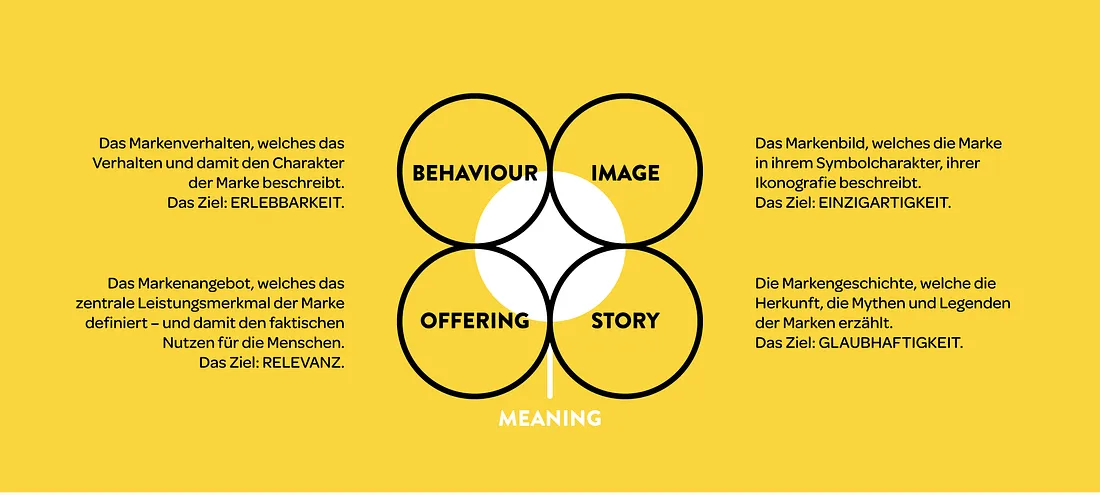
At think moto, we work with Brand BIOS®—a model developed to meet the realities of digital communication. BIOS stands for Behaviour, Image, Offering, and Story—four dimensions that all contribute to a shared core: Meaning.

1. Brand Behaviour: Authenticity Is Defined by Action

Brand behaviour describes how a brand acts—internally with employees and partners, and externally in its interactions with customers. It is grounded in behaviour attributes derived from the brand’s personality. Brand filters help translate these attributes into concrete decisions—from product development to campaign ideas.

2. Brand Image: Coherence Over Consistency

Brand image is the sensory expression of a brand: logo, typography, color, imagery—but also architecture, materials, and sound. The goal is not consistency for its own sake, but coherence. The visual language should express the brand’s behaviour, not compensate for it.

3. Brand Offering: Value You Can Experience

Brand offering defines the tangible value a brand delivers—and is the ultimate test across digital touchpoints. Unlike traditional advertising, digital environments allow brand promises to be fulfilled instantly. The more precisely the offering is tailored to user needs, the more it creates a genuine joy of use.

4. Brand Story: Credibility Through Narrative

Brand story captures origin, myths, and legacy. The story of Adolf Dassler personally fitting screw-in studs to the German national team in 1954 still defines adidas’ authenticity today. Brand story forms the foundation for content strategy and creative direction.

“Brands Need More Than Messages. They Need Meaning.”

Brand Meaning: The “Why” of a Brand

At the center of Brand BIOS® is Brand Meaning—the reason a brand exists. Simon Sinek popularized this idea with his Golden Circle: successful brands don’t start with what or how, but with why. Meaning is not a message—it’s the added value a brand creates beyond its functional offering.

Starbucks’ concept of the “third place”—somewhere between home and work—has become iconic. Not because Starbucks serves the best coffee, but because it clearly defines the role it wants to play in people’s lives.

Four Context Layers: How Brands Stay Relevant

Brand BIOS® does not treat brands as isolated systems. Instead, it places them within four broader forces that shape meaning. Ignoring these forces risks losing relevance—even if the internal brand core is strong.

Myths & Culture
Brands are shaped by cultural context. Which narratives matter right now? Which cultural codes does the brand tap into—or deliberately avoid?

Fashion &
 Trends
Trends reflect deeper changes in values, lifestyles, and technology. Brand BIOS® helps distinguish between what is merely a trend—and what carries lasting meaning.

Values & Core Beliefs
Sustainability, fairness, authenticity, community—these aren’t trends, but fundamental human needs. Brands built on them create real connection.

Benefits & Economic Value
Without economic relevance, a brand cannot sustain its broader meaning. This is not in conflict with purpose—it is what makes it viable.

These four layers are not external influences—they are the environment in which brand meaning emerges. Behaviour, Image, Offering, and Story must engage with them, respond to them, and draw from them.

What Is a Branded AI Assistant?

AI assistants are becoming a central interface between companies and customers.
This shift is changing how brands need to be designed.

For a long time, brands were primarily created for communication: websites, campaigns, and visual identities. Today, brands are increasingly beginning to interact. AI assistants answer questions, explain products, and help people make decisions. As a result, something fundamental is changing: the brand begins to speak. Once a brand communicates through AI, it is no longer just a piece of technology.
It becomes part of the brand experience.

This development marks a turning point in brand management. While digital transformation previously meant optimizing brands visually for screens, the new challenge is to design brands for conversation. This is not a gradual extension of existing design practices. It is a categorical shift: from representation to interaction, from presentation to dialogue.

The Shift in Digital Brand Management

Over the past decade, digital products have already transformed how brands operate. Websites became platforms. Products became services. Interfaces became the central place where brand experience happens.

Now, AI assistants introduce a new type of interface that differs fundamentally from previous ones: they communicate not only visually, but linguistically. With large language models, companies can develop assistants that answer complex questions, guide users through services, or support decision-making. What previously required menus, forms, or support hotlines can now happen through natural language conversations. An insurance customer, for example, no longer needs to navigate a complex form. Instead, they simply describe their situation. The assistant understands, asks follow-up questions, and explains available options.

Conversational interfaces do something that traditional digital interfaces rarely achieved: they communicate in natural language, with all the nuances that come with it — tone, attitude, and personality. This fundamentally changes the role of brands. Because as soon as an organization participates in conversations, it reveals how it thinks, argues, and explains. The brand is no longer just seen.
It is experienced — in every answer, every clarification, and every explanation.

The Blind Spots in Current AI Implementations

Many organizations currently see AI assistants mainly as technical tools to improve efficiency: automating support, reducing costs, or answering frequently asked questions. From an operational perspective, this makes sense. From a brand perspective, however, something critical is often overlooked.

An AI assistant represents the company. It explains products, responds to criticism, and helps users navigate complex decisions. In many cases, it speaks on behalf of the brand more frequently and more directly than any marketing campaign ever could. If this voice is not deliberately designed, inconsistencies quickly emerge that fragment the brand identity.

Different assistants speak differently. Responses vary depending on prompt engineering. Brand positioning becomes diluted because different teams maintain different knowledge bases. In visual brand management, consistency is standard practice: typography, color systems, and imagery are carefully defined. In conversational interfaces, this level of discipline is often missing. As a result, brands that spent years building a coherent visual identity suddenly speak with ten different voices.

Branded AI Assistants: A Conceptual Framework

This is where the concept of the Branded AI Assistant comes in. A Branded AI Assistant is more than a chatbot connected to a knowledge base. It is a deliberately designed interaction layer between an organization and its users. Several dimensions shape this layer:

Brand Voice: The assistant does not simply provide correct answers. It communicates in the characteristic tone of the brand. If a brand is precise and factual, the assistant responds with clear, structured explanations. If it is approachable and encouraging, it explains patiently, asks clarifying questions, and provides helpful context.

Conversational UX: Dialogues are systematically designed rather than left to chance. This means anticipating conversation flows, identifying common user intentions, and developing consistent response patterns.

Personality: The assistant has a defined way of reacting. How does it deal with uncertainty? How does it admit mistakes? How proactively does it guide the user? This personality is not a property of the AI model. It is a design decision.

Governance: Knowledge sources must be curated. Responses need to be reviewed regularly. Prompts should be maintained systematically. This requires clear responsibilities and processes — similar to content governance in traditional digital ecosystems.

Interaction Principles: Rules define how the assistant explains, guides, and responds. Does it answer immediately or ask clarifying questions first? How much context does it provide? How direct are its recommendations?

Only when these dimensions are consciously designed does a technical solution become a true brand interface. The difference is comparable to the one between a functional website and a carefully crafted digital brand experience.

A diagram of the five core dimensions of a branded AI Interface interacting to reinforce each other, and form a coherent brand interface.

Practical Implications for Organizations

As AI assistants become brand interfaces, responsibilities inside organizations begin to shift. Brand teams, design teams, and product teams need to collaborate more closely than before. Questions that used to be either technical or creative now become both:

How does the brand explain complex topics? How does it respond to criticism or complaints? How actively does it guide users through decisions? How does it handle uncertainty? These questions shape the brand experience just as strongly as typography, color systems, or visual language. Therefore, they increasingly belong inside brand systems, not only in technical architectures or prompt libraries.

In practical terms, companies must define their AI voice as systematically as their visual identity. They need to establish conversational design as a discipline. And they must create governance structures that ensure consistent AI interactions across touchpoints.

First Steps for Companies

Organizations that want to design AI assistants strategically can begin with several concrete steps. First, define the AI voice. This translates the brand’s tone into conversational rules. It does not mean simply copying existing brand guidelines, but clarifying how the brand sounds in direct dialogue. How much personality does it express? How formal or accessible is it?

Second, establish conversational design as its own discipline. This includes designing dialogue flows, defining typical conversation patterns, and developing interaction principles. Unlike traditional user interfaces, the focus here is not on click paths but on conversation dynamics — including the uncertainty and variability that natural language brings.

Equally important is the establishment of clear governance structures. Responsibilities for content, prompts, and knowledge sources must be defined. Processes for regular review and optimization should be implemented. Finally, AI interactions should be integrated into existing brand systems, alongside design systems, brand guidelines, and product design frameworks.

Only through this structured approach does a technical tool become a consistent part of the brand — an interface that not only works, but strengthens the brand identity instead of fragmenting it.

A New Design Challenge for Brands

For a long time, brands were primarily designed for visibility — to attract attention, create recognition, and establish visual differentiation. In the age of AI, brands are increasingly designed for interaction. This is more than a technological development. It represents a fundamental expansion of what brand management means.

Visual identity defines how a brand looks. Conversational identity defines how it thinks, argues, and communicates. It reveals how an organization understands problems, structures decisions, and deals with complexity. In this sense, Branded AI Assistants are not just a new technology interface. They are a new medium of brand management.

The challenge for organizations is not to leave this new dimension to chance, but to design it as deliberately as every other aspect of their brand. Not only defining how a brand looks — but how it speaks.

Customer Journey in the Age of AI: When Brand, Touchpoints and Technology Converge

Brands do not exist in isolation. They are formed through customer experience and continuously evolve. A brand’s personality should be tangible at every touchpoint, creating a coherent overall perception. This is less about rigid consistency and more about contextual coherence — adapting behavior to each interaction. And this is precisely where artificial intelligence is fundamentally reshaping the landscape.

The customer journey — from initial brand awareness to long-term customer loyalty — has always been complex. But with AI-driven personalization, intelligent assistants, and real-time data-driven decision-making, that complexity has reached a new level. Today’s leading brands understand that touchpoints are no longer static contact points; they are dynamic interaction moments that adapt to individual users.

From Analysis to Intelligent Experience Design

Customer journey optimization begins with honest assessment: How do customers truly experience our brand? Where does friction occur? Which moments generate delight, and which cause frustration? Understanding the current-state journey is the first step. The second requires courage: What could the ideal journey look like? Which touchpoints should exist that don’t yet?

The objective is clear — eliminate friction, personalize user experience, and increase conversion rates. However, the methodology has changed. In the past, brands optimized based on averages and A/B testing. Today, AI systems enable real-time personalization at the individual level. This is not merely a technical evolution; it represents a fundamentally new way of thinking about brand experience.

Rethinking the Five Phases of the Journey

The traditional stages — Awareness, Consideration, Decision, Post-Purchase, and Loyalty — remain relevant. Yet within each phase, the focus has shifted. In the awareness phase, success is no longer driven solely by SEO and content marketing. Predictive analytics can now identify potential customers before they actively begin searching. AI-powered content generation allows scalable personalization across audiences without compromising quality.

During consideration, customers compare options. Beyond reviews and testimonials, intelligent recommendation engines propose relevant solutions — often before users know exactly what they need. Interactive configurators and AI chatbots support evaluation and build trust through immediate, precise responses.

The decision phase is shaped by technical excellence: fast load times, intuitive navigation, and clear calls to action. Behind the scenes, AI enhances performance through dynamic pricing, personalized offers, and predictive lead scoring — increasing conversion probability without manipulation. It’s about delivering the right impulse at the right moment.

After purchase, the real work begins. Exceptional service, personalized communication, and proactive problem resolution form the foundation for retention. AI-powered support systems ensure 24/7 availability, while sentiment analysis detects dissatisfaction early and routes complex cases to human agents. Automated call summaries reduce operational workload and allow service teams to focus on high-value interactions.

The loyalty phase is the most valuable. This is where customers become brand advocates. Intelligent loyalty programs based on behavioral data, community building, and predictive retention strategies ensure lasting relationships. Retention is more cost-efficient than acquisition — and more sustainable in the long term.

Horizontal visualization of a customer journey as a linear timeline with five stages: Awareness, Consideration, Decision, Experience, and Loyalty. Each stage includes a short description of its objectives—from engaging potential customers to delivering needs-based offers and building long-term brand loyalty. At the bottom, AI-supported learning, optimization, and personalization are highlighted as a continuous layer across all stages.

Customer Journey Maps as Adaptive Experience Systems

Customer journey maps are a powerful starting point for continuous, agile experience optimization. They visualize not only where customers interact with a brand, but why and how — including emotional responses. Critical “moments of truth” become visible: those decisive interactions that shape perception, trust, and business success.

A professional journey map captures touchpoints across the entire customer lifecycle, defines user tasks, and contextualizes behavior. It highlights friction points and pain points while also identifying value-generating interactions. Most importantly, it reveals whether brand personality is consistently experienced throughout the journey.

However, journey maps should not remain static artifacts. As adaptive experience systems, they help model potential improvements, test hypotheses, and iteratively refine interactions. Great design can influence behavior — if brands are willing to challenge existing conventions. Customers can only evaluate what already exists. Future-oriented brands don’t just optimize journeys; they create entirely new experiences.

AI as an Enabler, Not a Replacement

Artificial intelligence fundamentally transforms the customer journey — not by replacing humans, but by augmenting human decision-making. AI systems can predict behavior, personalize in real time, and automate support processes. Yet strategic journey design, brand positioning, and the creation of new touchpoints remain human disciplines.

Intelligent system solutions — recommendation engines, personalization platforms, conversational AI — are tools. They enable data-driven, agile optimization. But they do not replace the strategic thinking required to create coherent brand experiences.

Human First. AI-backed. That is the approach that delivers sustainable impact.

The Journey Is the Strategy

Customer journey optimization is not a project with a fixed end date. It is an ongoing strategic process. Brands that systematically analyze data, respond to evolving customer needs, and boldly innovate create lasting competitive advantage. The combination of strategic journey mapping, AI-driven optimization, and forward-thinking design results in experiences that don’t just convert — they inspire.

A brand is not an island. But the journey across its touchpoints should be unmistakably distinctive.

Want to learn more? Let’s talk about your challenges — we combine strategic brand thinking with cutting-edge AI expertise.

Learn more about our Brand Intelligence expertise.

Why Conversational AI Is Now Part of Corporate Design

Brands today communicate through interfaces that are becoming increasingly dialog-based: chatbots, voice assistants, conversational interfaces, agentic AI systems, customer service automation, in-car assistants, mobile apps, websites — even products and devices themselves now enable language-based interaction.

When these interfaces do not align with the brand identity, friction occurs. A high-quality visual corporate design paired with a generic, “off-the-shelf” AI voice undermines trust and feels unprofessional.

Conversational Design addresses this gap by:

  • defining a brand-specific tone of voice, vocabulary, and sentence rhythm
  • translating brand personality into dialog-based interactions
  • ensuring consistent brand voice across chatbots and voice interfaces
  • creating clearer, more intuitive, and emotionally coherent customer experiences
  • becoming an integral part of the integrated brand experience

In short: Conversational Design translates Corporate Identity (CI) and Corporate Design (CD) into branded conversations.

From Visual to Dialogic Brand Identity

A contemporary brand identity today consists of three interconnected layers: visual identity, linguistic and narrative identity, dialogic identity. Logos, typography, and color systems still define how a brand looks. Purpose, messaging, and tone define how a brand sounds.

The dialogic identity translates both into concrete interactions: How does a digital assistant formulate responses? What attitude is conveyed through short, functional sentences? How are misunderstandings handled? Which recurring micro-phrasings, patterns, and conversational principles shape the interaction?

Conversational AI enables the transition from a static brand system to a living, interactive one. It ensures that every conversation — via chat, voice, or hybrid interfaces — remains consistent with the brand’s personality. Brand identity is no longer just seen or read. It is experienced.

Real-World Applications

For HUGO BOSS, we designed the dialogic layer of the Style Assistant — translating fashion expertise, confidence, and the brand’s elegant directness into a clear, distinctive conversational tone.

For Audi, we developed a Conversational UX Framework that carries the brand’s calm precision and technical clarity into voice-based and assistant-driven systems.

And for a leading German company in testing and certification, we recently designed an entire web interface around dialog-based interaction. Every step begins with a brand-specific conversation rather than traditional UI components. The result: a more intuitive user experience — and a brand that is present and tangible in every interaction.

How to Systematically Embed Conversational Design

At think moto, Conversational Design is now a standard component of our brand processes. Our workflow includes:

1. Conversational Identity Definition

  • Transferring brand personality to AI
  • Language, tone, sentence structures
  • Do’s & don’ts
  • Response patterns

2. Dialog Modules & UX Patterns

  • Intent structures
  • Interaction models
  • Micro-conversations
  • Error handling

3. Technical Translation

  • Prompting guidelines
  • Training data
  • Knowledge architectures
  • Integration into LLMs, voice systems, and chatbots

4. Brand AI Governance

  • Conversational style guides
  • Scalable prompt frameworks
  • Consistency across touchpoints

Conclusion: Brands Must Speak — in Their Own Voice

Conversational interfaces will become one of the most important touchpoints between brands and people in the coming years. Brands that sound generic will lose relevance. Brands that communicate in a distinctive, empathetic, and consistent way will build trust, proximity, and long-term value. Conversational Design is therefore not a technical feature. It is a brand and corporate design discipline.


Human First. AI-Backed.

This is especially true for brands that want to remain relevant in an AI-shaped future.

Learn more about our work with AI-driven branding at thinkmoto.de/en/ai-for-brands or at thinkmoto.de/en/Chatbots.

Why branding for the industrial Mittelstand is more critical than ever

Germany’s Mittelstand is widely seen as the backbone of the economy: highly specialized, technology-driven, and globally competitive through exports. Yet while machinery, materials, and production lines are continuously upgraded, one area often falls behind: the brand.

Many mid-sized industrial companies invest in branding, corporate design, or brand strategy only sporadically – typically when a relaunch is due or competitive pressure intensifies. In between, things often stand still. But this standstill is costly.

How the Mittelstand manages branding today—and why it’s becoming a problem

In many industrial companies, brand management still follows a traditional model: external agencies develop corporate designs, create guidelines, review campaigns, and run competitor analyses or brand audits. Internally, small marketing teams handle day-to-day execution and try to keep long-term brand development on track.

These structures have grown over time – but they come with three fundamental weaknesses:

1. Project-based, not continuous.
A corporate design gets updated – yet no routine follows to maintain it consistently over years.

2. High costs, limited scalability.
Every analysis, every adjustment, every approval requires new external budgets, time, and coordination.

3. Insufficient use of strategic brand work.
Because agency services feel costly, leadership often decides against them – and accepts the gradual erosion of the brand.

The result is visible across many industrial sectors: inconsistently designed channels, divergent layouts, fragmented brand messages, and products that feel more interchangeable than they actually are.

Interchangeability is the biggest risk for the industrial mittelstand

The frequently cited McKinsey analysis “Late vs. Made in Germany” highlights the following conclusion:a lack of brand leadership leads to commoditization. When products and services are technically world-class but not clearly differentiated visually, verbally, or strategically, Mittelstand companies compete almost exclusively on price and functionality.

This is strategically risky, because commoditization leads to:

  • increasing price sensitivity
  • declining customer loyalty
  • higher marketing and sales costs

And yet Mittelstand industrial companies would be perfectly positioned to build strong brands in line with our concept of Spherical Branding: Deep expertise, technological excellence, quality, mindset, and values form an ideal foundation for credible differentiation.

The real cost: high effort vs. high loss

Direct costs:

  • Recurring agency fees for layout checks, design adaptations, and brand reviews
  • Unclear processes that lead to long approval cycles
  • Small marketing teams drowning in operational workload

Indirect costs (often bigger):

  • Blurry brand presence across different marketsoutdated messages that no longer fit the company’s strategy
  • Inconsistent presentations, websites, and product communication
  • Long-term brand weakening and declining perceived quality
  • Increasing need for expensive relaunches

Why branding is more important for industrial companies than ever before

Digital transformation, new competitors from Asia, skilled labor shortages, and global pricing pressure are changing the rules.

Brands that are clear, consistent, and differentiated benefit in several ways:

  • Stronger competitive positioning
  • Higher visibility across digital channels
  • Clearer value propositions
  • Greater employer branding
  • Stronger pricing power
  • Closer customer relationships – including AI-based touchpoints

In a world where data, interfaces, and machines increasingly shape interactions, the brand must remain recognizable as the human layer: empathetic, credible, and distinct.

Rethinking brand management: Human First. AI-Backed.

Modern brand leadership in the industrial Mittelstand requires two things:

1. Strategic clarity and identity.
a brand must know who it is – what it promises, how it speaks, and what it looks like.

2. Support from intelligent systems.
The future of branding is hybrid: human creativity + AI-powered tools that make processes more efficient, reveal data patterns, accelerate workflows, and secure brand consistency.

This makes branding not only more emotional, but also more precise, scalable, and economically viable for mid-sized companies.

Conclusion: the mittelstand doesn’t need more branding – it needs better branding

Branding is not a nice-to-have. It’s a strategic value driver that determines whether companies remain visible, relevant, and differentiated in the future.

The good news: it has never been easier to build a lean, data-driven, and future-ready brand system than it is today – Human First. AI-Backed.

And this is exactly where a major opportunity begins for the industrial Mittelstand.

Human First. AI-backed.

Why Brands Are Becoming Human Again. The last few years belonged to technology. The years ahead belong to people — precisely because technology has become so powerful.

With Human First. AI-backed., we articulate our stance for a future in which AI does not replace humans, but amplifies them. It does not dominate — it empowers.

Human First stands for responsibility. And for radical creativity.

Brands must reconnect with emotion, learn to listen again, and create real meaning.
It’s about empathy, user-centered thinking, and the courage to make clear decisions. Intuition. Imagination. Judgment. These remain fundamentally human.

AI-backed means we design differently — and we advise differently.

We have rethought every step of our workflow: research, strategy, naming, brand voice, design, prototyping. AI changes speed and quality. We have rethought every step of our workflow: research, strategy, naming, brand voice, design, and prototyping. AI changes speed — and it changes quality.

Brands today are built within integrated, intelligent design systems. Strategies become sharper. Brand experiences more adaptive. Agentic AI solutions open up entirely new dimensions of brand leadership.

One thing is becoming unmistakably clear: it’s not the size of a team that matters, but the seniority of the minds behind it. AI amplifies what already exists. It does not replace responsibility.

That’s why we invest in experience, depth, and creative excellence — supported by purpose-built intelligent systems. This is how brands become not just more consistent, but more alive. The future of brand leadership is not about choosing between human creativity and technology. It lies in their interplay.

Human First. AI-backed.

Cookie Consent with Real Cookie Banner